
Anwar Insists Border Demining Unrelated to US Trade Talks Amid Suspension Crisis
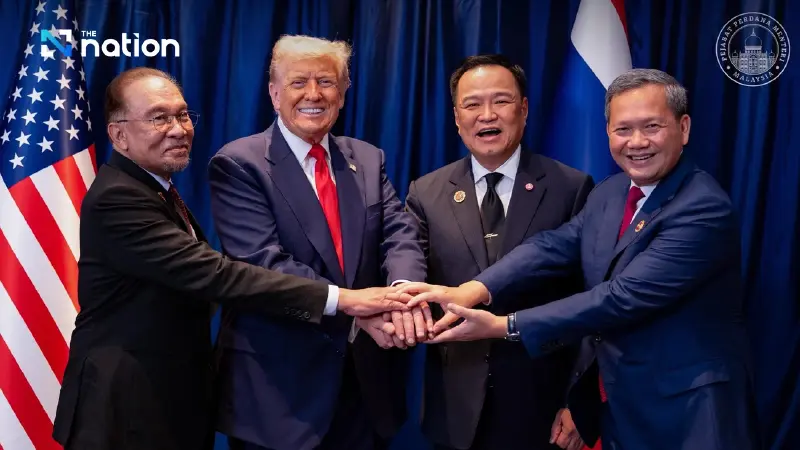


Malaysian PM reaffirms commitment to the Kuala Lumpur Peace Accord, stressing that humanitarian demining must be progressed separately from US-Thai trade cooperation
- Malaysian Prime Minister Anwar Ibrahim has publicly stated that humanitarian demining efforts on the Thai-Cambodian border should not be linked to US-Thai trade negotiations.
- Anwar's clarification comes in response to the U.S. reportedly suspending trade talks with Thailand, conditioning their resumption on Thailand's commitment to a joint demining declaration with Cambodia.
- The trade talk suspension was prompted by Thailand pausing its participation in the demining agreement after its soldiers were injured by a landmine.
- Anwar emphasized that the original Kuala Lumpur Peace Accord, which he facilitated, established that demining should be handled as a separate humanitarian issue, delinked from trade cooperation.
The Malaysian PM reaffirms commitment to the Kuala Lumpur Peace Accord, stressing that humanitarian demining must be progressed separately from US-Thai trade cooperation.
Malaysian Prime Minister Anwar Ibrahim used social media on Sunday morning to publicly clarify his government’s position on the increasingly tense border dispute between Thailand and Cambodia, insisting that efforts to clear landmines must not be linked to international trade negotiations.
At approximately 12:45 PM Thailand time (5:45 AM GMT), Anwar, who is the current ASEAN Chairman, posted a statement reiterating his facilitating role in the recent peace process:
"During my conversation with President Donald J. Trump, Prime Minister Hun Manet, and Prime Minister Anutin Charnvirakul, we reaffirmed our commitment to ensuring the full and effective implementation of the Kuala Lumpur Peace Accord. We also concurred that meaningful progress must be made on the issue of demining, without involving any form of trade cooperation."
ANWAR IBRAHIM
Anwar's post followed a tumultuous Saturday in which Thai media reported extensively that the US Deputy Trade Representative had formally notified Bangkok of a temporary suspension of negotiations for a reciprocal trade framework agreement between the US and Thailand.
The US reportedly linked the resumption of those trade talks directly to Thailand’s commitment to fully re-implementing the Thailand-Cambodia Joint Declaration.
Thailand had suspended its participation in the declaration following a landmine blast that injured Thai soldiers near the border.
The latest post from the Malaysian prime minister serves to clearly reinforce the position he has taken since facilitating the Joint Declaration between Thai prime minister Anutin Charnvirakul and Cambodian prime minister Hun Manet in Kuala Lumpur on October 26, which US President Donald Trump also witnessed.
Prime Minister Anwar's statement reinforces the principle that humanitarian demining, a core element of the peace accord, should be handled as a separate bilateral issue from the mutually beneficial trade relationship between Bangkok and Washington.
