
Cobra Gold 2026: Thailand and US Kick Off Asia’s Largest Multilateral Military Drill
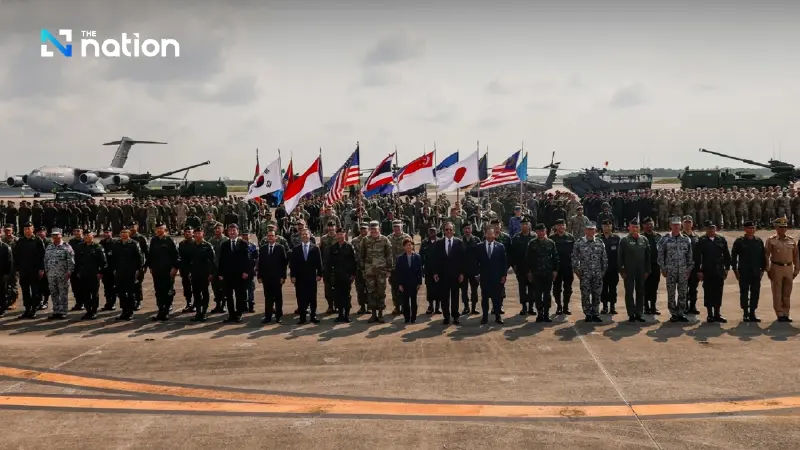


Over 8,000 personnel from 30 nations gather in Rayong for the 45th Cobra Gold, debuting advanced space and cyber operations to tackle modern global threats
- Thailand and the United States have launched the 45th Cobra Gold exercise, the largest multilateral military drill in Asia, with over 8,000 personnel from 30 nations participating.
- Co-hosted by the Royal Thai Armed Forces and the U.S. Indo-Pacific Command, the 2026 drill is designated a "Heavy Year," featuring full-scale field training.
- A primary focus this year is on Combined Joint All-Domain Operations (CJADO), which integrates traditional land, sea, and air maneuvers with advanced space and cyber operations.
- The exercise aims to enhance military readiness for modern global threats and improve coordination for humanitarian assistance and disaster relief in the region.
Over 8,000 personnel from 30 nations gather in Rayong for the 45th Cobra Gold, debuting advanced space and cyber operations to tackle modern global threats.
Thailand and the United States have officially launched "Cobra Gold 2026", the largest and longest-running multilateral military exercise in Southeast Asia.
This year’s drill, marking the 45th iteration of the event, commenced on Tuesday in Rayong province, bringing together more than 8,000 personnel from 30 participating nations.
Co-hosted by the Royal Thai Armed Forces (RTARF) and the U.S. Indo-Pacific Command (USINDOPACOM), the 2026 exercise is designated a "Heavy Year," featuring full-scale field training and high-level strategic coordination.
The primary focus of this year's exercise is Combined Joint All-Domain Operations (CJADO). This sophisticated framework integrates traditional land, sea, and air manoeuvres with a heightened emphasis on the space and cyber domains.
By developing these advanced capabilities, the Royal Thai Armed Forces and its international partners aim to refine their response to modern non-traditional threats, including non-combatant evacuation operations (NEO) and the protection of citizens in global conflict zones.

The scale of Cobra Gold 2026 reflects its status as a cornerstone of regional security. The participation is divided into several strategic tiers:
7 Core Participants: Thailand, the United States, Singapore, Indonesia, Japan, South Korea, and Malaysia.
3 Additional Participants: Australia, China, and India.
10 MPAT Nations: Members of the Multinational Planning Augmentation Team include Bangladesh, Canada, Fiji, France, the United Kingdom, Italy, Mongolia, Nepal, New Zealand, and the Philippines.
10 Observer Nations: The Combined Observer Liaison Team (COLT) includes representatives from Brunei, Germany, Jordan, Laos, the Netherlands, Pakistan, Saudi Arabia, Sweden, Vietnam, and Timor-Leste.

Scheduled to run until 6 March, the exercise serves not only as a display of military readiness but also as a vital platform for humanitarian assistance and disaster relief coordination.
Through these shared experiences, participating nations seek to bolster regional stability and ensure a swift, unified response to any future crises in the Indo-Pacific.
