
Bokeo International Airport opens as new gateway to the Golden Triangle
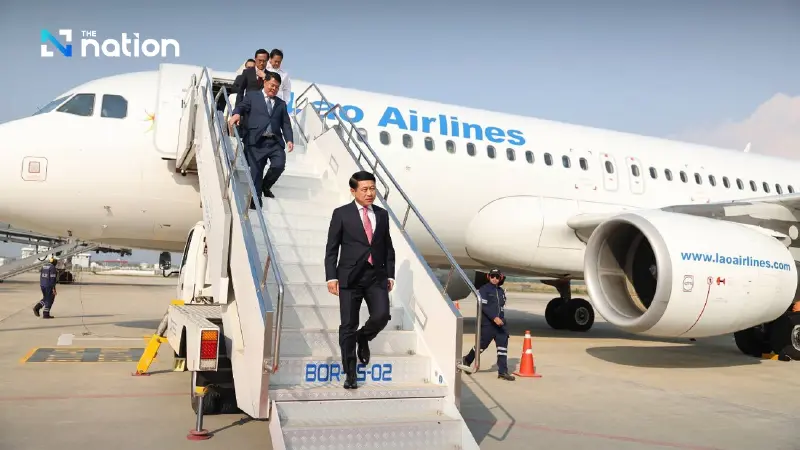


Laos has officially opened Bokeo International Airport, a 6-billion-baht BOT project aimed at turning the Golden Triangle into a new Mekong aviation hub
Laos’ Deputy Prime Minister has presided over the official opening of Bokeo International Airport in what has been described as an auspicious Year of the Horse launch.

With an investment value of more than 6 billion baht, the airport is the first project in Laos to be developed under a build-operate-transfer (BOT) model, under a 50-year concession granted to a company affiliated with Dok Ngiew Kham Group, the concessionaire of the Golden Triangle Special Economic Zone.
Observers are now watching closely as Laos and China advance their aviation strategy in the Greater Mekong Subregion, with plans to launch flights to six major domestic cities and nine overseas destinations.
On March 6, 2026, an official opening ceremony for Bokeo International Airport was held at Ban Si Muang Ngam, Ton Pheung district, Bokeo province, Laos. Construction began in 2020 on a site covering more than 1,800 rai, with investment exceeding 6 billion baht. The airport has been in trial operation since February 2024, with Lao Airlines currently serving the domestic Bokeo-Vientiane route.

The Lao government delegation was led by Saleumxay Kommasith, Deputy Prime Minister of Laos, who presided over the ceremony. Also attending were Somsavat Lengsavad, former Deputy Prime Minister of Laos and a close associate of Zhao Wei; Leklai Sivilay, Laos’ Minister of Public Works and Transport; and Gao Long, Vice Chairman of the Executive Council of the Golden Triangle Special Economic Zone in Ton Pheung district.
The opening of Bokeo International Airport comes in an area regarded as strategically important to China’s expanding influence in the Greater Mekong Subregion, and one seen as significant in boosting investor confidence from around the world.
However, Zhao Wei, Chairman of the Golden Triangle Special Economic Zone Council and a key figure behind the project, did not appear at the ceremony. Reports said he was receiving medical treatment in the Lao capital at the age of 74.
Bokeo International Airport is located within the Golden Triangle Special Economic Zone, where Dok Ngiew Kham Group holds a 55-year land lease concession from the Lao government. The airport itself is a 100% privately funded project by Greater Bay Area Investment and Development (Hong Kong), an affiliate of Dok Ngiew Kham Group, which has obtained a 50-year concession from the Lao government. Zhao Wei has set a goal for the airport to become an air transport hub for the Mekong region and Asean.
Leklai Sivilay, Minister of Public Works and Transport, said Bokeo International Airport is the first airport in Laos to be developed under the BOT model. He expressed confidence that it would help attract more foreign tourists to Laos and align with the country’s five-year national development strategy for 2026-2030, which targets average annual growth of 0.8% in air passenger and cargo transport.
Tianthong Sofa, Director of Bokeo International Airport in Ton Pheung district, Bokeo province, said the airport is a medium-sized airport classified as Code 4C, capable of accommodating Airbus A320 and Boeing 737 aircraft. It has three taxiways — Alpha, Bravo and Charlie — and an apron measuring 130 by 220 metres with four parking bays. It can accommodate two A320 or B737 aircraft at the same time, along with two ATR-72 or MA-60 aircraft.

The airport currently employs 155 staff. It has one fuel depot capable of supplying up to 400,000 litres of fuel to airlines, and one passenger terminal divided into domestic and international sections. It is designed to handle up to 2 million passengers a year. Its security system includes 10 X-ray machines, 9 walk-through metal detectors, 30 handheld metal detectors and 2 explosive detection devices.
At present, Lao Airlines operates one daily flight on the Bokeo-Vientiane route. In future, domestic services are expected to expand to Vientiane, Luang Prabang, Houaphanh, Savannakhet and Champasak. International routes are planned to Thailand, linking Bangkok and Chiang Mai; Vietnam, linking Hanoi and Ho Chi Minh City; Cambodia, linking Phnom Penh and Siem Reap; as well as Hong Kong and China, linking Kunming and Guangzhou.
