
Thai army rejects Cambodia incursion claim at Chong Chom scam site
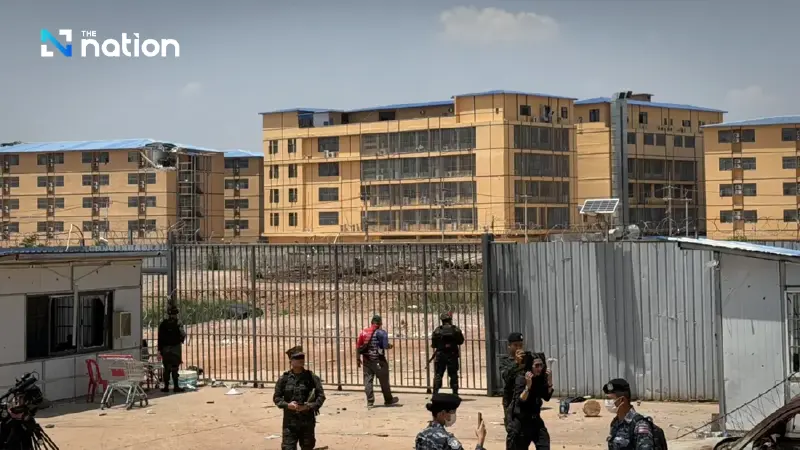


JIC said Thai forces stayed on the agreed troop deployment line and that control of the scam compound was a limited defensive measure, not a cross-border violation.
- The Thai army denies its troops have encroached on Cambodian territory, stating they have strictly adhered to positions agreed upon in a joint statement.
- Thailand justifies its forces' presence as a necessary and defensive security measure, alleging the area was used by Cambodian forces as a military base to attack Thailand.
- The site in question was also discovered to be a large-scale transnational scam operation, with evidence of industrial cybercrime found.
- Thailand states its commitment to resolving the situation through bilateral mechanisms and cooperation, urging a focus on tackling shared threats like transnational crime.
The Joint Information Centre on the Thailand-Cambodia Situation (JIC) on Friday (April 10) clarified the facts regarding the latest allegations over the presence of Thai troops in the Chong Chom area of Surin Province along the Thailand-Cambodia border, as follows:
1. Strict adherence to the Joint Statement
Thailand reaffirms its full commitment to the Joint Statement agreed at the Special General Border Committee (GBC) meeting on December 27, 2025, particularly paragraph 2, under which both sides agreed to maintain forces in their current positions along the troop deployment line and refrain from any action that would alter the situation on the ground.
Thai forces have strictly complied with this provision, with no encroachment, no reinforcement and no change in position from the line jointly agreed by both sides.
2. Thailand’s measures are for security and safety, not law enforcement
The presence of Thai forces is not a unilateral law enforcement action in another country, but a necessary security and safety measure in response to genuine transnational threats in the border area, following the discovery that Cambodian forces had used the area as a military base to attack Thailand.
3. Thailand’s control of the area is aimed at preventing military threats
Because the area was used as a military base by Cambodian forces to attack Thailand, Thailand’s actions are intended to protect its sovereignty and are defensive in nature, limited in scope and preventive in purpose, not an exercise of sovereign authority over another state.
4. Reliance on bilateral mechanisms
Thailand remains committed to resolving the issue through bilateral mechanisms such as the Regional Border Committee (RBC), the General Border Committee (GBC) and the Joint Boundary Commission (JBC).
Continuous communication remains in place between both sides, and all actions are being carried out under the principle of de-escalation.
5. Facts, not distortion
The situation should not be interpreted through the lens of distorted information.
Evidence found in the area shows that, in addition to buildings having been used as a military base to attack Thailand, the site was also a large scam compound.
Thailand, therefore, allowed media access to inspect the site and inform the international community, reflecting the transparency of its actions in this matter.
Evidence found on the site that may support further study, analysis and anti-scam operations included large numbers of foreign SIM cards, multilingual scam scripts and infrastructure consistent with industrial-scale scam operations.
This clearly shows that the area had been used as a hub of transnational cybercrime affecting people in many countries, and that such threats must continue to be tackled collectively.
6. Shared responsibility
Addressing transnational crime requires cooperation, not confrontation. Both sides have already agreed, under paragraphs 8 and 10 of the Joint Statement, to prevent fake news and distorted information and to work together in tackling transnational crime.
Provocative or misleading communication will only undermine such cooperation.
Thailand’s actions are based on three key principles: respect for joint agreements, protection of the people and preservation of regional stability.
The way forward should focus on cooperation and a shared solution, rather than creating conflict through competing narratives.
“Truth, transparency and cooperation are the foundations of sustainable peace.”
