
Thailand, Singapore align on energy crisis and ASEAN AI power plan
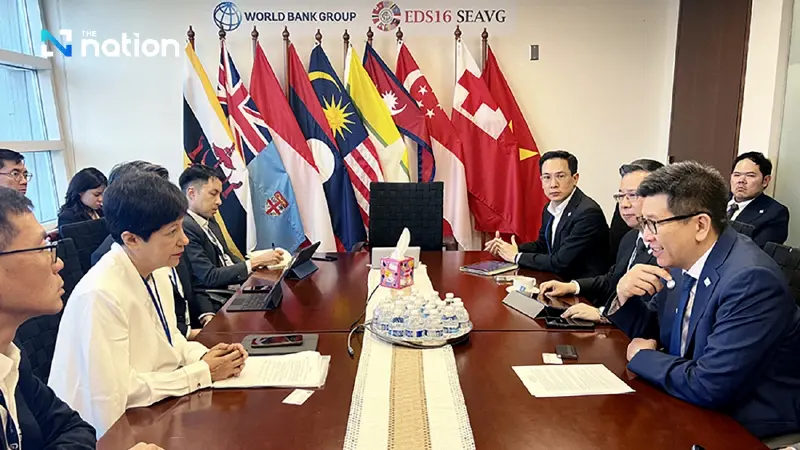


Thailand and Singapore discuss energy shock, ASEAN Power Grid and AI finance cooperation at the IMF-World Bank Spring Meetings in Washington
Thailand and Singapore used the sidelines of the IMF-World Bank Spring Meetings in Washington to sharpen a shared message on the energy crisis: this is no longer a problem any country can manage alone.
Deputy Prime Minister and Finance Minister Ekniti Nitithanprapas held bilateral talks with Singapore’s Indranee Rajah, whose official titles are Minister in the Prime Minister’s Office, Second Minister for Finance and Second Minister for National Development, to exchange views on the global economy and the widening risks from the energy shock.
At the heart of the discussion was the systemic risk created by conflict in the Middle East, particularly the threat to energy shipments moving through the Strait of Hormuz, one of the world’s most critical oil chokepoints.
Both sides agreed that volatility on this scale cannot be contained by domestic policy alone and instead requires a stronger regional framework for risk management.
Thailand and Singapore also exchanged views on how to soften the impact of persistently high energy prices, which are feeding through into inflation, production costs and household purchasing power.
The discussion focused on using fiscal and monetary tools in tandem to preserve economic stability without placing excessive strain on public finances.
Ekniti has been emphasising fiscal discipline even as Thailand weighs how to respond to overlapping crises and the transition away from oil dependence.
A broader strategic point also emerged from the talks. With Singapore set to chair ASEAN in 2027 and Thailand to take over in 2028, both sides see an opportunity to build a more continuous multi-year economic agenda rather than relying on one-year policy cycles.
Singapore’s forthcoming chairmanship has been confirmed by its Ministry of Foreign Affairs and by Thai diplomatic reporting on preparations for the handover period.
One of the most forward-looking areas of cooperation is the use of artificial intelligence in finance.
The two sides discussed how AI could help improve efficiency, reduce service costs and widen access to financial services, particularly as governments and regulators across the region push for more modern and inclusive financial systems.
Energy cooperation was another central theme, especially the long-running push for the ASEAN Power Grid.
The project is increasingly being treated not just as an infrastructure goal but as a strategic hedge against imported energy risk.
ASEAN, together with the Asian Development Bank and the World Bank Group, launched the ASEAN Power Grid Financing Initiative in October 2025, underscoring the bloc’s push to turn regional power connectivity into a more investable and deliverable reality.
That push is already becoming more concrete. Regional policy discussions in 2026 have highlighted the importance of cross-border electricity trade, including power flows from Laos through Thailand and Malaysia to Singapore, as a practical step towards a more integrated and resilient ASEAN energy market.
For Thailand, the meeting fits neatly into Ekniti’s broader message in Washington: that today’s energy crisis should not only be managed, but used to accelerate structural change.
Both Bangkok and Singapore appear to share the same longer-term ambition: to turn a period of geopolitical strain into a more coordinated regional push on energy security, digital finance and economic resilience.
