
Thailand Warned of Cambodia’s ‘Secret Weapon’ in Looming Maritime Legal Battle
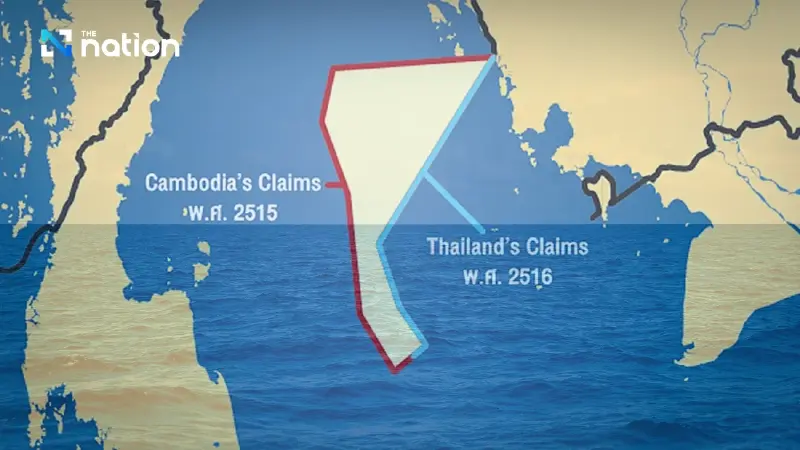


Independent scholar warns Thailand that revoking MOU 44 plays into Cambodia’s hands, as Phnom Penh leverages the expertise of a high-ranking ITLOS judge
- Cambodia's "secret weapon" is identified as Hidehisa Horinouchi, a current judge at the International Tribunal for the Law of the Sea (ITLOS) who is a former Japanese ambassador with deep ties to Cambodia's leadership.
- An expert warns that if Thailand revokes a 2001 maritime agreement (MOU 44), it will provide Cambodia with the pretext to escalate the dispute to ITLOS, a legal forum where Cambodia is exceptionally well-prepared.
- Horinouchi has allegedly given Cambodia a tactical advantage by advising its officials, providing them with an "insider's" understanding of international maritime law and legal strategy.
- The warning contrasts Cambodia's consistent, long-term legal preparation with Thailand's potential for inconsistent strategies due to frequent political changes.
Independent scholar warns Thailand that revoking MOU 44 plays into Cambodia’s hands, as Phnom Penh leverages the expertise of a high-ranking ITLOS judge.
Thailand must not underestimate its neighbour in the escalating dispute over maritime boundaries and trillions of baht in undersea energy reserves.
An expert warning has emerged suggesting that Cambodia is "exceptionally well-prepared" for a legal showdown, aided by a strategic "secret weapon": a former Japanese diplomat with deep ties to Phnom Penh and a seat on the world’s most influential maritime court.
Kritsada Boonruang, a US-based independent scholar and international relations specialist, warned in a broadcast on Nation TV that certain domestic calls to revoke MOU 44—the 2001 bilateral framework for overlapping claims—could lead Thailand into a strategic trap.
"Revoking the MOU unilaterally allows Cambodia to argue that bilateral diplomacy has failed," Kritsada explained. "This provides them with the perfect pretext to elevate the case to the International Tribunal for the Law of the Sea (ITLOS) under UNCLOS—a stage where they have spent years preparing their strategy."

The ‘Insider’ Advantage: Who is Hidehisa Horinouchi?
At the heart of Cambodia’s legal confidence is Hidehisa Horinouchi, a figure Kritsada describes as an "insider" with unparalleled knowledge of international maritime deliberations.
The Diplomatic Link: Horinouchi previously served as Japan’s Ambassador to Cambodia. During his tenure, he earned the deep respect of the Cambodian leadership, particularly Hun Sen, for his role in the country’s development.
The Judicial Role: He currently serves as a judge at ITLOS, the very body tasked with adjudicating global maritime disputes.
The Tactical Edge: It is alleged that Horinouchi’s historical role in advising and training Cambodian officials has given Phnom Penh a sophisticated understanding of "legal loopholes" and the precise data required to sway international mediators.
A Game of Political Savvy
Thailand is not without its own heavyweights, boasting esteemed legal experts and its own ITLOS judge, Prof Dr Kriangsak Kittichaisaree. However, Kritsada warns that international legal battles are decided by "policy unity" rather than individual brilliance.
"Thailand often suffers from inconsistent strategies due to frequent political changes and internal conflict," he noted. "In contrast, Cambodia has systematically hired world-class consultants to ensure they are ready for the 'Compulsory Conciliation' process—a mechanism under UNCLOS that Thailand cannot evade once triggered."
Sovereignty or Energy?
The scholar further suggested that the move towards international arbitration might be more "choreographed" than it appears.
By moving the dispute to the UNCLOS framework, both nations could potentially secure a "win-win" agreement on energy resources while using a third-party ruling to bypass the volatile nationalist sentiments in their respective countries.
"On the global stage, military might and raw resources are secondary," Kritsada concluded. "Precision in specialised law and international political savvy are the ultimate deciders. Thailand must be wary of being outmanoeuvred in a game they are only just beginning to play."
