
Army orders troop adjustments to block border gaps into Thailand
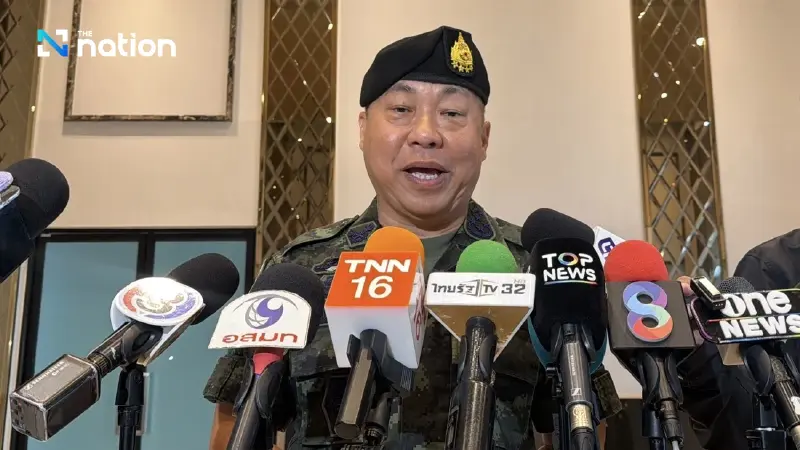


Gen Chaiyapruek Duangprapat says sensors and drones will be reviewed for patrols after villagers reported armed Cambodian troops in Buriram.
- The Royal Thai Army is adjusting its forces to tighten control over border gaps following an incursion by armed Cambodian soldiers in Buriram province.
- The troop adjustments were ordered after villagers reported encountering the Cambodian soldiers, who had used a covert route to enter Thai territory.
- Authorities are considering deploying advanced equipment, such as sensor systems and drones, to improve patrols and enhance security for local residents.
Royal Thai Army Chief of Staff Gen Chaiyapruek Duangprapat spoke on Wednesday (May 13, 2026) at Military Air Terminal 2, Wing 6, after visiting Chong Sai Taku in Buriram province to monitor security operations along the border.
He also visited Apirak Butphet at his home in Ban Kruat district, Buriram province, after Apirak had gone to gather forest products and encountered a group of armed Cambodian soldiers entering the area.
General Chaiyapruek said he had inspected a gap in the area after receiving information from villagers that Cambodian soldiers may have used the route to enter covertly.
He had discussed force adjustments with units in the area to tighten control.
Relevant equipment involving sensor systems or drones would next be examined for use in area patrols and to improve protection for local people.
On whether the group found by villagers were Cambodian soldiers or illegal entrants, Gen Chaiyapruek acknowledged that they were Cambodian soldiers, as both villagers confirmed that the other side had been standing at close range.
He said the body language of the Cambodian soldiers who entered was fairly threatening. However, the villagers knew the area better and were able to walk out, meaning the Cambodian soldiers could not catch up.
The commander of the local force had already spoken to the Cambodian military side, asking them to be careful and not take any action that would affect the Thai people.
Regarding the assessment of whether the Cambodian soldiers had entered to gather intelligence or had another purpose, Gen Chaiyapruek said the area’s terrain was quite complex because it was forested.
It was possible that they had intended to enter, or that they had walked into the area based on the Cambodian side’s own understanding, or that they had come to gather forest products, patrol Thai territory or see where Thai soldiers were positioned.
All were possible.
On whether the incident amounted to a breach of the Joint statement signed by Thailand and Cambodia, Gen Chaiyapruek said that if there was evidence, action would be taken according to procedure, but that villagers’ accounts indicated the incident had happened as described.
Gen Chaiyapruek also referred to the case of Yote Sainoi, a villager from Surin province who was detained by Cambodian soldiers while gathering forest products in the Thai-Cambodian border area.
He said consular officials at the Ministry of Foreign Affairs were trying to expedite the matter and provide assistance, while soldiers in the area had also coordinated contacts so that help could be provided as soon as possible.
Gen Chaiyapruek warned villagers in the area that although gathering forest products is part of local people’s way of life, they should inform government officials, subdistrict heads, village heads, and military and police officers in the area so officials know where Thai nationals are going.
If people leave without notifying officials and then go missing, it may delay authorities' learning of the matter.
He confirmed that the Thai side would try to inspect risk areas where confrontations could occur and would deploy soldiers to look after those areas.
