
THB10 million worth of illegal pig intestines seized at warehouse in Samut Sakhon
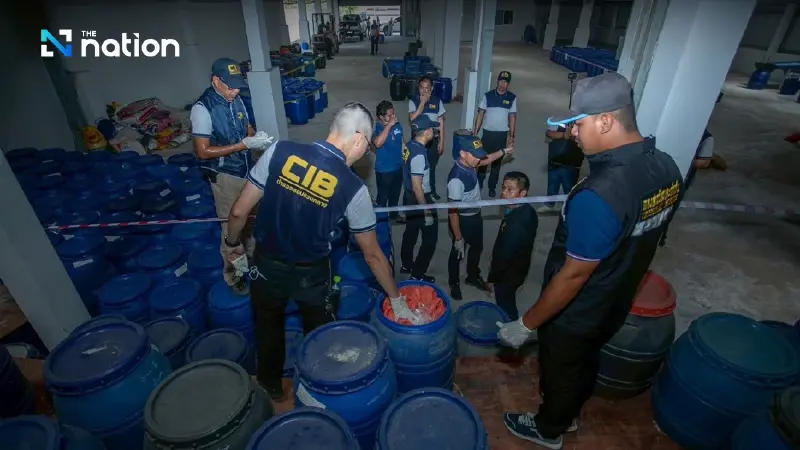


Officers seized 514 barrels of unidentified salted animal intestines, weighing approximately 41,120 kilograms, with an estimated value of over 10 million baht.
Authorities on Monday raided an unregistered warehouse in the Om Noi subdistrict, Krathum Baen district of Samut Sakhon province, following intelligence that pig intestines illegally imported from China were being stored there.

The operation was a joint effort between the Central Investigation Bureau (CIB) and the Department of Livestock Development to crack down on illegal food imports.
Police arrested a Thai woman identified only as Chawadol, who is believed to be the owner or lessor of the warehouse. Officers seized 514 barrels of unidentified salted animal intestines, weighing approximately 41,120 kilograms, with an estimated value of over 10 million baht.

Conditions inside the warehouse were described as appalling — an open-air structure filled with dust, dirty leaves, and animal entrails scattered across tables, emitting a strong foul odor. Officials stated that the setup failed to meet basic hygiene standards and posed serious contamination risks.

Preliminary investigations revealed that the actual tenant of the warehouse was a Chinese national identified as Chen, who had registered the facility for storing processed salted animal products. Authorities suspect the intestines were intended for distribution to restaurants across Thailand.
Further inspection uncovered packaging labeled in foreign languages, including urea fertilizer sacks marked “MADE IN VIETNAM,” raising additional concerns about potential chemical contamination.
Officials have confiscated all items and collected samples for laboratory testing to determine the type of animal parts involved and to check for hazardous pathogens. Legal proceedings against all responsible parties are now underway.
