
Submission of four border disputes to escalate Thai-Cambodian tensions


Tensions along the Thai-Cambodian border are expected to escalate further after Cambodia confirmed it would submit issues regarding four disputed areas to the International Court of Justice (ICJ).
In a recent statement, Cambodia announced that it would not participate in the upcoming Thailand-Cambodia Joint Boundary Committee (JBC) meeting, which is scheduled to be held in Phnom Penh on Saturday (June 14).
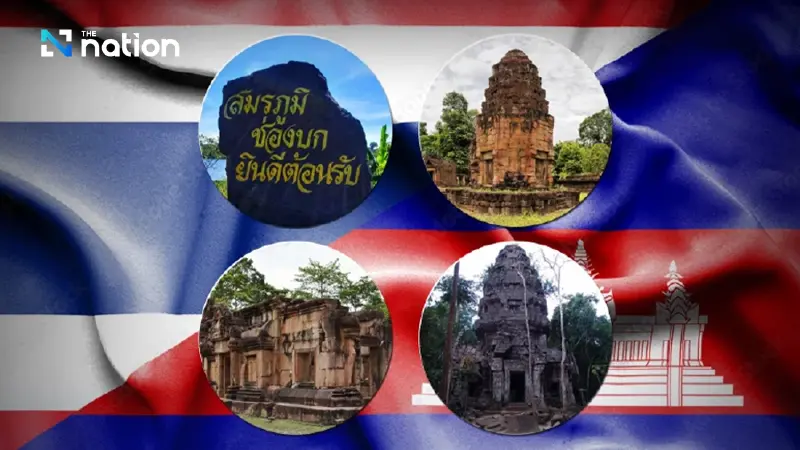
Instead, Cambodia will bring the disputes over four areas—namely the Emerald Triangle (Mom Bei), Ta Moan Thom, Ta Moan Tauch, and Ta Krabei temples—before the ICJ.
These four disputed areas have a long history, embedded with cultural, archaeological, and geopolitical significance. This move underscores the complexity of the unresolved border issue, which has significant implications for regional stability in Southeast Asia, as reported by Thansettakij.
Of these, Mom Bei or Chong Bok is the area at the junction of Thailand, Cambodia, and Laos, covering around 12 square kilometres in Nam Yuen district, Ubon Ratchathani. This area has not been clearly demarcated, and it was once seen as a strategic point for tourism cooperation.
However, a recent clash between Thai and Cambodian soldiers occurred on May 28, after Cambodian troops dug a 650-metre-long trench to establish a military position near the border. The Thai side viewed this as a violation of the memorandum of understanding (MOU) signed in 2000.
Though the incident ended within 10 minutes, it highlighted the fragile nature of the area, which could easily escalate.
The other three temples under dispute are located in the Phanom Dong Rak mountain range, Surin province, with Ta Moan Thom being the largest temple in the group. The temple is believed to have been built around the 16th century and was once an important religious site during the Angkor period.
This temple features ancient Khmer architectural elements and is only a few hundred metres from the Cambodian border. It has been a focal point of previous disputes, yet there has been no clear agreement on the border demarcation between the two countries.
Ta Moan Tauch Temple, meanwhile, is located approximately 750 metres northwest of Ta Moan Thom. It is a square-shaped building constructed with laterite and sandstone, believed to have been a hospital or healing place during the Angkor period.
The temple is part of the Angkor-era heritage site network, holding significant historical and cultural value shared between Thailand and Cambodia.
Ta Krabei Temple is located about 12 kilometres from the other two temples. This four-faced temple, built with laterite, faces east and is believed to have been constructed towards the end of the Angkor period.
It stands near a cliff over 10 metres high, giving the surrounding area strategic importance for national defence and border surveillance.
Cambodia’s decision not to participate in the upcoming JBC meeting and instead pursue legal channels through international law marks a significant turning point. This shift may cause diplomatic, border security, and bilateral relationship challenges, especially at a time when the world faces geopolitical uncertainties from multiple directions.
Meanwhile, Thailand remains committed to peaceful negotiations under the framework of the 2000 MOU, signed by both countries, to maintain peace along the border and foster good relations between their people.
However, any violations must be met with appropriate responses in accordance with international standards to prevent further clashes that could escalate beyond control.
