
Phu Man Fa Temple sparks cultural dispute between Thailand and Cambodia
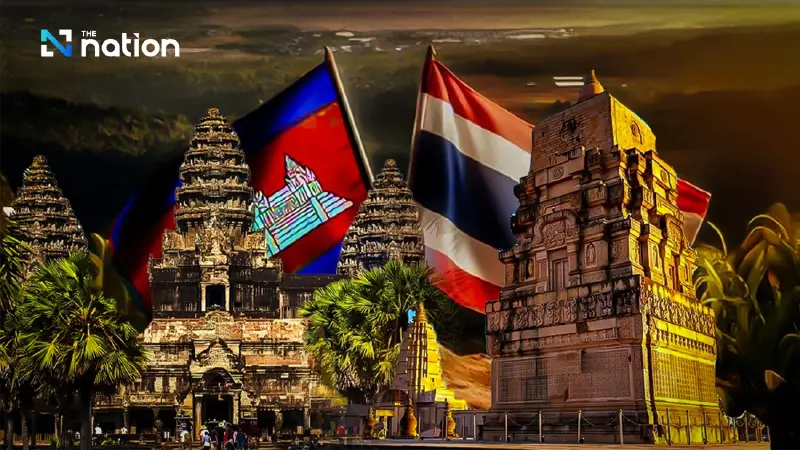


Cultural tensions between Thailand and Cambodia have resurfaced after Cambodia’s Culture Minister accused Wat Phu Man Fa of imitating Angkor Wat, warning that it may breach UNESCO conventions.
The dispute has ignited debates over national identity and shared heritage in the region.
Tensions reignited following remarks by Phoeung Sakona, Cambodia’s Minister of Culture and Fine Arts, who strongly criticised the construction of Wat Phra Phutthabat Sila—also known as Wat Phu Man Fa—in Buri Ram province, Thailand.
The minister accused the temple of imitating the architecture of Angkor Wat, a UNESCO World Heritage Site and a national cultural symbol of Cambodia. She stated that the temple’s design violated world heritage ethics and undermined the authenticity and universal value of Angkor Wat.
She also warned that the case could constitute a breach of the 1972 UNESCO World Heritage Convention and urged the Cambodian government to consider legal action at the international level.

Social media debate over cultural identity
This is not the first time concerns have been raised. In recent years, Cambodian internet users had already called for investigations into Wat Phu Man Fa, but the issue only recently gained wider public and international attention.
The controversy has sparked heated debate across social media platforms in both countries. Cambodian users expressed strong support for the minister’s stance, criticising the temple as a threat to Cambodia’s cultural identity and calling for firmer government action.

Meanwhile, Thai users argued that Khmer-style art has existed in Thai territory for centuries, predating modern national boundaries. They viewed the accusations as an attempt to claim ownership over shared cultural heritage.
The dispute reflects deeper issues beyond artistic interpretation—touching on national identity, historical legitimacy, and the complex politics of cultural representation. The case of Wat Phu Man Fa underscores the ongoing challenges faced by Southeast Asian nations in managing shared heritage within the context of modern statehood and sovereignty.

Temple built from faith and inspired by regional art
Wat Phu Man Fa is located in Ban Sing Subdistrict, Nang Rong district, Buri Ram province. The temple complex, known as Sihanakhon, is inspired by ancient Khmer art.
Still under construction, the temple includes the Great Pagoda, the Vihara of Luang Pho Hin, bas-relief carvings, a Reclining Buddha, and a base adorned with figures of deities, giants, and humans.
Unlike Angkor Wat, which was primarily built using laterite, Wat Phu Man Fa is mainly constructed from sandstone.

Peerawat Chantasit, the temple’s manager, rejected the accusations, noting that both Thai and Cambodian officials—including Cambodia’s culture minister—had visited the site in the past without raising concerns or labelling it an imitation.
He emphasised that the temple was the vision of its abbot and was built through the faith of the local community as an offering to the Buddha, with no intent to replicate or appropriate the heritage of any country.
Montri Prasri, a native of Maha Sarakham who is familiar with Angkor Wat, also observed that Wat Phu Man Fa differs significantly in both materials and design details.
However, he expressed his unease over the Cambodian accusations, saying he was unsure of the motive behind the timing—given the current tensions between the two countries—and questioned whether it was intended to stir public sentiment.
