
Royal Thai Army hits back at Cambodia over barbed wire border row
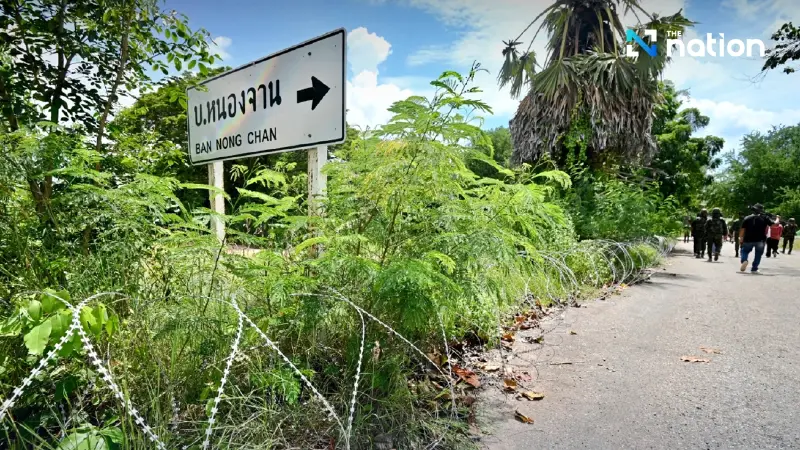


The Royal Thai Army on Wednesday accused Cambodia of distorting facts and inciting villagers to intrude into Thai territory at Ban Nong Chan in Sa Kaeo province, in violation of the MOU 2000.
It said Cambodia supported the establishment of a settlement on Thai sovereign land and filmed the provocation in a bid to present misleading evidence to the international community.
Regarding the case reported by Fresh News that Chum Sounry, spokesperson of the Ministry of Foreign Affairs of Cambodia, announced progress on the implementation of the Cambodia-Thailand ceasefire agreement on the evening of August 26 2025 at 4.00pm, stating that the Thai side violated Cambodia's sovereignty and violated the ceasefire agreement by placing barbed wire encroaching on residential areas and land belonging to citizens in Chok Chey Village, O Beichoan Commune, Ou Chrov District, Banteay Meanchey Province, which reflects that the Thai side has extended the conflict area into civilian community zones.
From the GBC meeting on August 7 2025, there was a 13-point memorandum of understanding stating that there would be no provocative actions and that any actions that might cause increased tensions would be avoided, including as stipulated in MOU 2000, which prohibits any actions that might change the environment in the border area.

Major General Winthai Suvaree, Army spokesperson, responded that Thailand's placement of barbed wire for self-defence resulted from being threatened with explosive ordnance by the Cambodian side, which constitutes Cambodia's intention to violate the ceasefire agreement.
He affirmed that such operations were entirely within Thai sovereign territory. The aforementioned operations confirmed that there was no encroachment on residential areas and land belonging to citizens of Chok Chey Village on the Cambodian side, but rather it was the Cambodian side that supported Cambodian citizens in encroaching on residential areas and land belonging to Thai citizens.
The facts that occurred in Nong Chan area were that the Cambodian side supported the establishment of communities encroaching on Thai sovereign territory, which violates the MOU 2000 agreement, causing hardship to Thai citizens. Despite the Thai side's use of proper procedures to lodge protests, the Cambodian side has never responded with remedial action.
These characteristics do not indicate that the conflict area is extending into civilian community zones, as this area has been disputed for over 20 years. The Thai side has consistently used the approach of lodging protests according to the conditions of the MOU 2000 agreement, but the Cambodian side has remained indifferent.
Furthermore, according to the MOU 2000 memorandum of understanding that prohibits any actions that might change the environment in the border area, it is not the Thai side that is in violation, but rather the Cambodian side that has conducted additional construction both in terms of civilian residential buildings and shelter buildings for Cambodian soldiers.

Therefore, Cambodia's allegations that Thailand violated the ceasefire agreement and MOU 2000 are distortions intended to malign the Thai side. This case constitutes Cambodia's distortion of information, which is also a violation of the ceasefire agreement.
Most recently, as the Thai side attempted to place barbed wire to maintain security for the land survey team, the Cambodian side supported citizens in coming to cause disturbances, displaying aggressive attitudes, possibly hoping that Thailand would be provoked into using violent retaliation, then secretly record footage to accuse Thailand before the world.
However, since the Thai side remained aware and exercised patience and restraint, what the Cambodian side intended may not achieve the desired results.
