
Steel groups call for rebar standard review after earthquake concerns
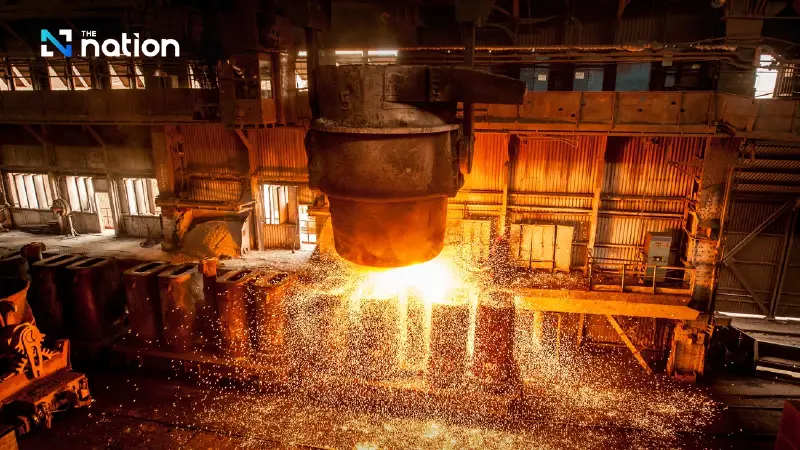


Three steel industry associations have submitted a letter to the Minister of Industry, requesting a review of rebar production standards following concerns over quality issues with steel produced using induction furnaces (IF), fearing another earthquake-related building collapse.
Prawit Horrungruang, from the steel bar manufacturers association using Electric Arc Furnace (EAF), Pao Bunyiam, from the hot rolled structural steel producers association, and Bantoon Juicharern, from the Thai hot rolled steel association, have submitted a letter to the Minister of Industry, proposing the review and improvement of rebar production standards.
The call for a review follows the identification of quality issues in rebar produced by IF, specifically in the following Thai industrial product standards:
- TIS 20-2543 (Reinforced Concrete Steel Bars, Round Bars)
- TIS 24-2548 (Reinforced Concrete Steel Bars, Deformed Bars)

The steel industry associations argue that setting proper rebar quality standards is crucial for the structural integrity of buildings and other constructions. They stress the importance of regulating rebar production to ensure safety, as it is essential for protecting lives and property.
Producing rebar to meet the IF standards requires meticulous care in selecting clean scrap metal free of contaminants. This is because IF has limitations in eliminating impurities such as phosphorus, sulfur, and boron, which need to be controlled within the standard limits.
Additionally, improper chemical composition can affect mechanical properties, causing the rebar to fail to meet strength requirements.
The IF process uses electrical induction for melting, which does not allow for oxygen or slag formation, limiting its ability to purify the metal. As a result, scrap metal containing impurities must be carefully selected, and the chemical composition must be accurately controlled during the melting process to meet the required specifications.
Thailand lacks sufficient domestic steel scrap and often imports about 20-25% of the scrap metal, totaling around 1.2 to 1.5 million tons annually to meet the demand of 6 million tons per year. This makes it challenging to source high-quality scrap metal.
Currently, Thailand produces approximately 3 million tons of construction rebar annually. Of this, about 1.2 million tons are made using EAF, and 1.6 million tons are produced using IF.
China, once the largest producer of rebar using IF, faced long-standing issues with substandard rebar and eventually banned the production of construction rebar using IF in 2017. This incident, coupled with the March 2025 earthquake, raises concerns about whether Thailand’s rebar standards need to be revised, similar to China’s move.

As the draft TIS for construction rebar undergoes review, industry associations see this as an opportunity to improve standards and address existing problems, such as ensuring rebar strength for seismic regions.
They suggest that Thailand’s standards should align with global practices, including those in China and other developed countries, by adopting only the Basic Oxygen Furnace (BOF) and EAF methods for rebar production. This, they argue, will ensure the safety and reliability of rebar used in earthquake-prone areas.
