
Foreign Ministry to brief economic Cabinet on impact to Thai businesses in Cambodia
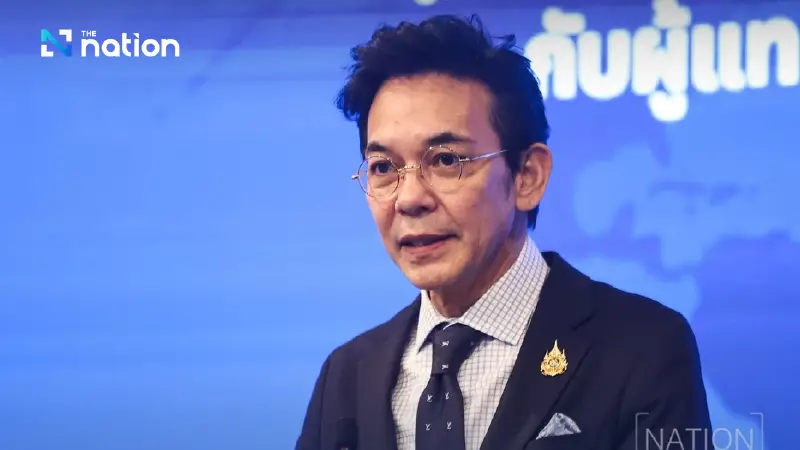


The Foreign Ministry will present the impact on Thai businesses in Cambodia to the economic Cabinet. It denies any proposal to reopen border checkpoints and criticises Cambodia for dragging state-level disputes into the public sphere.
Foreign Ministry spokesman Nikorndej Balankura said on Friday that Foreign Minister Sihasak Phuangketkeow had met with a delegation of Thai private-sector representatives in Cambodia to hear their concerns and proposals regarding the current situation and Thai-Cambodian relations.
According to Nikorndej, the meeting was attended by more than 90 participants from government agencies, private enterprises, and other relevant sectors. The foreign minister expressed his gratitude to the Thai business community in Cambodia for helping to drive and promote economic ties between the two nations.
However, he noted that the border situation has affected all dimensions — including the economy and local livelihoods — and that Cambodia’s various measures have impacted several Thai business groups. Anti-Thai sentiments have also led to ongoing boycotts of Thai products in Cambodia, which have further affected sales.
He emphasised that the Thai government does not wish to see the conflict escalate, stressing that the issue remains a state-to-state dispute, not one targeting ordinary citizens. Yet, Cambodia has deliberately allowed its people to suffer both directly and indirectly, including through boycotts of Thai goods.
Nikorndej said the meeting involved exchanging information on short-, medium-, and long-term responses. The government will use this input to design remedial measures, which are expected to be discussed at the upcoming economic Cabinet meeting chaired by the prime minister later this month.
Going forward, Thai agencies at home and abroad will act in unity under the “Team Thailand” framework, with the Foreign Ministry coordinating closely with all stakeholders to align with the proactive economic diplomacy policy.
The aim is to enhance Thai business competitiveness and resilience amid geopolitical volatility and changing global trade measures, while also supporting smaller entrepreneurs in adapting to these challenges.
The spokesman revealed that the private sector had proposed several forms of assistance, including tax measures, financial support, and subsidies for electricity costs. Many businesses have also suffered from disrupted border trade due to Cambodia’s campaign urging consumers to boycott Thai products.
This has affected industries such as energy, restaurants, hotels, convenience stores, and wholesale retailers. The ministry will submit these proposals to the economic Cabinet for policy consideration.
On the impact of border closures, Nikorndej acknowledged that cross-border trade accounts for about 50% of total bilateral trade value.
Many companies have adopted temporary solutions, such as shifting transport routes from land to sea, while awaiting the outcome of Thai-Cambodian negotiations through existing bilateral mechanisms, including the General Border Committee (GBC), the Regional Border Committee (RBC), and the Joint Boundary Commission (JBC), as well as the ceasefire agreement aimed at achieving lasting peace.
He reiterated that Thailand remains confident in diplomacy and believes that if Cambodia negotiates in good faith, the situation will improve.
Asked whether there were any proposals to reopen border checkpoints, Nikorndej firmly denied it, saying only that participants had asked when reopening might be possible.
He said the private sector fully understood the security reasons behind the closure and expressed empathy for the government’s position. The ministry is confident that ongoing negotiations will eventually lead to workable agreements.
The spokesman concluded by reaffirming Thailand’s commitment to resolving the Thai-Cambodian issue through peaceful means and cooperation. He expressed hope that Cambodia would choose the same path towards stability and lasting peace.

Foreign Ministry urges powers to press Cambodia on four Thai conditions
Foreign Ministry spokesman commented on whether US President Donald Trump’s failure to win the Nobel Peace Prize would affect his commitment to mediating peace talks between Thailand and Cambodia.
He said it was too early to say whether Washington’s interest in the matter would wane, noting that the United States’ involvement stemmed from goodwill and a genuine desire to see peace in the region. Thailand, he added, had already expressed gratitude for that goodwill.
The spokesman also urged major powers to help push Cambodia to fulfil Thailand’s four key conditions — the withdrawal of heavy weapons, the clearance of landmines, the suppression of call-centre scam operations, and proper management of the border area.
He said Cambodia’s cooperation on these points would help bring lasting peace and stability to the border area.
