
Foreign Ministry condemns Cambodia for using civilians as human shields
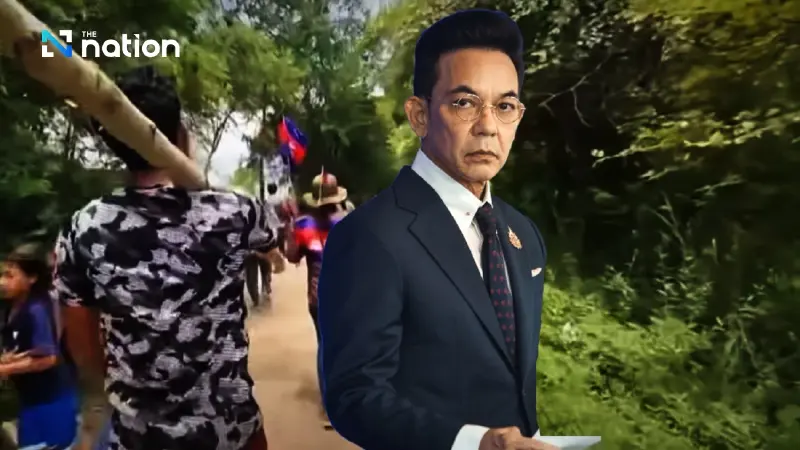


Foreign Ministry spokesman Nikorndej Balankura on Tuesday condemned Cambodia for deploying civilians, including women, children and elderly people, as human shields at Ban Nong Chan in Sa Kaeo province.
He made the remarks at a press conference on the Thai-Cambodian border situation, following Monday’s incident when Cambodian civilians dismantled barbed wire at Ban Nong Chan, sparking clashes.
Nikorndej stressed that Ban Nong Chan lies within Thai sovereignty. The area was once a temporary shelter for Cambodian refugees fleeing conflict, but after the war ended Cambodian villagers expanded their settlements, violating the 2000 Memorandum of Understanding (MOU 43).
Thailand has consistently protested these encroachments, he said, but Cambodia has ignored such objections. At the latest Thailand-Cambodia Regional Border Committee (RBC) meeting on August 22, Thailand again raised the issue of joint border management, including Ban Nong Chan, but Cambodia gave no response.
He explained that Thailand’s installation of barbed wire was strictly defensive – to protect Thai sovereignty, ensure the safety of local residents in Sa Kaeo, prevent further incursions, and deter the planting of landmines by Cambodian forces.
These measures, he said, were not in conflict with agreements under the Thailand-Cambodia General Border Committee (GBC).

Evidence of provocation
Video clips from Monday’s incident clearly showed Cambodian soldiers allowing their civilians to dismantle Thai barbed wire, he said. The footage also captured provocative actions, including shouting at Thai soldiers and pushing women carrying infants to confront them.
“Cambodian troops allowed their people to be pushed to the front, when in fact it is soldiers who should stand in front to protect their citizens,” Nikorndej said.
“Thailand strongly condemns Cambodia for using civilians – particularly women and children – as human shields. This inhumane behaviour violates international humanitarian law,” he declared. “We call on Cambodia to end such practices and to stop staging incidents that use civilians as tools.”
The Foreign Ministry is preparing an official protest note to Cambodia and will raise the issue within the Thailand-Cambodia Joint Boundary Commission (JBC), he added.

Diplomatic mission in Geneva
Foreign Minister Maris Sangiampongsa will travel to Geneva from August 26–28 to brief the international community, especially the UN and the International Committee of the Red Cross (ICRC).
Maris will emphasise that Thailand’s actions are based on human rights and humanitarian principles, while highlighting Cambodia’s repeated violations – including landmine attacks on Thai soldiers, which breach the Ottawa Convention.
“Thailand will show international agencies Cambodia’s behaviour, which disregards humanitarian principles and international norms – whether it is attacking civilians, using children in propaganda videos, planting landmines, or pushing women and the elderly to the front,” Nikorndej said.
He reaffirmed that Thailand is committed to peaceful resolution under the 2000 MOU and existing bilateral mechanisms such as the GBC, RBC and JBC. “We have strictly adhered to the ceasefire and expect Cambodia to do the same,” he said.
Nikorndej warned the public to be cautious about fake news and disinformation spread by Cambodia, urging them to rely on verified official updates.

Press Q&A
When asked whether Thailand might escalate its response, he said: “Our concern is how to respond proportionately while adhering to humanitarian law. We will never harm civilians. The only appropriate response is bilateral condemnation and informing embassies worldwide.”
Asked whether Cambodia’s conduct could be described as ‘wilful ignorance’, he said this was a fair interpretation, noting that the video clearly shows soldiers positioned at the rear, inciting civilians to move forward with words, gestures and symbols that amount to provocation.
“I do not believe that any woman, any mother with a true maternal instinct, would willingly carry her child into a battlefield or a dangerous area. We do not even take our children outside when it rains, let alone into such risks,” he said.
“This clearly shows there was incitement. It is a dangerous act that we must endure with the utmost restraint, which is why I must condemn it as inhumane.”

He added that any long-term solution lay in clear border demarcation under bilateral mechanisms, supported by multilateral frameworks such as international humanitarian law, the Geneva Conventions and the ICRC.
On reports that Deputy Defence Minister Gen Natthaphon Narkphanit had ordered the First Army Area to file a protest through the Foreign Ministry, Nikorndej said the ministry had not yet received such a letter but was already proceeding with its own diplomatic protest against Cambodia.
