
Thailand pushes urgent cybercrime agenda at IPU meeting in Geneva
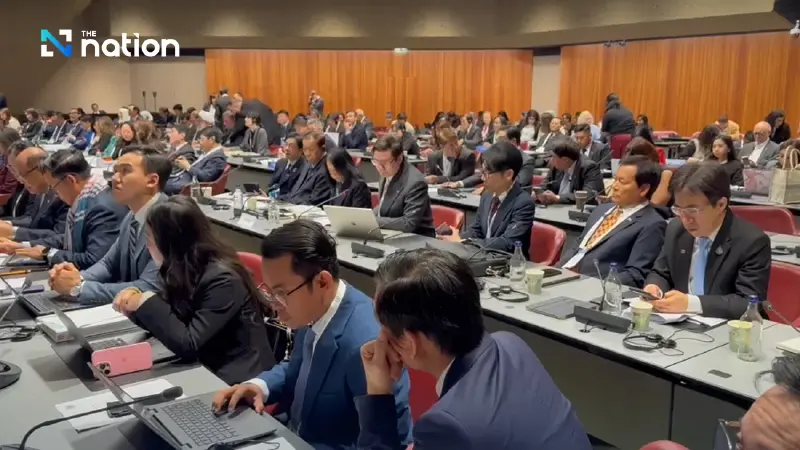


Thailand proposes an emergency item on cybercrime at the IPU meeting in Geneva, with support from Australia, the Philippines and Malaysia, but opposition from China and Cambodia.
The 151st Inter-Parliamentary Union (IPU) Assembly and related meetings officially opened on Sunday at the Geneva International Conference Centre (CiCG), Switzerland.
Thailand’s parliamentary delegation took the floor early in the session to propose an “emergency item” aimed at tackling cross-border cybercrime — a move that immediately drew objections from China and Cambodia.
The first session began with the ASEAN+3 meeting, followed by the Asia-Pacific Group meeting. The Thai delegation, led by House Speaker Wan Muhamad Noor Matha, attended alongside Cambodian representatives amid ongoing diplomatic tensions between the two nations.

Rangsiman Rome calls for regional unity against scams
During the ASEAN+3 session, Rangsiman Rome, Member of Parliament, informed participants that Thailand would table an emergency item titled “Enhancing the role of parliaments in combating cross-border cybercrime.”
The Thai side emphasised that cyber scams have evolved into a major transnational threat, fuelling other serious crimes such as human trafficking, forced labour, and human rights violations.
Rangsiman urged ASEAN members and the Plus Three countries — China, Japan, and Australia — to support Thailand’s draft resolution for inclusion as an emergency item at the IPU General Debate, which is scheduled for formal presentation on October 21.
Following Thailand’s proposal, China’s representative expressed concern over “certain wording” in the draft resolution and requested revisions, noting that further comments would be raised during the General Debate.
Cambodia echoed China’s position, urging Thailand to refocus its resolution on the IPU’s overarching theme of “defending humanitarian principles in times of crisis” rather than on cybercrime specifically.
Reports indicate that Beijing’s reservations stem from phrases such as “forced labour,” which appear in both the Thai draft and Western reports on cybercrime. China reportedly viewed this terminology as overly specific and potentially detrimental to its national image.

Thai–Cambodian tension surfaces in seating arrangement
Tensions between Thailand and Cambodia were also visible during the session, particularly in the seating arrangements. The Thai delegation, led by Wan Noor, arrived early and chose seats in the second row for a clear view of the stage.
However, when the Cambodian delegation entered, they immediately took the front row — directly in front of the Thai seats — prompting speculation about whether the move was deliberate.

Australia, the Philippines and Malaysia back Thai cybercrime motion
After the ASEAN+3 discussions, the Asia-Pacific Group meeting convened with China chairing the session. One of its key agenda items was to review proposed emergency items for the upcoming IPU General Debate.
Rangsiman presented Thailand’s detailed draft resolution on “Enhancing the role of parliaments in combating cross-border cybercrime.”
He explained that cyber scams are not only a Southeast Asian issue but a growing global crisis involving deception, financial fraud, human trafficking, forced labour, and modern slavery — all of which undermine fundamental humanitarian values.
The presentation received strong applause from most Asia-Pacific delegates. Cambodia, however, reiterated its opposition, arguing that the proposal diverged from the IPU’s main theme.
In contrast, Australia voiced full support for the Thai initiative, stressing that cybercrime affects citizens worldwide, including Australians.
The Philippines called on Cambodia to recognise the urgency of the issue, warning against dismissing a problem that affects all nations. Malaysia also backed Thailand’s motion, echoing the sentiment that Cambodia should not reject the proposal outright.
After extensive debate, the chair urged Thailand and Cambodia to continue discussions informally. During the closing segment, three countries — China, Cambodia, and Thailand — volunteered to serve on the drafting committee to review and refine the final wording of the resolution, should it receive majority backing in the General Debate.
The formal presentation of the emergency item will take place on October 21, the second day of the IPU’s General Debate (the first being October 20). Each member nation will cast votes, with the number allocated varying according to population size — for instance, Thailand holds 18 votes, while China has about 23.
