
JBC talks necessary to solve border issue with Cambodia, says Thai govt
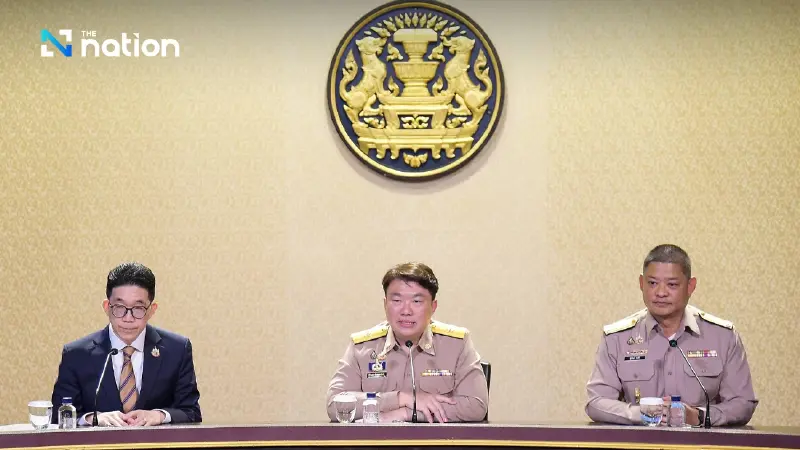


Thai government clarifies scope of JBC meeting with Cambodia, stressing border talks vital to resolving boundary issues.
At Government House on Monday, government spokesman Siripong Angkasakulkiat, joined by Benjamin Sukanjanajtee, Director-General of the Department of Treaties and Legal Affairs, and RAdm Surasan Kongsiri, spokesman for the Defence Ministry, outlined Thailand’s framework for upcoming bilateral negotiations with Cambodia.
Siripong said the Joint Boundary Commission (JBC) and General Border Committee (GBC) meetings scheduled this week form part of Thailand’s broader diplomatic strategy to strengthen security cooperation and ensure national benefit. He emphasised that every stage of discussion had been carefully planned to serve the country’s best interests.
He noted that the ASEAN Defence Ministers’ Meeting will be held in Kuala Lumpur from October 20 to 22, followed by the JBC meeting in Chanthaburi from October 21 to 22.
Benjamin said the Thai JBC delegation will be led by Prasat Prasatwinijchai, while the Cambodian side will be headed by Lam Chea, Minister in Charge of the State Secretariat of Border Affairs of Cambodia. Representatives from relevant Thai agencies will also take part, including those from the National Security Council, the Ministry of Defence and the armed forces, and the Ministry of Interior.
He explained that the meeting will focus exclusively on border issues, continuing from the previous session, with the agenda designed to align with discussions under the GBC and Regional Border Committee (RBC). This coordination, he said, would allow Thailand to advance its national interests in a unified and coherent manner.
Benjamin recalled that a special JBC meeting on 10 September had assigned both sides to discuss the situation in Ban Nong Chan and Ban Nong Ya Kaew, as well as security measures such as building a border fence to establish clearer demarcation in areas under the JBC’s jurisdiction. He said this reflected Thailand’s determination to resolve border issues through existing bilateral mechanisms, underscoring the necessity of the upcoming meeting.
Key items on the agenda include revising the 2003 Terms of Reference (TOR) to incorporate LiDAR (Light Detection and Ranging) technology for aerial mapping and proposing priority areas for boundary delineation, particularly where both sides have already reached mutual understanding.
Benjamin stressed that the JBC serves as a crucial bilateral mechanism for engaging Cambodia through peaceful dialogue, reaffirming to the international community that Thailand’s approach to border resolution remains legitimate and consistent with international norms.
Surasan added that the September 10 meeting had approved four key points: the withdrawal of heavy weapons from border areas, joint landmine clearance, a crackdown on transnational scam operations, and the restoration of order in the Ban Nong Chan–Ban Nong Ya Kaew zone.
While some progress has been achieved in tackling scam operations — with the Royal Thai Police gathering intelligence on 60 sites to share with Cambodia — progress in landmine clearance and the withdrawal of heavy weapons has been slow.
Surasan said Thailand would urge Cambodia to demonstrate sincerity in implementing joint measures, with the upcoming meeting expected to establish a clearer and more coordinated plan of action. The two sides will set a definite timetable for cooperation, particularly regarding heavy weapon withdrawal, and identify specific areas and timeframes for landmine clearance. Joint operations to suppress cross-border scam networks will also be conducted under an agreed schedule. Malaysia and the United States will attend the meeting as witnesses and observers, ensuring transparency and sincerity from both sides.
Siripong concluded by affirming that the JBC meeting would not jeopardise Thai sovereignty. Any discussion about revising or revoking the 2000–2001 MOUs may arise in the future, he said, but for now the government’s focus remains on strengthening bilateral cooperation to ease tensions and stabilise the border situation.
