
Thai Military Unifies Command to Secure Cambodia Border and Eastern Flank
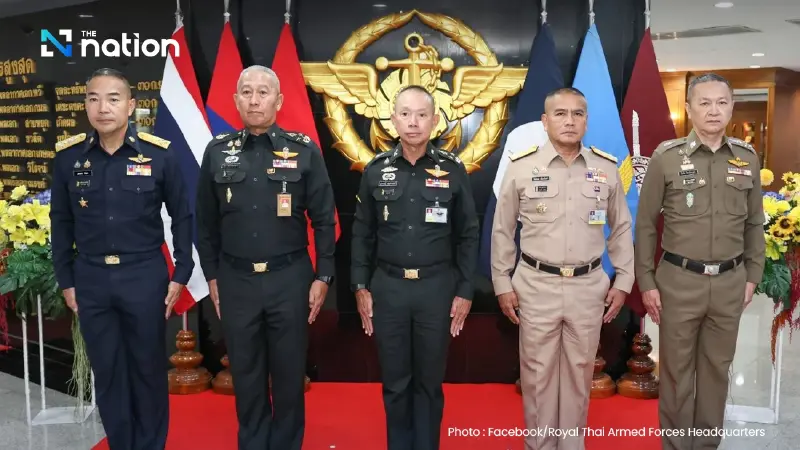


Supreme Commander leads first meeting, tasking Army with mine clearance and cyber-scam patrol; all services on high alert for land and sea defence
- Thailand's Supreme Commander has unified the command of the Army, Navy, Air Force, and Police, establishing the defense of the Cambodian border as the highest priority.
- The Royal Thai Army is tasked with key ground operations, including border surveillance, mine clearance, and patrols to combat cross-border cyber-scams.
- The Navy is assigned to secure the land and maritime borders in the eastern provinces of Chanthaburi and Trat, while the Air Force is on high alert to provide air support, cyber defense, and surveillance.
Supreme Commander leads the first meeting, tasking Army with mine clearance and cyber-scam patrol; all services on high alert for land and sea defence.
The Royal Thai Armed Forces (RTARF) held its inaugural meeting of service chiefs under the new Supreme Commander, reaffirming that the highest priority remains defending sovereignty along the border with Cambodia.
The meeting, presided over by Gen Ukrit Boontanon, Chief of Defence Forces (Supreme Commander), brought together the heads of the Army, Navy, Air Force, and the Commissioner-General of the Royal Thai Police at the RTARF Headquarters on Friday.
Maj Gen Winthai Suvaree, spokesperson for the Royal Thai Army (RTA), confirmed the Army's commitment to protecting the Thai-Cambodia frontier under the framework of the 'Chakrabongse Bhuvanath' command.
The RTA's operational plans—which involve the Suranaree Force and Burapha Force—are being tightly coordinated with the Royal Thai Navy's Chanthaburi-Trat Border Defence Command to ensure maximum efficiency.
Key actions currently underway or planned by the Army include:
- Close surveillance and monitoring of the entire border area.
- Demining operations in operational zones under Thai responsibility.
- Improving tactical routes for troop deployment and surveillance.
- Conducting frequent contingency drills to maintain combat readiness.

Maj Gen Winthai emphasised that the Army is directly driving issues agreed upon during recent diplomatic meetings, including the Thai-Cambodia Joint Boundary Commission (JBC) and General Border Committee (GBC), and those raised at the upcoming ASEAN Summit.
These crucial matters include border area management in Sa Kaeo, continued demining, and tackling cyber-scam and online crime, all in close coordination with the Foreign Ministry and police.
Regarding the plan to withdraw heavy weapons from the border—an outcome of the GBC meeting—the RTA has tasked the 2nd Army Area to discuss the details with Cambodia's Military Region 4.
The RTA’s mandate is clear: to defend the nation's sovereignty and ensure civilian safety.

The meeting also clarified the defensive roles of the other services:
Royal Thai Navy (RTN): Rear Admiral Parach Rattanachaiphan, RTN spokesperson, confirmed the Navy has been assigned the mission of safeguarding both land and maritime sovereignty in Chanthaburi and Trat provinces, while simultaneously ensuring freedom of navigation in the sea lanes.
Royal Thai Air Force (RTAF): Air Marshal Jakkrit Thammavichai, RTAF spokesperson, outlined the Air Force's preparedness to counter threats in the East. The RTAF maintains high-performance fighter jets, reconnaissance aircraft, and unmanned aerial vehicle (UAV) systems on combat readiness. The objective is to use air support swiftly to "compel any opposing force to cease hostilities" against Thai forces and civilians.
In the crucial cyber dimension, the RTAF is conducting continuous intelligence and covert operations to ensure national cybersecurity, proactively working ahead of any conflict escalation.
Furthermore, the RTAF is using its space capabilities to monitor the conflict area, detecting significant changes and reporting findings to the RTARF for contingency planning.
