
Behind the royal portrait: The significance of Her Majesty Queen Sirikit's attire
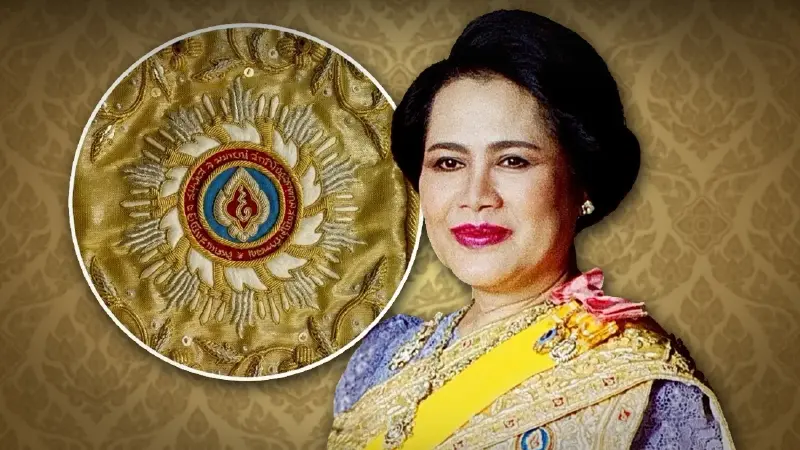


Discover the intricate royal attire in the iconic portrait of Her Majesty Queen Sirikit The Queen Mother, a symbol of grace and honour.
The iconic portrait of Her Majesty Queen Sirikit The Queen Mother, seen displayed in front of the Great Golden Royal Urn during the funeral rites at Dusit Maha Prasat Throne Hall, was taken during the celebration of the birthday of His Majesty King Bhumibol Adulyadej the Great (Rama IX) on December 5, 1992. The photograph was captured at Phisan Thaksin Throne Hall in the Grand Palace and is a portrait that exudes the highest level of elegance and honour.

In this portrait, Her Majesty Queen Sirikit The Queen Mother is seen wearing a lace blouse and a traditional ceremonial sinhs (a type of sarong), but what draws the eye and holds great significance is the Saphak Maha Chakri, a piece of exquisite craftsmanship.
Attire Details: The Queen’s attire includes a lace blouse and ceremonial sinhs with a Saphak Maha Chakri draped over her shoulder. This piece of royal clothing is a symbol of grandeur and prestige.
Embroidery Technique: The Saphak Maha Chakri is intricately embroidered with the Great Unalome symbol and Chakri Star, using silk threads, translucent metallic threads, sequins, and beads to enhance its exquisite design.
Origin of the Embroidery: Such embroidery is considered a delicate art form, dating back to the Ayutthaya period. It was traditionally used on the royal garments of kings and high-ranking nobles to add elegance and signify their noble rank and status.

The Royal Symbolism in Queen Sirikit’s Attire: The Chakri Star and Unalome
The embroidery of the Great Unalome and Chakri Star on the Saphak Maha Chakri holds deep connections to the prestigious Most Illustrious Order of the Royal House of Chakri, the highest royal order. These symbols, intricately embroidered onto royal garments, have rich religious and historical meanings.
1. The Great Unalome
The Great Unalome is a symbol of profound spiritual and royal significance. In Hinduism, it represents the third eye of Shiva, symbolising the beginning of a new dynasty with great power and authority. The root of the word "Om" in Hinduism, a sacred word that represents the three gods—Brahma, Vishnu, and Shiva—can also be traced to this symbol.
In Buddhism, the Unalome represents the Eye of Enlightenment, symbolising the third eye that sees the world of suffering and leads to enlightenment, representing the path to balance and truth.
Historical Background: King Phutthayotfa Chulalok, or King Rama I, established the Pathum Unalome (Great Unalome) as a royal seal to mark the founding of the Chakri dynasty.

2. The Chakri Star
The Chakri Star is a distinctive symbol of the Chakri dynasty. It is worn on the left chest of the royal ceremonial attire and features the symbols of the chakra (wheel) and trident. The chakra, with ten petals inlaid with white enamel, is accompanied by a silver trident and silver radiance around the petals. This symbol represents the Royal Chakri Family.
Additionally, at the centre of the star is a golden crown, symbolising King Phutthayotfa Chulalok, the first monarch of the Chakri dynasty, shining with radiance.
Historical Background: The Chakri Star was designed as part of the royal insignia by HSH Prince Pravich Chumsai, and it was awarded to the royal family on important occasions as a mark of the highest honour.

The first instance of the emblem being used was during the reign of King Chulalongkorn (Rama V), who granted the Chulachomklao Order to royal consorts and noble women, and this led to the practice of embroidering these symbols onto royal garments, establishing a long-standing tradition. This continued to be upheld when Her Majesty Queen Sirikit The Queen Mother wore this attire, showcasing the royal order.
This iconic portrait, therefore, is not merely a photograph but a historical record that reflects the supreme honour, the beauty of Thai craftsmanship, and the connection with the monarchs of the Chakri dynasty, a legacy that Her Majesty Queen Sirikit The Queen Mother has upheld with dignity throughout her reign.
