
Cyber police and AMLO raid 36 locations linked to Ly Yong Phat
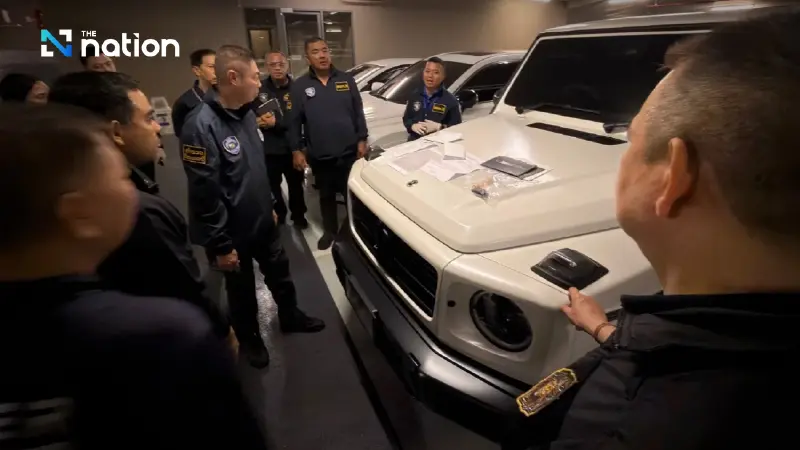


Cybercrime police and AMLO raided 36 sites in Bangkok and Trat, seizing assets worth over 90 million baht linked to Cambodian tycoon Ly Yong Phat and associates.
The Cyber Crime Investigation Bureau (CCIB) and the Anti-Money Laundering Office (AMLO) launched coordinated raids on 36 locations across Bangkok and Trat province on Sunday (November 9) to seize assets linked to Phat Suphapha, also known as Ly Yong Phat — a Cambodian senator and businessman of Chinese and Thai Koh Kong descent, and owner of the LYP Group.
Among the key sites was a pair of condominium units in the Sukhumvit area of Bangkok. Officers reported finding no occupants, only building management staff, and proceeded to seize property-related documents from the premises.
In Trat province, officials confiscated land worth around 5 million baht and bank accounts holding more than 88.2 million baht.

The operation followed an extensive cybercrime investigation, which revealed connections between Ly Yong Phat, his associates, and an international scam network. Evidence indicated a structured system of profit-sharing and money laundering activities.
Authorities have issued arrest warrants for five individuals within the network — including Ly Yong Phat, 67, his close associate Chokchai Suphapha, 37, and three Chinese nationals — on charges of conspiracy to commit money laundering and joint money laundering.
Government sources said Prime Minister and Interior Minister Anutin Charnvirakul has prioritised the suppression of call-centre gangs and scam networks as a national agenda, directing all relevant agencies to conduct sweeping crackdowns.
Further details of the investigation are expected to be announced at a press conference at the Royal Thai Police headquarters in Bangkok on Monday (November 10).

About Ly Yong Phat
Ly Yong Phat (Cambodian name) or Phat Suphapha (Thai name) was born in Koh Kong province, Cambodia.
Though a Cambodian national, he held a Thai ID card — like many Thai-Koh Kong families who fled the Cambodian civil war and later settled in Trat province, where they obtained Thai citizenship under the surname Suphapha.
After 1993, Ly Yong Phat — widely known as Sia Phat — secured concessions to develop hotels, resorts, and casinos on over 1,000 rai (160 hectares) of land in Cham Yeam village, Mondol Seima district, Koh Kong province, opposite Ban Hat Lek in Khlong Yai district, Trat.
His conglomerate, LYP Group, later expanded into property development, industrial estates, large-scale agriculture, sugar production, power generation, casinos, and tourism.
Over a decade ago, Sia Phat extended his casino empire to several Cambodian provinces, including Chong Sa-ngam in Preah Vihear and O Smach in Oddar Meanchey.
He was known to be close to Tea Banh, Cambodia’s former Defence Minister, with Koh Kong serving as both a political and business stronghold for Tea Banh. His ties also extended to Cambodian Senate President Hun Sen.

In 2024, four hotels and resorts under LYP Group — O-Smach Resort, Garden City Hotel, Koh Kong Resort, and Phnom Penh Hotel — were designated by the US Department of the Treasury as entities linked to illicit “grey businesses” and call-centre scam operations involving forced labour and human trafficking.
The US alleged that many of these properties were used as detention sites for scam victims. Cambodia strongly denied the accusations at the time, insisting that the US had received misleading information and that Ly Yong Phat was not involved in any scam operations.
However, investigations by Thailand’s CCIB and AMLO later uncovered connections between Ly Yong Phat and scam networks linked to the O-Smach Resort in Cambodia. AMLO had previously seized assets worth 70 million baht belonging to him.
On October 24 2025, Prime Minister Anutin signed an order revoking Ly Yong Phat’s Thai citizenship.
The Interior Ministry’s statement, based on reports from AMLO and the Foreign Ministry’s Department of Consular Affairs, concluded that Ly Yong Phat was connected to groups engaged in fraud, human trafficking, and cybercrime — and was sanctioned by the US Office of Foreign Assets Control.
The order cited sections 19 (2), (3), and (4) of the Nationality Act BE 2508 (1965), declaring that his conduct posed a threat to national security, public order, and morality, justifying the revocation of his Thai citizenship.
