
PM vows zero tolerance on scam networks, pledges prosecution for all involved
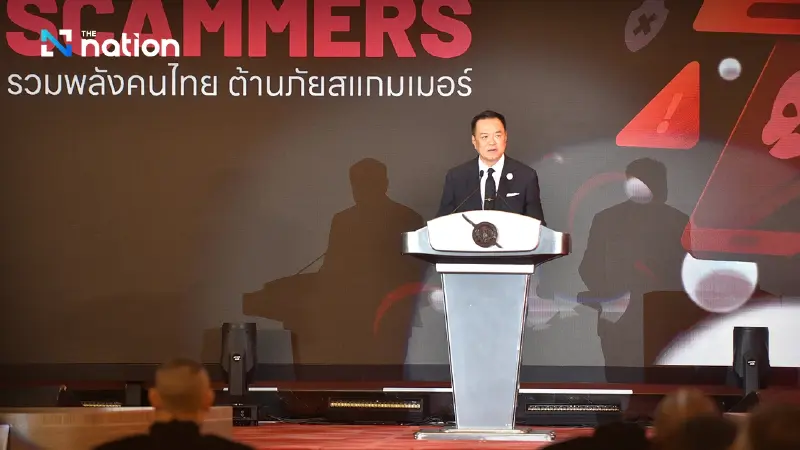


Prime Minister Anutin Charnvirakul declares crackdown on scammers a national agenda, vowing to prosecute every official or politician involved

On November 10 2025, at the Royal Thai Police Training and Welfare Centre in Bangkok, Prime Minister and Interior Minister Anutin Charnvirakul presided over a press conference titled “United Thailand Against Scammers” to announce intensified measures against cybercrime and transnational scam networks.
Anutin declared that the government’s goal is to eradicate scammers and online fraud networks from Thailand, calling the crackdown a national agenda. He emphasised that scam operations undermine public trust, damage the economy, and hurt Thailand’s trade and investment confidence — making success in this mission a key performance indicator of his administration.
He announced the establishment of the National Committee on the Prevention and Suppression of Technology Crime, chaired by the Prime Minister, and the signing of a memorandum of understanding among 15 key agencies — from state bodies and private institutions to financial organisations — to close loopholes and cut off financial routes for criminals.

“We are no longer on the defensive; we are taking the offensive,” Anutin said, noting that the police had already seized tens of billions of baht in assets, revoked visas, deported foreign suspects, and cancelled numerous Thai citizenships and mule accounts linked to scams.
Addressing public concerns that state officials or politicians might be involved, Anutin vowed uncompromising action.
“If anyone — officials or politicians — is found connected to scammers, there will be no negotiations and no exemptions,” he stated firmly. “This government will not clear anyone. The law will be applied strictly and equally.”
He urged the public to remain alert and share information with relevant authorities if they suspect wrongdoing, stressing that scam prevention depends on public awareness.
“Scammers use our ignorance as a weapon. The best defence is knowledge. We will continue educating citizens nationwide until these crimes can no longer harm our people,” he said.
“Thailand stands as the strongest enemy of scammers — there are no safe havens for them in our country under law enforcement protection,” Anutin added.

Pol Lt Gen Jirabhop Bhuridej, Assistant Commissioner-General of the Royal Thai Police, highlighted that cyber scams have become a trillion-dollar global problem. According to the Global Anti-Scam Alliance (GASA), global scam-related losses total US$1.03 trillion, with Asia suffering the most — US$688 billion in damages.
He said China has been hardest hit, particularly in Laukkaing, where authorities discovered six high-rise scam compounds housing over 5,000 suspects, including about 500 Thais, who have since been repatriated. In the United States, losses reached US$12.5 billion, while Singapore suffered damages exceeding 1.2 billion baht.
In Thailand, over the past three years, there have been roughly 1 million scam cases, with total losses exceeding 100 billion baht. So far this year alone, authorities have logged 300,000 new cases worth 20 billion baht, averaging 3,000 new incidents per day and daily losses of around 70 million baht.
Jirabhop said the key lies in addressing root causes, including diplomatic coordination with countries hosting scam operations.
“We must pressure or persuade those countries to cooperate, even through measures like cutting internet, electricity, or fuel supplies,” he said. “If they don’t cooperate, we will do whatever it takes to keep Thais safe.”
He concluded that stronger domestic and international collaboration will be essential to achieving lasting success.
“In just one month, we’ve already seen progress. We will keep fighting with every agency’s full capacity,” Jirabhop said.
