
Thailand's army receives advanced DTI-1G guided rocket system for long-range precision strikes
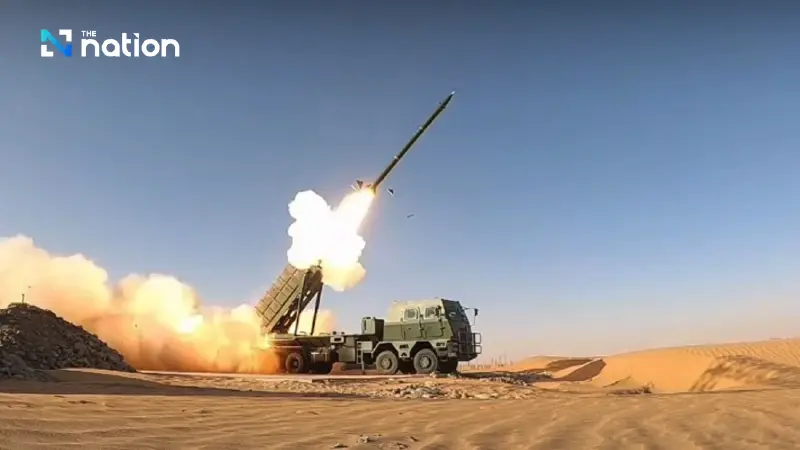


Army receives "DTI-1G Guided Multiple Launch Rocket System and D11A Rocket Launcher Vehicle" with 150 km range, ready for use to protect sovereignty

On November 13, 2025, the Defence Technology Institute (DTI) held a ceremony to deliver military equipment to the operational units for deployment. Gen Anupap Sirimonthon, Deputy Chief of Staff of the Royal Thai Army, represented the Army in receiving three pieces of equipment, including:
- D11A Multi-Purpose Rocket Launcher Vehicle Prototype
- 105mm CS/AH2 Light Field Gun, delivered to the Artillery Center
- DTI-1G Guided Multiple Launch Rocket System, delivered to the Field Artillery Division
Gen Naphon Sangsomwong, Chairman of the Defence Technology Institute, stated that today marks the delivery of three weapons systems that the institute developed in collaboration with the Royal Thai Army. These include the 105mm light field gun, which has been technology-transferred from China and assembled by DTI personnel in Thailand.

The DTI-1G Guided Multiple Launch Rocket System has also been technology-transferred from China, and the system has already been used in real-world military scenarios in previous border incidents.
Meanwhile, the D11A Multi-Purpose Rocket Launcher Vehicle, capable of firing five types of rockets, has the following specifications:
- 122mm rockets with a range of 40 km
- 306mm rockets with a range of 150 km
- 170mm rockets with a range of 300 km
This vehicle, developed with technology from Elbit Systems of Israel, can fire rockets with a maximum range of over 450 km. In addition, the vehicle is designed for multi-purpose operations, and once the rockets are launched, the system can reconnoitre and adjust target acquisition before transforming into a missile strike, or return to its original position for re-launch.
Both the D11A Multi-Purpose Rocket Launcher Vehicle and the DTI-1G Guided Multiple Launch Rocket System are guided missile systems.

Regarding confidence in handling potential situations, Gen Naphon noted that the guided missiles developed by Thailand are highly precise and designed for national security. He emphasized that the government’s stance is clear: these weapons are intended for defensive purposes only, with no intent to invade any other country, and their use will be limited to necessity. He added that the Institute will continue collaborating with the Royal Thai Army to evaluate how the two missile systems will be used, including the 105mm light field gun.
Gen Naphon also stated that production will focus solely on military requirements, and acknowledged the importance of technology development. Once research is completed, the systems will enter production as part of Thailand’s future policy.

When asked about the use of these weapons in border conflicts with Cambodia, Gen Naphon responded that the Royal Thai Army would be the appropriate agency to decide. He assured that DTI will produce systems based on the Army’s needs, focusing on effective use and defending sovereignty and military personnel.
When asked whether the previous border conflict would be factored into weapon adjustments for future situations, Gen Naphon confirmed that there are plans, and that discussions with military commanders and operational units have taken place to determine the Army’s needs. DTI will then act accordingly to ensure cost-effective production while prioritizing self-reliance.
When further asked if additional research on weapons systems had been conducted, Gen Naphon mentioned the development of a tactical robot, which has already been delivered to Suranaree Command, Second Army Region. This robot, equipped with a gun and weaponry, replaces human patrols and can carry equipment. It is controlled from the base station via a 360-degree camera and can move forward up to 3-5 kilometers. The Army is currently evaluating whether there is a continued need for this technology.
Regarding mine clearance, discussions are underway to determine the best approach, in consultation with the Engineer Department. Experts at the DTI are also proficient in creating MEDIUM GIRDER BRIDGE and FIXED BRIDGE for strategic use.
As for unmanned aerial vehicles (drones), the development is ongoing, and DTI plans to expedite the process. The institute is focusing on three levels of research:
- General military equipment used by infantry, cavalry, and artillery
- Specialized equipment, such as anti-drone systems and tactical robots
- Advanced systems, like high-tech satellites and balloons for high-altitude surveillance, which are part of future plans.
The D11A Multi-Purpose Rocket Launcher Vehicle is a prototype research and development project that will be used to launch 122mm rockets (40 km range), 306mm rockets (150 km range), and 370mm rockets (300 km range), all of which have been developed in collaboration with Elbit Systems to meet the Royal Thai Army's needs, making it a strategic weapon system capable of long-range operations.
The 105mm CS/AH2 Light Field Gun is a towed artillery system with GPS/INS automated targeting and can fire without a map. Its maximum firing range is 20 km and it’s used for supporting artillery units in the field.
The DTI-1G Guided Multiple Launch Rocket System is a tactical, operational, and strategic weapon designed to destroy deep, distant targets, including military units, command posts, ammunition depots, airports, and other significant military targets. It is used as a support weapon to strike targets such as artillery positions, rocket systems, radar stations, command and control centers, and other critical military sites.
This system is a surface-to-surface guided missile with a range of up to 150 kilometers. It uses a highly accurate GPS/INS guidance system and is mounted on a mobile rocket launcher vehicle equipped with explosion-resistant armor. The system can move with high mobility and strike targets with precision. Its CEP (Circular Error Probable) is less than 40 meters, with a destruction radius of over 70 meters. The vehicle can fire one missile at a time or in rapid succession, with a firing interval of 10 seconds, and each launcher can carry up to four missiles.
