
Thai Army reveals Cambodia’s false reporting campaign, slanders Thailand
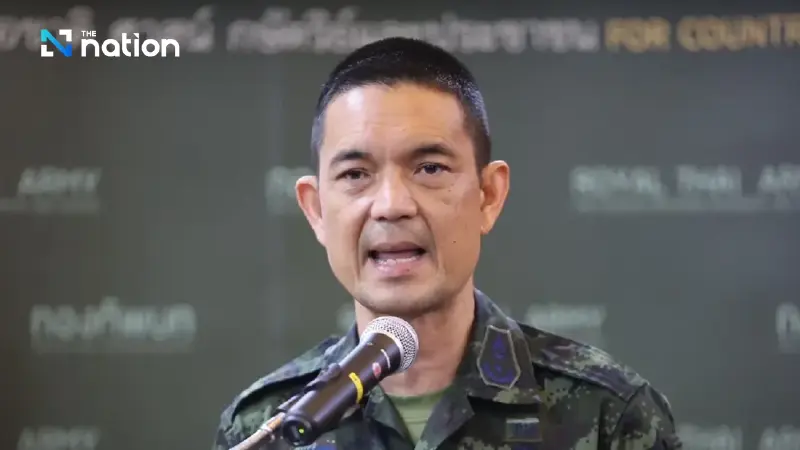


The Thai Army spokesman reveals that Cambodia has systematically spread false news using government agencies, media, and citizens, unjustly accusing Thailand.
Royal Thai Army Spokesman Maj Gen Winthai Suwaree addressed the recent tensions at the Thai-Cambodian border on Thursday (November 13).
These tensions erupted after Cambodian forces illegally planted landmines, which Thailand considers a violation of the Joint Declaration and a provocative act. In response, Thailand suspended its implementation of the Joint Declaration and postponed the transfer of prisoners.
On Wednesday (November 12), Cambodian forces opened fire in the Thai territory of Ban Nong Ya Kaew, in Sa Kaeo province, forcing Thailand to retaliate in accordance with its rules of engagement to protect its citizens.
Following this incident, Cambodia launched a widespread misinformation campaign, falsely claiming that Thai forces had attacked Cambodian civilians and violated agreements, while also demanding the immediate, unconditional release of prisoners of war.
Winthai stated that despite Cambodia’s attempts to fabricate a situation where Thailand is portrayed as violating agreements and to cast itself as the victim of Thai actions—accusing Thailand of firing on Cambodian civilians and even claiming that Thai troops had triggered landmines they had supposedly laid—there is no factual evidence to support these allegations.
Instead, Cambodia has engaged in a systematic misinformation campaign, using government bodies, domestic media, and the public to spread falsehoods, creating widespread confusion and misunderstanding.
The Thai Army has clarified the facts to ensure the public has a correct understanding of the situation:
- Regarding the discovery of PMN-2 landmines in the Huai Ta Maria area, Cambodia falsely claimed that Thai forces had triggered these mines. However, Thailand has clear evidence from a forensic investigation that the mines were newly laid. Additionally, three other mines were found nearby. Reports also confirmed that Cambodian soldiers had illegally cut barbed wire previously laid by Thai forces before the landmines were found, consistent with previous reports of similar landmine discoveries in other areas.
- In the incident where Cambodian forces opened fire in Ban Nong Ya Kaew, Sa Kaeo province, Thailand’s Burapha Task Force was forced to return fire in self-defence. Following the event, Cambodia spread false information claiming that Thailand had targeted and injured Cambodian civilians. The Thai Army clarified that its actions were in accordance with the rules of engagement, and the firing was in response to Cambodian gunfire. If Cambodia claims that civilians were affected, it suggests that Cambodia used its citizens as human shields by mixing troops with civilians, disregarding the potential consequences.
- Regarding the claim that Thailand returned the body of a deceased Cambodian civilian, Cambodia falsely portrayed this as the repatriation of a prisoner of war’s body. In reality, the individual had died of a pre-existing medical condition in a Bangkok hospital, and Thai authorities had facilitated the return of the body in accordance with humanitarian principles. Cambodia’s misrepresentation of this incident further illustrates its disregard for human rights and humanitarian standards, using the death of its own citizens to fuel a false narrative.
