
ONWR issues urgent warning: 11 southern provinces at risk of flash floods and landslides, November 17–22, 2025
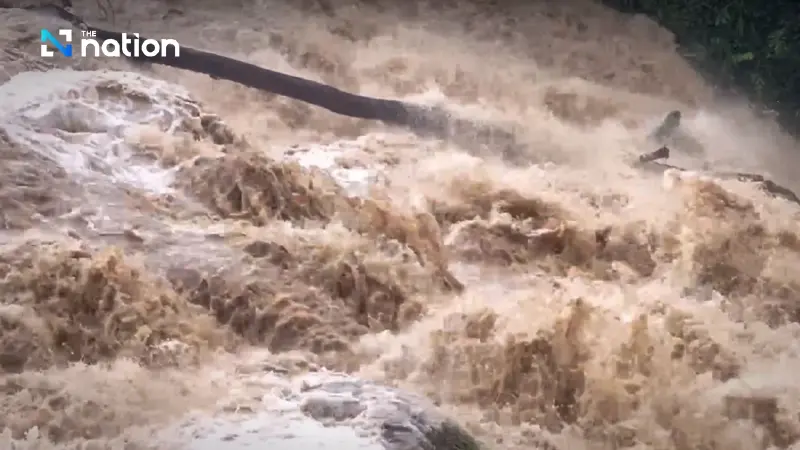


The Office of the National Water Resources (ONWR) has issued Announcement No. 30/2025, dated November 13, 2025, warning of flash floods, forest run-off, and landslides across southern Thailand
ONWR reported that weather forecasts indicate a rather strong northeast monsoon covering the Gulf of Thailand and the upper South, combined with an easterly wind wave moving across the southern region. These conditions are expected to bring heavy to very heavy rainfall in several southern provinces.
ONWR, in coordination with the Meteorological Department, Hydro–Informatics Institute, Department of Water Resources, Department of Mineral Resources, Royal Irrigation Department, Electricity Generating Authority of Thailand, and the Department of Disaster Prevention and Mitigation, has assessed weather conditions, water situations, and high-risk flood and landslide zones. They have identified areas that must be monitored closely for flash floods, forest run-off, landslides, and urban flooding—especially in low-lying areas with poor drainage—during November 17–22, 2025.
1. High-risk areas for flash floods, forest run-off, landslides, and urban flooding
- Chumphon Province (Sawi, Thung Tako, Phato, Lamae, Lang Suan)
- Surat Thani Province (Mueang Surat Thani, Chai Buri, Phra Saeng, Wiang Sa, Kanchanadit, Don Sak, Ban Na San, Tha Chang, Ko Samui, Ko Pha-ngan)
- Phuket Province (Mueang Phuket, Kathu, Thalang)
- Nakhon Si Thammarat Province (Mueang Nakhon Si Thammarat, Chian Yai, Cha-uat, Hua Sai, Chaloem Phra Kiat, Pak Phanang, Phra Phrom, Sichon, Nopphitam, Tha Sala, Khanom, Chang Klang)
- Trang Province (Mueang Trang, Huai Yot, Na Yong, Palian, Yan Ta Khao)
- Phatthalung Province (Kong Ra, Tamot, Pa Bon, Srinakarin, Si Banphot, Pa Phayom)
- Satun Province (Mueang Satun, Khuan Don, Khuan Kalong, Tha Pae)
- Songkhla Province (Mueang Songkhla, Ranot, Krasae Sin, Sathing Phra, Singha Nakhon, Rattaphum, Bang Klam, Khuan Niang, Hat Yai, Khlong Hoi Khong, Sadao, Na Mom, Chana, Na Thawi, Thepha, Saba Yoi)
- Pattani Province (Mueang Pattani, Nong Chik, Khok Pho, Mae Lan, Yarang, Yaring, Mayo, Thung Yang Daeng, Panare, Kapho, Sai Buri, Mai Kaen)
- Yala Province (Mueang Yala, Kabang, Yaha, Krong Pinang, Raman, Bannang Sata, Than To)
- Narathiwat Province (Mueang Narathiwat, Bacho, Rueso, Yi-ngo, Si Sakhon, Ra-ngae, Tak Bai, Cho-airong, Chanae, Sukhirin, Su-ngai Padi, Su-ngai Kolok, Waeng)
2. Reservoir monitoring
ONWR warns of medium and small reservoirs exceeding 80% of capacity in Ranong, Surat Thani, Phuket, Krabi.
Reservoirs with inflows exceeding storage capacity may overflow, posing risks to downstream communities.
3. Monitor sudden rises in water levels.
Communities near main rivers and tributaries should monitor: Lang Suan River, Tapi River, Khlong Cha-uat, Khlong Lam, Khlong Tha-nae, Trang River, Pattani River, Sai Buri River.
Risk includes overtopping, flash floods, and prolonged inundation.
ONWR urges all agencies to take immediate action:
(1) Monitor weather and water levels continuously: Especially areas with over 90 mm of cumulative rainfall within 24 hours and locations that frequently experience flooding.
(2) Inspect and repair river embankments: Remove debris blocking water flow, adjust operations of major, medium, and small reservoirs, canals, and water gates to support expected heavy rainfall.
(3) Prepare emergency response plans: Mobilise personnel, machinery, and equipment, clear drainage channels, and ensure rapid assistance to affected communities.
(4) Public communication: Issue early warnings and ensure communities in at-risk areas are ready to evacuate promptly if conditions worsen.
