
Thailand’s suspension of peace pact sparks debate over US role and future use of F-16s
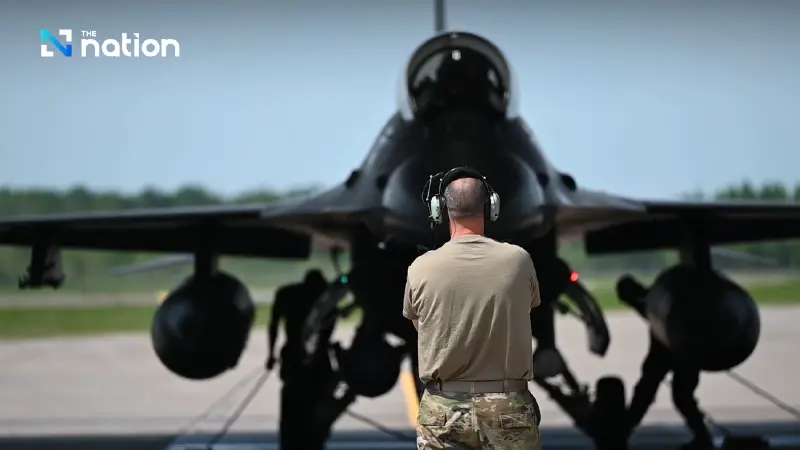


Thailand’s suspension of the Kuala Lumpur Peace Declaration over new Cambodian landmine violations prompts scrutiny of US influence, tariff politics and whether Washington could restrict Thailand’s use of F-16 fighter jets in any future border conflict.
Thailand’s decision to suspend the Kuala Lumpur Joint Declaration — after evidence that Cambodia violated the peace agreement by secretly laying new anti-personnel landmines along Thai patrol routes in Kantharalak district, Si Sa Ket — has triggered widespread debate about the United States’ reaction and the wider geopolitical implications.
Immediately after Thailand’s suspension, Washington delivered a formal notice temporarily halting Thai-US reciprocal tariff negotiations, saying talks would resume only when Thailand recommits to strict compliance with the Kuala Lumpur Declaration.
Although the Thai government later clarified that the US notification occurred before Prime Minister Anutin Charnvirakul spoke by phone with President Donald Trump and Malaysian PM Anwar Ibrahim, officials insisted that Thailand had not been fully suspended from tariff talks and urged the public to “give more weight to the leaders’ words than to documents” — a remark that has fuelled scepticism among Thais.
The tariff issue has also prompted public speculation about whether the US could restrict Thailand’s use of F-16 fighter jets, especially as these aircraft were used during July’s five-day border clashes, where Thailand launched combined air-and-ground strikes under Operation Yuttha Bodin.
Former Cambodian prime minister and current Senate president Hun Sen has openly urged Thailand not to use F-16s and appealed to the international community to stop supplying advanced fighter jets to Bangkok.
Legal experts note that the purchase contract between the Royal Thai Air Force (RTAF) and Lockheed Martin contains no clause requiring US approval for Thailand’s operational use of F-16s — including combat missions along the Cambodian border.
Thailand’s F-16s were used in live combat previously, and RTAF legally retains full authority to deploy them. However, the procurement agreement has significant limitations:
- Thailand did not receive technology transfer
- Thailand cannot manufacture its own spare parts
- All major maintenance requires notification to the US, with Lockheed Martin supplying critical components
This has given rise to a common saying within the military:
“Thailand has F-16s, but not full ownership — if the US stops sending parts, they cannot fly.”
Even the use of Link-16, the encrypted tactical data-link network, requires US authorisation, since Washington controls the access codes.
The RTAF is now gradually retiring its ageing F-16s, to be fully decommissioned by 2032, though current aircraft remain operational with adequate spare-parts stockpiles for border missions.
In August 2025, Thailand signed a 60-billion-baht contract to acquire 12 Gripen E/F fighters from Sweden over ten years (2025–2035). Phase 1 contains four aircraft worth 19.5 billion baht, to be delivered by 2032, replacing F-16s at Wing 1, Nakhon Ratchasima. These will join Thailand’s existing fleet of 11 Gripens, which once flew combat missions alongside F-16s in the Thai-Cambodian clashes.
Despite this modernisation, Thailand is still expected to procure more US-made “F-series” jets in future due to their combat power and geopolitical balancing value.
The RTAF maintains fighter fleets from multiple countries to ensure operational flexibility. If one model is temporarily grounded due to supply issues or political conditions, others remain available for national defence.
The Thai-Cambodian border situation remains tense and unstable, and Thailand must exercise caution, especially with US trade pressure now in the background.
For now, the government and military are focused on stabilising the situation while waiting for conditions that would allow Thailand to act with legitimacy and without contradicting international expectations.
