
Water Quality Results of the Salween River: Pollution Sources to Be Investigated by Myanmar
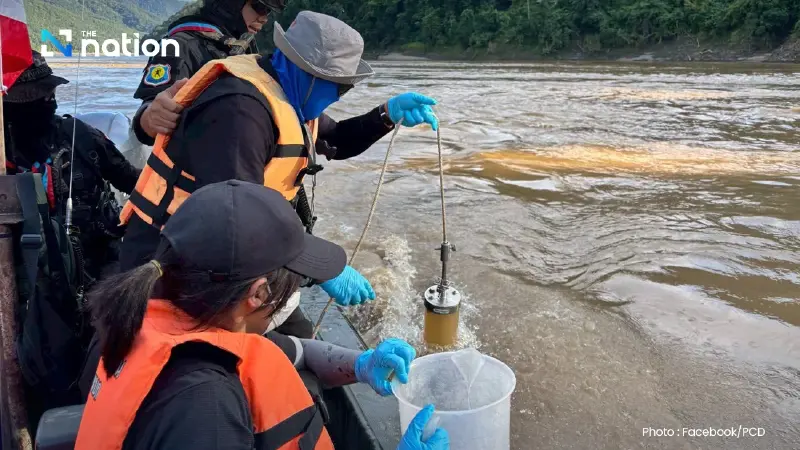


PCD reports arsenic contamination in Salween River, with 13 test points exceeding standards. Myanmar to be notified for pollution source investigation.
- The Pollution Control Department (PCD) revealed the results of water quality tests in the Salween River, Mae Hong Son province, showing arsenic levels exceeding standards at all 13 test points, with lead exceeding the standard at one point.
- The Ministry of Natural Resources and Environment will send a letter through the Ministry of Foreign Affairs to inform Myanmar of the results and request an investigation into the pollution sources.
- PCD will visit communities to advise on safe water usage and recommend simple methods to improve water quality. They will also seek alternative water sources to mitigate the impact on local communities.

Following the issue of abnormal turbidity in the Salween River, Surin Worakijthamrong, Director-General of the Pollution Control Department (PCD), revealed that the PCD had designated environmental monitoring points and collected water and sediment samples from the Salween River and its tributaries in Mae Hong Son province during November 12-13, 2025. Samples were collected and analyzed in accordance with PCD guidelines and the standard methods for the examination of water and wastewater.
Laboratory results from the PCD’s Environmental Laboratory showed that water quality in the Salween River at 13 locations, from the Thai-Myanmar border at Mae Kong, Mae Sariang District, Mae Hong Son Province to Ban Sabeuy, Mae Sam Lab Sub-district, Sabuay District, Mae Hong Son Province, showed arsenic levels exceeding the water quality standard at all test points (standard limit is 0.01 mg/l), and lead exceeded the standard at one point (standard limit is 0.05 mg/l). Mercury levels were within the standard at all points. In the tributaries, 5 test points met the required standards.

The results for the 13 river locations are as follows:
- SAL01: Phatang, Thai-Myanmar border, Mae Kong Sub-district, Mae Sariang District - Arsenic 0.023 mg/l
- SAL02: Phadaeng Wildlife Conservation Unit, Mae Kong Sub-district, Mae Sariang District - Arsenic 0.025 mg/l
- SAL03: Ban Chothat, Mae Kong Sub-district, Mae Sariang District - Arsenic 0.023 mg/l
- SAL04: Go Kae, Mae Kong Sub-district, Mae Sariang District - Arsenic 0.027 mg/l
- SAL05: Sabaeng, Mae Kong Sub-district, Mae Sariang District - Arsenic 0.024 mg/l
- SAL06: Umda Forest, Mae Kong Sub-district, Mae Sariang District - Arsenic 0.025 mg/l
- SAL07: Ban Mae Sa Koep, Mae Kong Sub-district, Mae Sariang District - Arsenic 0.027 mg/l
- SAL08: Ban Tha Ta Fang, Mae Yom Sub-district, Mae Sariang District - Arsenic 0.025 mg/l, Lead 0.076 mg/l (exceeds standard of 0.05 mg/l)
- SAL09: Boundary between Sabuay and Mae Sariang Districts - Arsenic 0.028 mg/l
- SAL10: Mae Sam Lab Pier, Mae Sam Lab Sub-district, Sabuay District - Arsenic 0.029 mg/l
- SAL11: Ban Putha, Moo 6, Mae Sam Lab Sub-district, Sabuay District - Arsenic 0.024 mg/l
- SAL12: Ban Phala U, Moo 4, Mae Sam Lab Sub-district, Sabuay District - Arsenic 0.027 mg/l
- SAL13: Ban Sabeuy, Moo 4, Mae Sam Lab Sub-district, Sabuay District - Arsenic 0.029 mg/l
Tributaries:
- PO01: Mae Kong, Mae Sariang District
- SAM01: Mae Sam Lab, Sabuay District
- KEB01: Mae Kong, Mae Sariang District
- PIN01: Ban Phala U, Mae Sam Lab, Sabuay District
- MOE01: Ban Sabeuy, Mae Sam Lab, Sabuay District
For all tributary points, water quality met the required standards.

Next Steps:
- The Ministry of Natural Resources and Environment will send an urgent letter to the Ministry of Foreign Affairs to inform Myanmar of the findings and request an investigation into the pollution sources.
- The PCD will visit local communities to explain water usage for daily consumption and provide guidance on simple water quality improvement methods. Most people use mountain tap water, which has been tested and found free of arsenic. However, four families living on floating rafts along the river use water directly from the Salween River. PCD staff have already provided guidance on basic water quality improvement in early November.
- The PCD will continue to monitor water quality and provide public updates.
- Analysis of contamination in fish and plants is ongoing. Relevant authorities have already collected samples, and results are pending.
The PCD will continue discussions with the local community next week, and the Ministry of Natural Resources and Environment will expedite efforts to find alternative water sources for consumption and agriculture. Initial surveys have been conducted by the Department of Water Resources and the Department of Groundwater Resources, with plans to drill wells or find other sources to mitigate the impact on the community.
