
DLT steps up fight against PM2.5 with nationwide emission checks and free vehicle-care services
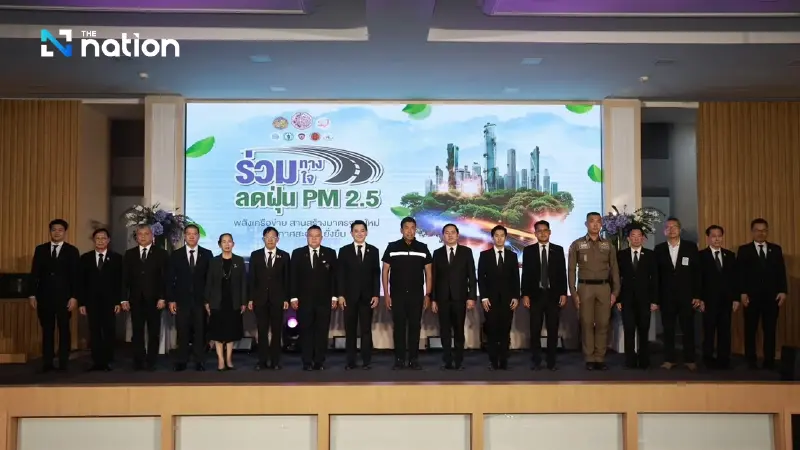


The Department of Land Transport has launched a major anti-pollution initiative with integrated black-smoke inspections, public service demonstrations and private-sector collaboration, including free vehicle-care benefits from Autobacs Thailand.
The Department of Land Transport (DLT), under the Transport Ministry, in collaboration with Bangkok Metropolitan Administration, has launched activities under the campaign “Travel Together, Work Together, Reduce PM2.5” to strengthen Thailand’s vehicle-related pollution controls.
The event was held on November 26, 2025 at the Road Transport Innovation and Technology Centre. The event was presided over by Sorapong Paitoonphong, DLT Director-General, and attended by Chadchart Sittipunt, Bangkok Governor; Thanapat Sangchan, Director of the Bureau of Cooperation, Office of the Vocational Education Commission; Thongyu Kongkhan, President of the Land Transport Federation of Thailand, as well as representatives from government agencies, private-sector organisations, bus and freight operators.

The event included an integrated black-smoke inspection campaign, a visit to the Passenger Protection and Complaint Centre 1584, demonstrations of black-smoke testing procedures and the application of ‘Do Not Use’ sign, along with inspection points set up by agencies such as the Traffic Police Division, the Pollution Control Department, Bangkok Metropolitan Administration, the Federation of Thai Industries, the Office of the Vocational Education Commission, and Autobacs Thailand.
Under the policy of Phiphat Ratchakitprakarn, Deputy Prime Minister and Minister of Transport, and Manlikaa Jiraphanwanitch, Deputy Transport Minister, road-transport agencies have been instructed to integrate their efforts to effectively tackle PM2.5 pollution. This includes proper vehicle maintenance to reduce black smoke, supporting electric and alternative-energy vehicles, improving freight-transport efficiency, and promoting environment-friendly public transport in the long term.

Sorapong Paitoonphong, DLT Director-General, said that the department has developed the road transport system to be efficient, safe, and environmentally friendly under the “3E1C” concept, comprising:
- Engineering – focusing on raising technical standards for vehicles;
- Enforcement – monitoring, supervising, and enforcing the law;
- Education – developing and disseminating knowledge on environmentally friendly road transport to the public;
- Collaboration – integrating cooperation with all network partners.
The department has also tightened operational measures as follows: deploying special task teams to provide vehicle-maintenance advice at business premises; training drivers to enhance efficiency in safe and fuel-efficient driving to minimise emissions. In addition, the department has encouraged operators to maintain vehicles in optimal condition throughout their use, to replace filters and fluids as required, and to register under the Green List system to access Low Emission Zones in accordance with Bangkok Metropolitan Administration regulations.
DLT officers also conduct inspections to supervise and monitor the operations of private vehicle-inspection centres, as well as measure black-smoke emissions from all vehicles undergoing procedures such as transfer, relocation, or colour change at transport offices. The department has increased roadside black-smoke inspections at BMTA depots, Transport Company depots across all bus-operation zones, and all passenger terminals. It has also increased the frequency of black-smoke checks on main and secondary roads.
If a vehicle is found to emit black smoke exceeding 20%, the owner will be fined up to 5,000 baht and the vehicle will be prohibited from use, marked with a “Do Not Use” notice until the owner repairs the engine to meet emission standards and passes a re-inspection.
For this year, the DLT is offering a special New Year gift to the public in collaboration with the Office of the Vocational Education Commission, providing free vehicle inspections and maintenance services, including filter and fluid changes, at OVEC service points nationwide. As for the private sector, Autobacs is offering special discounts, including a free 25-point vehicle inspection at all Autobacs branches nationwide. The department has also received cooperation from PTT Oil and Retail Business Plc (OR), which is inviting the public to benefit from a free 35-point vehicle check-up, helping to sustainably improve both public well-being and national air quality.

Bangkok Governor Chadchart Sittipunt said that after the National Environment Board declared Bangkok a pollution control zone from November to March each year, all relevant sectors—both public and private—have joined forces to drive the “Green List Plus: Fight the Dust, Reduce PM2.5” campaign. This collaborative effort involves government agencies such as the Ministry of Energy, the Department of Land Transport, the Traffic Police Division, and the Department of Disaster Prevention and Mitigation, together with private-sector partners.
The objective is to prevent and reduce PM2.5 emissions from the transport sector by encouraging the public to bring their private vehicles in for engine check-ups, oil changes, and air-filter replacements, which significantly reduce pollution from exhaust fumes. Studies have found that changing engine oil and air filters can reduce black-smoke emissions by more than 50%, leading to a subsequent drop in airborne dust.
This year, strong cooperation has been received from the Federation of Thai Industries and various automobile manufacturers, who are offering Phase 1 promotions, including free engine inspections of more than 55 items, and discounts of up to 50% on engine oil, spare parts, and labour. These services are available at 1,745 service centres nationwide operated by nine automotive brands—Isuzu, Mitsubishi, Nissan, Toyota, Honda, Mazda, Hino, Ford, and Suzuki—as well as at oil-company service centres run by PTT, Bangchak, Shell, PT, Mobil, and participating B-Quik branches.
Drivers who join the Green List Plus programme and register a Green List account with the Bangkok Metropolitan Administration will receive additional Phase 2 benefits from private-sector partners, including Central Pattana, CP Axtra, The Mall Group, Advanced Info Service (AIS), and BTS Group Holdings. Benefits include free parking at Central, The Mall and Lotus’s, BTS travel vouchers, and discounts on compulsory motor insurance or car insurance purchased through AIS.
Chadchart emphasised that regular engine oil changes significantly help reduce particulate matter, and urged the public to participate by bringing their vehicles for service—echoing the campaign slogan: “A quick vehicle check helps cut pollution.”
Thanapat Sangchan, Director of the Bureau of Cooperation, Office of the Vocational Education Commission (OVEC), said that OVEC is ready to deploy students and trainees to support the public and business operators in bringing their vehicles in for services to reduce PM2.5 dust at Fix It Centers nationwide. These service points will provide vehicle maintenance advice, air-filter replacement, and fluid changes.
He added that the cooperation between the DLT and OVEC demonstrates a shared commitment to tackling the problem of PM2.5 particulate pollution, while also helping to promote and develop students’ technical skills, enabling them to apply their knowledge for the benefit of society, cultivate volunteer spirit, and make constructive use of their free time.
Thongyu Kongkhan, President of the Land Transport Federation of Thailand, said that the Federation is ready to cooperate with the public and private sectors in campaigns for clean air, addressing PM2.5 in all forms—especially within Bangkok. The Federation serves as a partner in the Green List (Green Sticker) initiative for small trucks that must enter urban areas to deliver consumer goods to convenience stores.
He emphasised that road freight operators are a key driver of the national economy, and the success of Thailand’s transport and logistics sector depends on strong cooperation between the public and private sectors to enhance the competitiveness of Thai transport on the global stage. Addressing the PM2.5 issue is a priority for operators, who are fully committed to participating in solutions.
The Federation, which has numerous associations and transport operators as members, will help publicise, build knowledge, and promote cooperation in proper vehicle maintenance among its members to ensure vehicles stay in good condition. This includes regular oil changes, air-filter replacement, routine engine checks, fuel-injector calibration to ensure fine spray, and cleaning fuel systems, among other maintenance practices.
