
Kick Off: Emissions Testing for Black Smoke in Vehicles to Reduce PM2.5 Over 90 Days
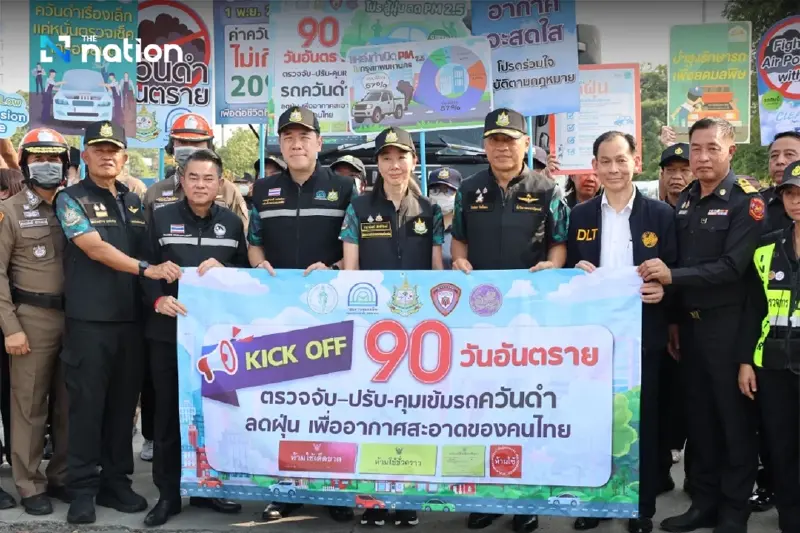


Government launches 90-day crackdown on black smoke-emitting vehicles to reduce PM2.5, with increased inspections and penalties for non-compliance
The PM2.5 dust situation has increased in many areas, significantly affecting public health. Pol Lt Gen Ittiporn Pho Thong, Advisor to the Deputy Prime Minister Suchart Chomklin, visited the site to inspect operations on black smoke detection and enforcement to ban the use of vehicles emitting black smoke.
This is part of an integrated effort involving government agencies such as the Pollution Control Department (PCD), Bangkok Metropolitan Administration (BMA), Department of Land Transport (DLT), and Traffic Police Division at the Bangkok Port, Khlong Toei District, Bangkok on December 2, 2025.
Pol Lt Gen Ittiporn stated that Suchart Chomklin, Deputy Prime Minister and Minister of Natural Resources and Environment, had assigned him to inspect operations concerning black smoke emissions from vehicles due to the PM2.5 dust situation in Bangkok and surrounding areas, which typically worsens from November to March each year. This is caused by meteorological conditions with low air circulation, combined with over 3 million diesel-powered vehicles, which account for 57% of PM2.5 sources in Bangkok. As a result, Bangkok has been declared a pollution control zone to manage and reduce dust, necessitating strict control measures. The government prioritizes public health and environmental quality.

To combat the PM2.5 pollution in urban areas, the standards for black smoke have been reduced from 30% to a maximum of 20%, effective from November 1, 2025. In addition, inspections of vehicles emitting black smoke have become stricter, with checks at various locations such as bus garages, concrete plant trucks, construction sites, and along traffic routes, enforcing the law to prohibit vehicles exceeding the prescribed smoke limit. These actions are in cooperation with the Pollution Control Department (PCD), Bangkok Metropolitan Administration (BMA), Department of Land Transport (DLT), and Traffic Police Division, using relevant legal measures to control all types of black smoke-emitting vehicles.
Pol Lt Gen Ittiporn further emphasized that to prevent and solve the problem of PM2.5 dust from the transportation sector in Bangkok, a 90-day Dangerous Period is designated from December 1, 2025 to February 28, 2026, where all agencies will conduct 14 checkpoints per day in Bangkok and 16 checkpoints in surrounding areas. In other provinces, inspections will be intensified in major cities.
The PCD has integrated efforts with provincial transport offices, provincial natural resources and environmental offices, provincial police, and local administrative organizations. If any vehicle is found to exceed the smoke limit, the traffic officer will temporarily stop the vehicle and order the owner to correct it within 15 days, reduced from the previous 30-day period. If the owner fails to comply, they may face penalties for violating the vehicle registration law and land transport law, with fines of up to 5,000 baht under Section 102 of the National Environmental Quality Promotion Act.
To further alleviate the burden on vehicle owners, the PCD has collaborated with Bangkok, the Thai Industrial Standards Institute, and the private sector. This partnership encourages car owners to have their vehicles checked and oil changed under the Green List Plus program in partnership with various car manufacturers. This initiative offers discounts for engine checks (over 55 items), oil changes, spare parts, and labor costs up to 50%.
In addition, vehicle owners who register for the Green List Plus with Bangkok will receive additional benefits from the private sector, including free parking at Central, The Mall, and Lotus shopping malls, BTS transit vouchers, and discounts for compulsory car insurance through AIS.
Surin Worakijthamrong, Director of the Pollution Control Department, stated that between October 1 – November 30, 2025, authorities inspected and prohibited the use of 85,731 vehicles, including 62,763 vehicles in Bangkok. Of these, 656 vehicles exceeded the smoke limits, and 291 vehicles were successfully repaired and passed inspection, representing 44%. Vehicles that did not comply or were not brought for repairs within the legal timeframe will be subject to further fines under the law.
