
Drone ban stays in seven provinces, six airport zones remain fully restricted
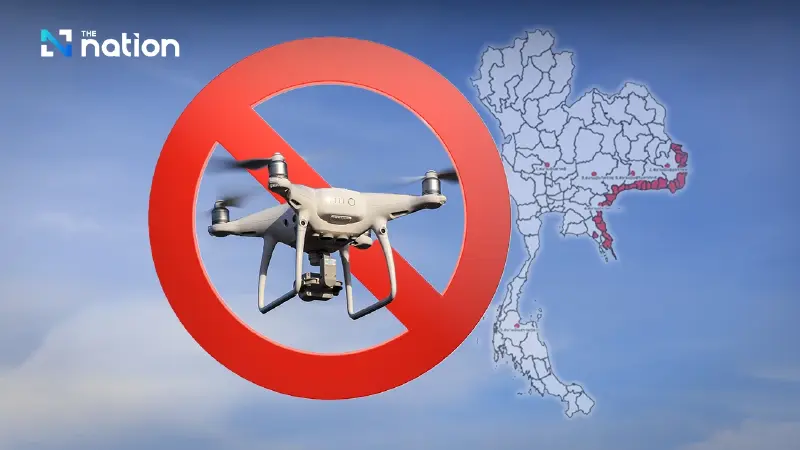


Thailand’s aviation regulator updates drone restrictions near the Thai–Cambodian border, narrowing no-fly zones to six airports while maintaining bans in specific districts across seven provinces. Night-time flights after 18.00 allowed with prior notification.
The Civil Aviation Authority of Thailand (CAAT) has issued Notice No. 11 on the prohibition of operating or releasing unmanned aircraft (drones) in areas deemed sensitive to national security amid the Thai-Cambodian border situation.
Following a joint reassessment with security agencies, CAAT confirmed that certain areas must remain under strict control, though the number of fully restricted airport zones has been reduced to six, namely Korat, Watthana Nakhon, Takhli, Surat Thani, Ubon Ratchathani, and Surin Pakdi airports
The updated notice also permits drone operations after 18.00 hrs, provided operators submit a request to CAAT in advance if their planned activity differs from standard operating conditions.
The notice is effective from December 1-31, 2025, or until further amendments are issued.
Areas where drone flights are strictly prohibited
District-level no-fly zones in 7 provinces:
- Sa Kaeo Province: Khlong Hat, Aranyaprathet, Khok Sung, Ta Phraya
- Buri Ram Province: Lahan Sai, Ban Kruat
- Si Sa Ket Province: Phu Sing, Khun Han, Kantharalak
- Surin Province: Phanom Dong Rak, Kap Choeng, Sangkha, Buachet
- Ubon Ratchathani Province: Khemarat, Na Tan, Pho Sai, Si Mueang Mai, Khong Chiam, Sirindhorn, Buntharik, Na Chaluai, Nam Yuen
- Trat Province: Mueang Trat, Bo Rai, Khlong Yai
- Chanthaburi Province: Mueang Chanthaburi, Pong Nam Ron, Soi Dao
Additional prohibited zones
- A 9-kilometre radius (5 nautical miles) around designated airports
- Any areas specifically declared restricted by security agencies
Conditions for drone operations (outside restricted zones)
- Operators must be registered with CAAT and the drone must also be registered correctly.
- Flight permission must be requested at least 3 days in advance through the UAS Portal (application or website: uasportal.caat.or.th).
- Maximum flight altitude: 90 metres (300 feet) above ground.
- Flight hours allowed: 06.00–18.00 hrs.
- Flights outside this timeframe require special CAAT approval.
- Absolutely no flights allowed between 00.01–04.00 hrs.
- Once permission is granted, operators must notify CAAT via the UAS Portal before each flight, providing:
- Location
- Date & time
- Purpose of the operation
- Operators must also notify the Anti-Drone Operations Centre at:
Email: [email protected] - Any operation outside these conditions requires an additional request and documentation submission through the UAS Portal.
CAAT explained that Announcement No. 11 resulted from continuous joint assessment with national security agencies, which found that certain areas still require drone prohibitions to ensure effectiveness of ongoing security operations along the Thai-Cambodian border.
At the same time, CAAT emphasised that it remains mindful of public and business needs. Therefore, drone usage is permitted across most areas of the country under strict conditions.
CAAT will continue to closely monitor the border situation and is prepared to adjust measures in line with the prevailing security environment, ensuring drone activity remains balanced, safe, and non-disruptive to national security.
