
Thai Military Insists All Strikes on Cambodia Based on Joint Intelligence Assessment


Defence Ministry confirms three armed forces coordinate target selection to counter 'imminent threats' as border conflict intensifies
- Thailand's Defence Ministry asserts that all military strikes in Cambodia are based on coordinated intelligence assessments from the Royal Thai Army, Navy, and Air Force.
- Target selection follows a rigorous process to prioritize and neutralize "imminent threats" to national security and civilian safety.
- The strikes are part of a response to what Thailand describes as Cambodian aggression, including the firing of approximately 50 rockets into Thai civilian areas.
- The Royal Thai Air Force is prepared for deep strike operations but states such actions would only occur if intelligence verifies a clear and imminent threat from Cambodia.
Defence Ministry confirms three armed forces coordinate target selection to counter 'imminent threats' as border conflict intensifies.
Thailand's armed forces have emphasised that every military strike against targets in Cambodian territory is based on coordinated intelligence assessments by all three services, with clear evidence of threats to national security and civilian safety.
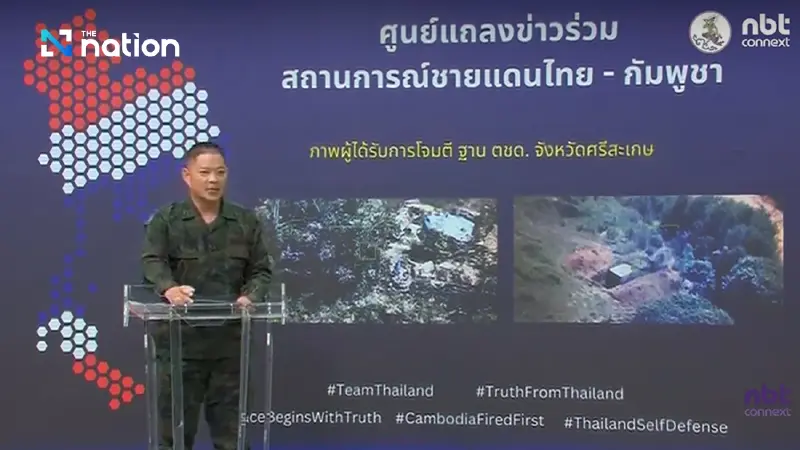
Speaking at a joint press conference on Wednesday, Defence Ministry spokesperson Rear Admiral Surasant Kongsiri stressed that target selection follows a rigorous process involving the Royal Thai Army, Navy and Air Force, with each objective ranked by priority and strategic importance.
"We have a comprehensive and complete operational plan regarding operations against targets," Rear Admiral Surasant said. "We have plans to designate various targets according to the importance of those targets. This is intelligence information — we know very well where is what, how they are used, which is why we have a clear ranking of 1, 2, 3, 4, 5 of which targets should be destroyed first."
The coordinated approach comes as Thailand continues "Operation Suppress Enemy" launched by the Royal Thai Navy to repel what military officials characterise as aggression from Cambodian forces threatening the livelihoods of people along the border.

Military Operations Intensify Across Border Provinces
The conflict, which began on 7th December in Trat province, has now spread across seven border provinces: Ubon Ratchathani, Si Sa Ket, Surin, Buri Ram, Sa Kaeo, Chanthaburi and Trat.
Royal Thai Navy forces have focused operations on two prominent areas in Trat province. The first involves three houses that have been an "ongoing task" to combat and secure, with forces working to achieve 100 per cent control of the area.
The second target is a deserted casino building opposite Trat province, which intelligence indicates has been used as a storage facility and antenna installation site for drone and anti-drone systems operated by Cambodian armed forces.
"We did not attack to destroy the building itself, but we attacked to destroy the military stronghold to reduce their capability to be a threat to us," Royal Thai Navy spokesperson Rear Admiral Paraj Ratanajaipan explained. "Therefore, we confirm that we retaliated against the opposing side proportionately and reasonably. We did not want to raze everything to the ground, but we destroyed to eliminate the threat to us only."
In Sa Kaeo province, Thai forces have achieved 100 per cent control of Ban Nong Chan, whilst operations continue at two other locations in the province.
In areas under the Second Army Region's responsibility, forces have secured two of four positions at Prasat Khan, with efforts ongoing for the remaining positions.

Air Force Ready for Deep Strike Operations
The Royal Thai Air Force has been conducting air operations supporting ground forces along the entire border over the past three days, targeting military command and control centres, drone control facilities, weapons depots, ammunition storage sites and equipment deemed threatening to national security and civilian safety.
When asked about potential deep strike operations into Cambodian territory, Royal Thai Air Force spokesperson Air Marshal Chakkrit Thammavichai said forces stand ready to conduct such missions if intelligence clearly establishes imminent threats.
"If there is clear verification, whether from intelligence or any information, that Cambodia still intends to use weapons and equipment to attack targets in Thailand — whether important buildings or other targets — the Air Force is ready and capable of conducting deep operations to attack targets deep inside Cambodia," the spokesperson said.
However, he emphasised such action depends on verified intelligence of clear, imminent threats.
"We can respond to threats against independence, sovereignty, state security, and the safety of our people," he added.

Escalating Cambodian Rocket Attacks
The Defence Ministry reported that Cambodia has fired approximately 50 BM-21 rockets and artillery shells into Thai territory since Tuesday, landing across the four provinces of Ubon Ratchathani, Si Sa Ket, Surin and Buri Ram.
"I would like to stress the threat from these rockets," Rear Admiral Surasant said. "These are rockets that do not have accurate directions and targets, and they have been shelling the rockets since yesterday. They have landed in many civilian homes and civilian facilities as a result."
Images shown at the press conference depicted destruction in civilian homes in Surin province. Most alarmingly, BM-21 rockets also landed near Phanom Dong Rak Hospital, a medical facility treating numerous civilians.
"This is an example indicating the inhumane actions by the Cambodian armed forces," the spokesperson said.

Police Border Patrol Casualties Mount
The Royal Thai Police reported that at 10:00 AM Wednesday, Cambodia launched an attack using BM-21 rockets and killer drones against a Border Patrol Police operational base at Company 22, injuring eight officers who were transported to hospital.
According to Pol Maj Gen Siriwat Deepor, this brings the total number of injured Border Patrol Police officers to 16. Twelve remain hospitalised whilst four have been discharged.
Notably, all four discharged officers have requested to return to frontline duty alongside their police and military colleagues.
"I would like to confirm that the police have excellent morale and spirits to maintain sovereignty together with the armed forces," Pol Maj Gen Siriwat said.
Meanwhile, he emphasised that the Royal Thai Police has elevated screening of people entering Thailand by land, water and air to prevent infiltration, whilst increasing inspections of foreign nationals' residences to guard against those "with ill intentions" potentially entering to cause unrest.
Police hospitals and affiliated medical facilities have been placed on alert to prepare for medical operations, with authorities calling for police officers and the public to donate blood as a reserve for the current situation.
The Defence Ministry confirmed that between 10 and 20 per cent of residents in the seven border provinces have chosen to remain in their homes rather than evacuate to shelters.
Those remaining are primarily working-age adults, whilst vulnerable groups including children, women and the elderly have been prioritised for evacuation.
Police and relevant agencies have enlisted those who remain to join night patrol operations alongside Border Patrol Police units. Authorities emphasised that police presence ensures the safety of residents' property in rear areas.

Government Support for Casualties
Rear Admiral Surasant expressed the Ministry of Defence and government's condolences for personnel killed and injured in the conflict, whilst emphasising commitment to supporting their families.
"We are ready to take care of the families behind them, who have stood by these personnel throughout. We are ready to take care of them and compensate for the lost personnel," he said. "We are ready to continuously support personnel."
For citizens wishing to support frontline personnel through blood donation or provision of supplies, the Defence Ministry has opened channels through regional command headquarters: First Army Region Command, Second Army Region Command, and the Marine Corps Command in Chon Buri province for Royal Thai Navy donations.
