
Air force confirms F-16 strikes on three Cambodian targets in Chanthaburi–Trat “successfully completed”
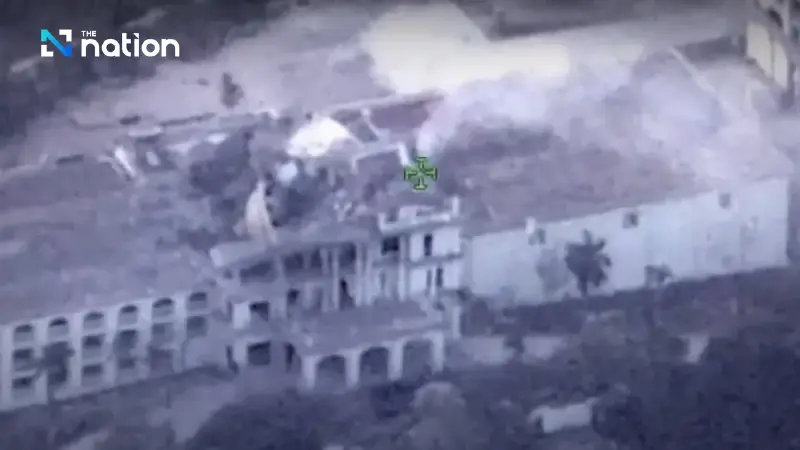


Royal Thai Air Force says F-16s hit three strategic targets in Cambodia near the Chanthaburi–Trat border, destroying two supply bridges and a casino command centre
At a press briefing on December 13, 2025, held at the Joint Press Centre on the Thai–Cambodian Situation at Army TV, Navy assistant spokesman Captain Nara Khunthothom outlined recent operations.
He said the Royal Thai Navy had been operating in two main areas: Ko Yor, Koh Kong province
Cambodian forces had established artillery positions with two 130mm gun batteries on the island, posing a serious threat to Thai naval units.
Thai forces launched an attack to destroy these artillery positions.
“The operation went smoothly,” Nara said, adding that damage assessment flights would follow.
Targets near the Chanthaburi–Trat border
In a second area where Thai positions had come under heavy Cambodian fire from artillery, mortars and BM-21 multiple rocket launchers, it was deemed too dangerous to send in Marine infantry to seize ground.
Thai forces therefore sought to strip away Cambodia’s fire-support capability by calling in air support.
At the request of the Chanthaburi–Trat Border Defence Command, the air force conducted strikes on three strategic targets in two areas:
- Two bridges, including the Chai Chum Nea bridge in Thmoda, Pursat province, which were used as key routes for transporting weapons and reinforcements into the area.
- Thmoda Casino in Ban Nong Ri, which Cambodian forces had converted into a military command and control centre, equipped with systems to manage drone operations and reinforce front-line units.
Nara said the air force struck the main casino building and an adjacent structure, causing such extensive internal damage that the complex could no longer be used as a military headquarters, even if the exterior was not completely flattened.
Precision weapons, delayed fuses
Air force spokesman Air Marshal Chakkrit Thammavichai said the strikes in the Chanthaburi–Trat sector were carried out after continuous fighting overnight and a formal request from the border command.
Because the command centre was located close to civilian areas, the air force used high-precision munitions:
F-16s dropped precision-guided bombs with delayed fuses, he explained.
“When the bomb hits, it does not explode immediately. It penetrates into the structure first and then detonates, blowing outward from inside,” Chakkrit said.
As a result, the glass and internal structures were destroyed from within, leaving the external shell of the building seemingly intact, but with its entire internal framework rendered unusable.
For the bridges, the strikes were carried out in the morning to minimise the risk to civilians who might use them.
“The bridge structures were destroyed to the point that no vehicles can cross — not trucks, not tanks, not any military equipment,” he said.
Chakkrit stressed that the air force is using its capabilities strictly against military targets, employing precision weapons to prevent harm to civilians not involved in the conflict.
“Our operations are based on national defence. We apply the principles of necessity and proportionality in every air strike, to protect the sovereignty of the country and the safety of the people,” he said.
