
Nation Group unveils “Nation Election 2026: The Crossroads”
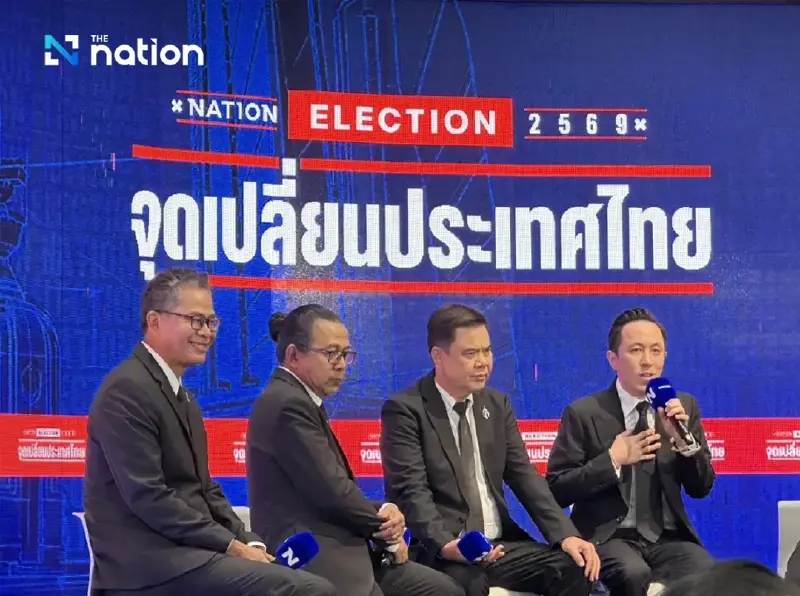


Nation Group launches “Nation Election 2026” campaign, pushing a Clean Election agenda with fact-checking, scrutiny and nationwide forums to boost turnout
- Shine Bunnag led Nation Group in launching the “Nation Election 2026: The Crossroads” campaign ahead of the major 2026 polls.
- The group is promoting a flagship “Clean Election” campaign, calling for transparent, accountable and verifiable politics.
- It says it will act as a watchdog media organisation, delivering facts, scrutinising the election process and encouraging higher voter turnout.
- Nation Group will work with partners to hold travelling forums nationwide and revamp programmes to help voters make informed choices.

Nation Group on Monday, December 15, 2025 announced its “Nation Election 2026: The Crossroads” campaign, bringing together a network of partners and laying out a strategy ahead of what it described as a pivotal election year. The project is anchored in the “Clean Election” theme—“transparent politics, accountability and public scrutiny”—and was launched by Nation Group executives led by Shine Bunnag, chairman of the Executive Committee and chief executive officer, alongside Somchai Meesen and Baakbun Boonlert, both vice-chairmen, and Veerasak Pongaksorn, executive editor.
Shine said 2026 will be an election year, beginning with a general election expected in February 2026, followed by the Bangkok governor’s election, the Pattaya mayoral election and elections for local administrative bodies nationwide. Elections, he said, are at the heart of democracy, giving citizens the right to determine the country’s direction freely and equally. Sovereignty, he added, does not rest with any one individual, but in the hands of everyone.
He said Nation Group has stood alongside Thai society for 55 years and wants to strengthen its role by delivering substantive, useful information to the public and remaining with people through major national moments. An election, he said, is one of the most important such moments, especially given the country’s current challenges.
He pointed to economic problems he described as a prolonged “stuck in the mud” situation, including development issues, GDP performance and deflationary pressures, which he said the public is well aware of. He also cited border tensions as well as broader trade conflicts. On the social front, he pointed to inequality, arguing that politics, the economy and society are interconnected.
Shine said many of the country’s problems stem from political parties and weak politics, noting that Thailand has had three prime ministers in the past two years—making it seem as though the premiership has become something disposable, “used and replaced”.
“This is one of the things we want to campaign on,” he said. “Beyond bringing information to the public, we want this election to be honest, transparent and clean—under the concept we have set: ‘Clean Election’. This election could be Thailand’s crossroads, and we hope it will be a turning point for the better.”
He said Nation Group and its partners had been preparing for some time, and while the launch event may have been somewhat rushed, the goal remains to provide useful information to help people make their choice at the ballot box, build civic awareness and promote clean politics.
In closing, Shine urged people to join the campaign and to vote, saying that even one vote and one voice can be enough to express rights and freedoms and help shape the country’s future. He asked audiences to follow Nation Group’s outlets, saying newsroom and production teams are committed to delivering the most useful information to support public decision-making.
Somchai said media organisations, both in Thailand and abroad, have three core responsibilities during elections.
First, he said, the media must present facts and report events without bias. Regardless of personal preferences, reporting must be accurate.
Second, he said, the media must scrutinise the election. He said a truly clean and fair election is difficult to guarantee, especially where there is what he described as “extra-constitutional power” and control over the Election Commission. Even so, he said, the media must not back down from investigating and exposing the truth.
Third, Somchai said the media must analyse who is likely to form the next government, hold leaders to the “social contract”, and encourage higher voter turnout. He said Thailand has around 50 million eligible voters, but turnout has typically been around 42 million. He said he would like to see turnout rise to about 45 million, arguing that an additional 4–5 million voters could disrupt vote-buying calculations if those attempting to manipulate results assume lower participation.
Veerasak said this election is not a normal one but a contest that will determine the country’s fate. He said he strongly believes there will be large-scale cheating, claiming it could involve money, state mechanisms and independent agencies. He said anti-corruption organisations and private-sector partners have a key mission in this period.
He also raised a procedural concern, saying that if a referendum were to be held alongside the election with a required 60-day period, the previously discussed February 8 date might be too soon and would need to shift by two days. He warned that holding an election on weekdays could reduce turnout—from 40–50 million to potentially 35 million—making outcomes easier to manipulate when fewer people vote.
Veerasak said the “Crossroads” theme matters because even a 0.01% chance of change is still worth hoping for. He argued that without hope and dreams, people would lose the will to go on, and said the election could be a decisive moment for Thailand.
He said concerns about electoral manipulation stem from both external and internal factors. Externally, he cited global economic pressures and the Thailand–Cambodia conflict, arguing that major powers may also exert influence and that, historically, external forces have played roles in shaping Thai governments. He said such pressures could affect the election as well.
Internally, Veerasak said the election reflects an intense struggle among two or three power blocs, where defeat is not an option. He claimed that those who lose could be pushed “off the board”, including imprisonment, as seen in earlier cases, and said elite competition is especially fierce this time. He argued that, in the past, elites might compromise while ordinary people suffered the consequences—but now, he said, the contest is more ruthless, with power seen as essential to hold at all costs.
He went further, warning that some actors may pursue any path to retain control—holding an election if they can “control the game”, or even avoiding an election if they can do so—suggesting the situation is extremely volatile.
Baakbun said Nation Group’s core intent is reflected in its ten media brands working together. He said elections in a democracy are the “least worst” system, but that after elections, hopes often shift away from the people—who hold sovereignty—into the hands of representatives.
He said Nation Group has spent around three months preparing to enter “election mode”, recognising that one hand cannot change the system alone, but many hands working together can be powerful, even if the change is small. He said the group aims to “spark a light” at a time when society feels dark, so people can see the possibility of a better future.
Baakbun said Nation Group’s role is to carry the message, help spark scrutiny and report problems to the public so social power can gather. He argued that if many organisations work together, the push for cleaner politics will be stronger.
He said the initiative goes beyond campaigning. Nation Group plans a nationwide roadshow of public forums across the country—North, Central, Northeast, South and East—culminating in a major event in Bangkok. The aim, he said, is to bring political parties and candidates to meet voters directly, giving people clearer context before they enter the voting booth and hand power to representatives.
He added that programming will be adjusted for the election period, not only to give candidates space to present their visions, but also to encourage civil society and organisations to help drive ideas through Nation Group’s platforms. He said Nation TV will be a main engine of the effort, with other outlets coordinating alongside it.
Baakbun said Nation Group also plans a “Nation Election: The Crossroads Special” format every Friday, described as a coffeehouse-style discussion, to widen public access to information and support voter decision-making.
He said the group’s broader goal is to build a nationwide network of partners to campaign for a “clean” election and “white” politics. He acknowledged that real life is never perfectly “white” because people are complex, but argued that a better society is possible than allowing “black and grey” politics to dominate.
He said that through Nation Group’s platforms and collective effort, the public can help drive a more transparent and accountable political system—one that can be meaningfully scrutinised by society—and move Thailand forward.
