
KK Park–Shwe Kokko brought down: three countries join forces to wipe out call-scam hubs


Thailand, China and Myanmar launched a joint crackdown on KK Park and Shwe Kokko scam hubs, with demolitions and plans to speed up repatriations

On Monday, December 15, 2025, the Royal Thai Police’s Anti Cyber Scam Center (ACSC), led by Pol Lt Gen Jirabhop Bhuridej, Assistant Police Chief and Deputy Director of the force’s cyber operations centre, travelled to Mae Sot district in Tak province to coordinate with Myanmar authorities in what was described as the largest cross-border crime crackdown to date. The Thai delegation was joined by Liu Zhongyi, Assistant Minister of Public Security of the People’s Republic of China, and his team.

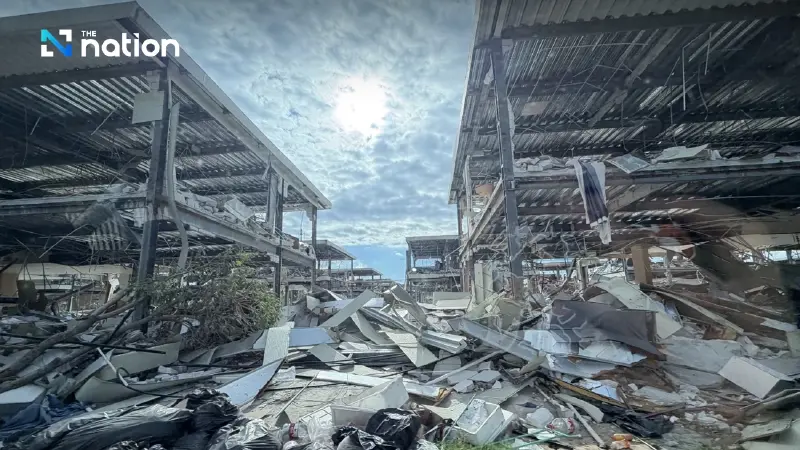
Images of a “nest raid”: scammer towers reduced to rubble
A key element of the operation was Myanmar security authorities escorting Thai and Chinese officials to inspect two primary target locations: KK Park and Shwe Kokko, described as major bases used by call-scam networks that have defrauded victims worldwide.
Officials said that high-rise buildings and offices previously used as scammer hideouts had been demolished permanently, leaving empty lots and ruins. This, they said, reflected a serious effort to “uproot” the networks by removing locations that could be used again as operational bases, disrupting the activities of Chinese grey networks and scam operatives targeting multiple countries.

At 2.20pm, a trilateral meeting was held at the Second Thai–Myanmar Friendship Bridge meeting room on the Myanmar side. The meeting brought together Pol Lt Gen Jirabhop and his delegation (Thailand), Pol Maj Gen Min Htike Myo, Deputy Commander of Myanmar Police, and his delegation (Myanmar), and Liu Zhongyi and his delegation (China). The three sides agreed on a set of decisive measures.

Thailand said it will use the Anti Cyber Scam Center (ACSC) as a central mechanism for information exchange among the three sides. They also proposed establishing a joint task force to share information and evidence and expand investigations together within 24 hours, stressing the principle that “crime has no borders, and enforcement must have no borders”. Cooperation, they said, must be fast, unrestricted and continuous.
The three sides also reaffirmed continued coordination to cut off key enabling factors for criminal networks in border areas, such as electricity and internet signals.
In addition, they agreed to cooperate on facilitating and streamlining procedures for transferring foreign nationals who have fled from Myanmar back to their home countries, so the process can move more quickly, reduce the burden on Thai officials, and improve safety for both foreign nationals and personnel involved.
Detentions and transfers
Following the demolition of buildings and strongholds, Myanmar authorities reportedly arrested a large number of Chinese scam operatives attempting to flee the KK Park and Shwe Kokko areas. Liu Zhongyi and his delegation visited a holding facility in Myawaddy, which officials said is currently full of Chinese suspects being detained pending transfer back to face legal proceedings in China.
The operation was presented as a clear warning that border areas will no longer serve as a “safe zone” for criminals, as tangible results emerge from coordinated action by the three countries.

