
Royal Rainmaking Fleet Mobilised as Toxic Smog Grips Bangkok
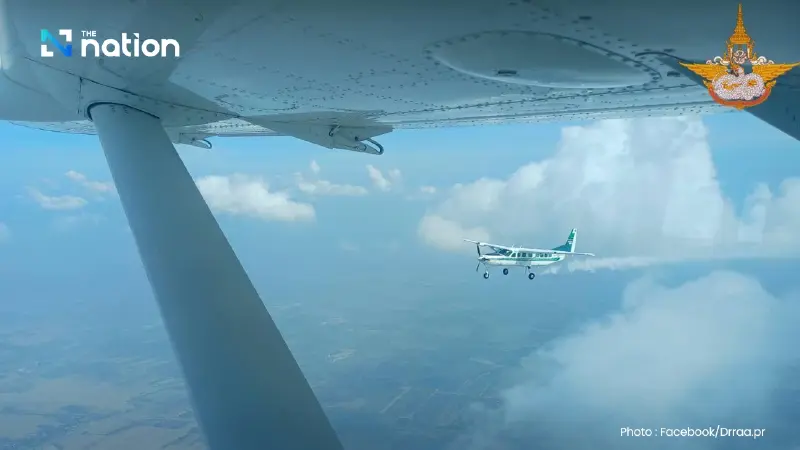


The Department of Royal Rainmaking and Agricultural Aviation has launched emergency flights to disperse PM 2.5 particles as air quality reaches hazardous levels
- Thailand's Royal Rainmaking fleet has been deployed to combat hazardous levels of PM 2.5 smog that have surpassed the national safety threshold in Bangkok.
- The operation involves aircraft from multiple airbases using cloud-seeding and dry ice seeding techniques to disperse the fine dust particles.
- The severe pollution is attributed to a combination of stagnant weather conditions trapping pollutants and an increase in agricultural burning.
- Authorities have increased flight frequency and are prepared to authorize additional night-time missions if the air quality does not improve.
The Department of Royal Rainmaking and Agricultural Aviation has launched emergency flights to disperse PM 2.5 particles as air quality reaches hazardous levels.
Thailand’s cloud-seeding authorities have ramped up emergency operations today, deploying a fleet of aircraft to clear a thick blanket of PM 2.5 pollution currently choking the capital and its surrounding provinces.
Rachen Silparaya, director-general of the Department of Royal Rainmaking and Agricultural Aviation (DRRAA), announced this morning that fine particulate matter levels have surpassed the national safety threshold of 37.5 µg/m³.
Air quality sensors are now flashing orange and red, indicating levels that range from "unhealthy" to "hazardous" for the general public.
The current crisis is being driven by a "closed" atmosphere and poor ventilation, which has trapped pollutants near the ground.

A rise in regional hotspots—primarily agricultural burning within Thailand and neighbouring countries—has further exacerbated the accumulation of smog.
In response, Rachen has ordered an immediate increase in flight frequency across several key airbases.

The department’s tactical response includes:
The Southern Front: Four aircraft from the Hua Hin base are currently operating over Ratchaburi and Samut Songkhram, utilising dry ice seeding techniques at 7,000 feet to break up the dust.
The Eastern Front: The Rayong base has seen its fleet bolstered to three aircraft, focusing on cloud-seeding to absorb pollutants between Prachin Buri and Nakhon Ratchasima.
Expansion to the North-East: Operations are set to commence in Khon Kaen tomorrow (15 January) to provide relief to residents in the Northeast.

"We are monitoring the situation around the clock," Rachen stated. "If air quality does not show significant signs of improvement, we are prepared to authorise additional night-time sorties to maximise the dispersal of these particles."

Health officials have advised residents—particularly "at-risk" groups such as children, the elderly, and those with respiratory conditions—to limit time spent outdoors and avoid strenuous exercise.
The public has been urged to wear high-filtration masks whenever they are outside.
While rainmaking bases in the north (Tak and Phitsanulok) are not scheduled to be fully operational until 1 February, the Director-General assured the public that resources are being diverted where they are most urgently needed.
