
Ekniti in Davos: Thailand pitches neutrality and smart tech, EVs, food, wellness
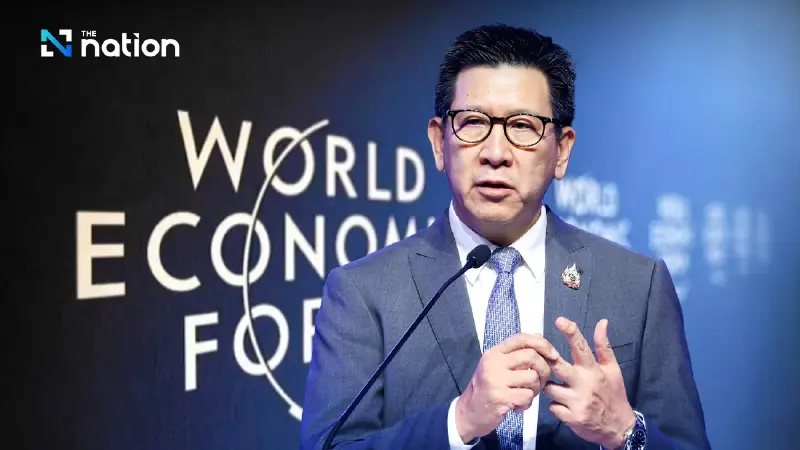


At WEF Davos 2026, Ekniti pitched Thailand’s “New Growth Pathways”, stressing geopolitical neutrality to draw investors into 4 target sectors.
Deputy Prime Minister and Finance Minister Ekniti Nitithanprapas attended the World Economic Forum (WEF) Annual Meeting 2026 in Davos, Switzerland, to announce Thailand’s “New Growth Pathways” strategy—highlighting the country’s strength in geopolitical neutrality and urging global investors to use Thailand as a production base.
The WEF Annual Meeting 2026, held in Davos from 19–23 January 2026, was described as an important platform for Thailand to showcase its role internationally. Ekniti led the “Team Thailand” delegation, together with the commerce minister, representatives from the Ministry of Foreign Affairs, and Thai business leaders, to send a clear signal to the global community that Thailand is ready to become a new economic hub in ASEAN.
In a special interview with Krungthep Turakij during the event, Ekniti referred to the vision he presented at the session “New Growth Pathways in ASEAN.” He said that amid a storm of global geopolitical conflict, Thailand has become a “safe haven” for investors, thanks to its geopolitical neutrality—an advantage that supports Thailand’s potential as a manufacturing base for exports to China, the United States and Europe.
This, he said, was reflected in applications for investment promotion submitted to the Board of Investment (BOI), which he said grew by more than 90% last year.
“Thailand has geopolitical neutrality. This makes Thailand and ASEAN strong amid the crisis in global politics. They see ASEAN as a source of opportunity,” Ekniti said.
Four strategic industries in focus
On investment opportunities, Ekniti said priority is being given to four strategic industries in which Thailand stands out and has attracted particular investor interest:
- Smart electronics – especially the printed circuit board (PCB) industry, which currently includes more than 200 investment projects with a total value of 300 billion baht.
- Food and bio-industry – with significant opportunities to build on Thailand’s upstream agricultural base and move into pet food and bio-solutions.
- Electric vehicles (EVs) – Thailand’s existing automotive strength, alongside support for a transition towards becoming a regional EV hub.
- Wellness services – health-related services, using public health soft power to create economic value.
He added that there had also been discussions with UpLink, the WEF’s start-up promotion arm, on co-hosting an event to showcase the potential of Thai start-ups—particularly in the four target industries mentioned above.
Stepping up clean energy and people skills
Ekniti acknowledged that although Thailand is attracting investor interest, major challenges must be addressed urgently to maintain competitiveness:
- Green electricity – accelerating investment in clean energy to respond to the European Union’s Carbon Border Adjustment Mechanism (CBAM) rules.
- UpSkill/ReSkill – upgrading Thai workers’ skills in digital and AI to compete with rivals such as Vietnam.
- Accelerating free trade agreement (FTA) negotiations – especially with the European Union, noting that Thailand currently has FTAs with only 17 countries, which he said is still too few.
- Regulatory reform – improving rules and procedures that have been obstacles, to make investment easier.
‘Saraburi model’ showcased to the world
Ekniti said that as global industrial structures shift towards clean energy, Thailand has presented the “Saraburi model”—a collaboration project involving the state, SCG, and local communities in Saraburi, where cement plants are located.
The project features comprehensive ESG development and community participation, producing green cement to cut carbon emissions while generating income for local areas—an example of adaptation towards a green economy.
Domestic politics will not affect investment
Ekniti said that although Thailand currently has a caretaker government during the election period, the fundamentals of the Thai economy remain strong. The private sector continues to invest, and many political parties share a focus on policies to strengthen national competitiveness—seizing opportunities from global change and sustainably improving people’s quality of life.
He added that what is visible at the WEF is that global rules have shifted significantly due to geopolitical conflict, weakening multilateral frameworks such as the United Nations (UN), the World Trade Organization (WTO) and the World Health Organization (WHO)—but one major opportunity lies in ASEAN, he said.
Thailand’s expanded international role
Ekniti said Thailand’s international role in 2026 will be significant, including serving as chair of ASEAN’s Digital Economy Framework Agreement (DEFA) to shape digital rules and AI governance.
Thailand is also preparing to host the IMF–World Bank Group Annual Meetings in October 2026, under the concept “New Horizons: Empowering People and Building Resilience,” to demonstrate its potential as a regional financial hub.
On 20 January 2026, Ekniti met Mathias Cormann, Secretary-General of the Organisation for Economic Co-operation and Development (OECD), to accelerate Thailand’s membership process—aimed at raising governance and transparency to global standards and strengthening long-term investor confidence.
He also met Paul Chan Mo-po, Hong Kong’s Financial Secretary, on 21 January 2026 to discuss cooperation on financial market connectivity and attracting Hong Kong capital to invest in data centres, logistics and advanced technology.
In addition, he exchanged views with Christopher J. Elias of the Gates Foundation on the success of Thailand’s universal health coverage system and preparedness for public health emergencies in the region.
