
Commerce Minister takes DEFA to WEF Davos, pitching ASEAN’s digital economy pact as a model for modern trade rules
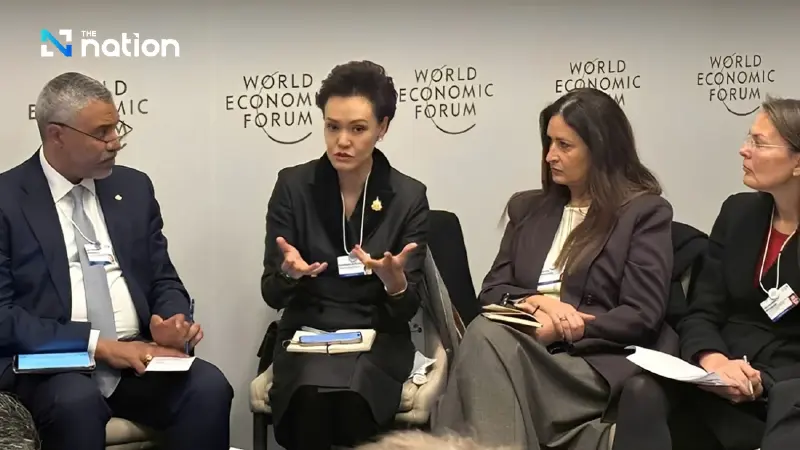


Commerce Minister Suphajee Suthumpun joined WEF Davos 2026 to promote ASEAN’s Digital Economy Framework Agreement (DEFA) as a template for interoperable trade and data rules, aimed at boosting digital trade, supporting SMEs and advancing sustainability.
Commerce Minister Suphajee Suthumpun joined the World Economic Forum (WEF) Annual Meeting, held from January 19-23, 2026, saying she participated as a panellist in a discussion titled “Recoding Trade” at Kurpark Village in Davos-Klosters, Switzerland. The session was a closed session, allowing participants—ministerial-level representatives, senior private-sector executives and international organisations—to exchange views candidly on how to upgrade trade rules and trade infrastructure to keep pace with technological change.
The discussion focused in particular on digital technology, artificial intelligence (AI), cross-border data flows, and the creation of resilient and sustainable supply chains, as well as the digital economy and the Sustainable Development Goals. Other participants included the trade ministers of Canada, the United Arab Emirates, Ukraine and Zimbabwe, as well as executives from organisations such as the World Customs Organization and the OECD.

Suphajee presented ASEAN’s role in developing an interoperable trade and data framework that is balanced, open, flexible and enhances competitiveness. She said Thailand is chair of the negotiating committee for the ASEAN Digital Economy Framework Agreement (DEFA), which is expected to become the world’s first regional digital economy agreement and reflect ASEAN’s growing role.
She said DEFA will serve as an important foundation for promoting digital trade and investment, improving inclusion and reducing economic inequality, alongside strengthening digital governance. Progress towards digitalisation across multiple areas will also support small and medium-sized enterprises (SMEs).
She added that DEFA will help advance sustainability and environmental friendliness, and that ASEAN is ready to expand DEFA linkages with other countries and regions in the future.

Suphajee told the meeting that Thailand’s role as chair of the DEFA negotiations since 2023 has highlighted the potential of ASEAN as a group of developing countries to build modern trade and data frameworks suited to the region’s context in the digital era.
She said DEFA aims to strengthen supply-chain resilience, promote digital system interoperability, and ensure a balanced approach to personal data protection, privacy and cyber security, while designing rules that enable SMEs to access and use the framework effectively.
She said ASEAN’s digital framework would also enhance the region’s competitiveness through the development of common digital standards, the promotion of innovation, digital skills development, and the use of digital technology to support SMEs—alongside consumer protection, lower trade costs, and capacity-building across both the public and private sectors. It would also link the digital economy with sustainability goals and the green economy.
Suphajee stressed that “recoding” the global trading system is not only about revising rules, but about building a trading system that is open, inclusive, flexible and sustainable. She said Thailand is ready to work with international partners to drive a global trading system that supports development, innovation and shared long-term growth.
During the Davos meeting, the commerce minister is also scheduled to meet trade ministers from countries including Canada, Switzerland and the United Arab Emirates, and to join several other discussions—part of efforts to reinforce Thailand’s role on the international stage.
She said the work is being carried out alongside Team Thailand, including Ekniti Nitithanprapas, Deputy Prime Minister and Minister of Finance, and Sihasak Phuangketkeow, Minister of Foreign Affairs.
