
Govt updates royal crematorium plans for the Queen Mother
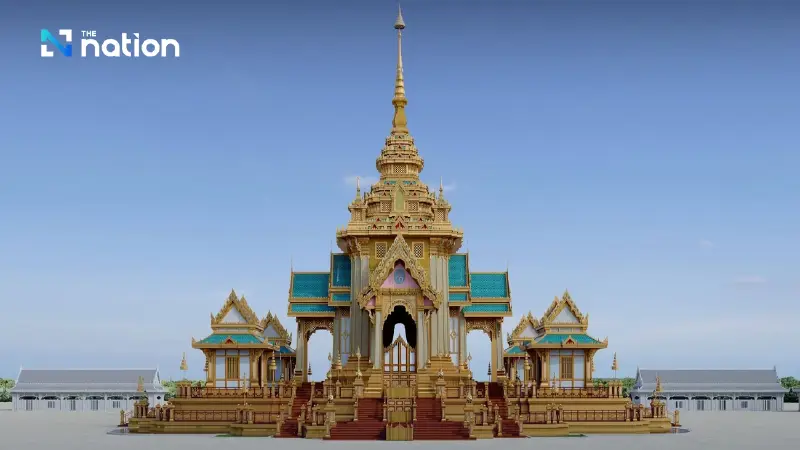


Construction of the royal crematorium for Queen Sirikit The Queen Mother will start in February and finish in October 2026
On January 26, 2026, at Government House, Prime Minister Anutin Charnvirakul, who is also Minister of the Interior, gave an update on the construction of the royal crematorium (Phra Merumas) and related ceremonial structures for the Royal Cremation Ceremony for Her Majesty Queen Sirikit The Queen Mother.

Anutin said the passing of Her Majesty Queen Sirikit The Queen Mother on October 24, 2025 brought profound sorrow to people across the country, in remembrance of Her Majesty’s immense grace and dedication to the nation and her subjects throughout her life.
The government, as a representative of the Thai people, has appointed an organising committee to ensure the Royal Cremation Ceremony is carried out in accordance with ancient royal tradition and with full royal dignity in every respect. The government has respectfully invited Her Royal Highness Princess Maha Chakri Sirindhorn to serve as an adviser to the organisation of the Royal Cremation Ceremony.
The government has assigned the Ministry of Culture, through the Fine Arts Department, to design and construct the royal crematorium and associated structures; to restore and refurbish the royal chariots and the royal palanquin; to design the sandalwood royal coffin and urn; and to prepare ceremonial offerings for the Royal Cremation Ceremony.
His Majesty the King has granted royal approval for the construction to proceed in accordance with the design presented by the government.

For the crematorium design, the Fine Arts Department has adhered to principles that ensure full compliance with royal tradition, while also achieving artistic beauty reflecting Her Majesty’s royal conduct and benevolence towards the Thai people. The uppermost section is designed as a crown-transformed form, based on royal head ornaments, with a seven-tiered roof structure comparable in rank to royal halls within the Grand Palace.
The finial at the peak is in the form of a Brahma face, symbolising the ascent to the Brahma realm following the passing, and also reflecting the royal epithet “Mother of the Land”, in recognition of Her Majesty’s royal duties akin to a mother caring for her children. The very top is adorned with the Nopphadon Maha Sawet Chatra (the nine-tiered white umbrella), signifying the highest royal status.
The crematorium follows a square plan in a prang-style pavilion form, with projecting porches on all four sides, set upon a two-tiered base platform decorated with deities symbolising the ascent to the heavenly realm. The roof is in muted blue, alternating with iridescent beetle-wing tones. Each gable is decorated with Her Majesty’s royal monogram “S.K.” on a blue background, the colour associated with Friday, Her Majesty’s day of birth, with a pink background, regarded as an auspicious colour for the day of birth.
The gable pediments are designed in the style of a nang niche, inspired by the form of a crown and the royal necklace worn during Her Majesty’s lifetime. Decorative motifs for the crematorium draw inspiration from various plants associated with the name “Sirikit”.
The cremation screen (the fire-shielding backdrop) will be embroidered by artisans of the Sirikit Institute, an institution established under Her Majesty’s royal patronage and benevolence.

The landscape surrounding the crematorium will be arranged in accordance with a cosmic realm concept, featuring circular ponds and decorations of Himmapan creatures and characters from the Ramakien, reflecting Her Majesty’s role in conserving the classical Khon performance tradition.
Additional structures accompanying the crematorium will include the Phra Thinang Song Tham, the Sala Luk Khun, the Thap Kaset, and pavilions for royal presence and for receiving diplomats and guests attending the ceremony.

The Ministry of Natural Resources and Environment has delivered fragrant sandalwood for the construction of the sandalwood coffin and sandalwood urn to the Fine Arts Department’s traditional crafts division, which is currently expanding patterns and decorative designs for production.
The urn for the royal relics is to be made of gold, enamelled in Ratchawadi style and set with gemstones, in an eight-sided form with a crown-shaped top, following long-established royal tradition.
In addition, His Majesty the King has graciously ordered the creation of ceremonial gifts to be bestowed upon royal monasteries and religious sites. These include sets of altars, book cabinets, desks with bookshelves and chairs, produced in four designs, as well as lamps.
Construction of the royal crematorium is scheduled to begin in February and is expected to be completed in October 2026. The government will then respectfully submit an update for royal consideration, in order to proceed with determining the date for the Royal Cremation Ceremony.

