
Nine small quakes shake Surat Thani over two days, expert urges monitoring
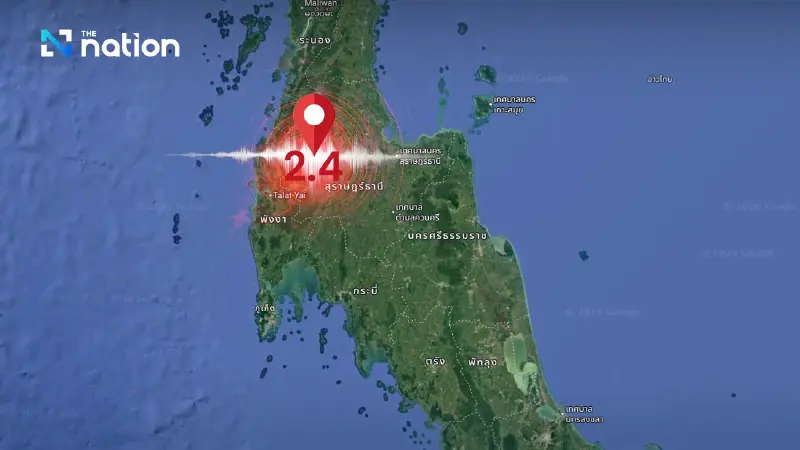


Nine minor earthquakes hit Surat Thani on February 11–12, linked to the Khlong Marui Fault; an expert says buildings are unlikely to be affected.
Following a series of nine earthquakes in Surat Thani province between February 11–12, Prof Dr Amorn Pimanmas, president of the Thailand Structural Engineers Association (TSEA) and a lecturer at the Faculty of Engineering, Kasetsart University, explained that the tremors were minor, measuring 1.9–3.2 in magnitude.
He said quakes of this size can be felt by the public but do not affect building structures. Earthquakes likely to impact buildings are typically of moderate strength, starting from magnitude 4–5 and above, depending on the building’s structural integrity.
Regarding this cluster of tremors, Amorn said they were caused by the Khlong Marui Fault, one of Thailand’s 16 active faults. The Khlong Marui Fault affects not only Surat Thani but also Krabi, Phang Nga and Phuket.
However, in this case, the epicentres were located in Surat Thani, so ground shaking was felt mainly in the province.
He added that Surat Thani is classified as “Zone 1” under the 2021 ministerial regulation on load-bearing capacity, resistance and durability of buildings and the ground supporting them for earthquake resistance.
This zone is considered a surveillance area because there is a possibility that buildings could be affected by ground shaking. Zone 1 covers Krabi, Chumphon, Phang Nga, Trang, Nakhon Phanom, Nakhon Si Thammarat, Bueng Kan, Prachuap Khiri Khan, Phitsanulok, Phetchaburi, Loei, Songkhla, Satun, Surat Thani and Nong Khai.
Earthquakes have occurred in this zone in the past, but they have not affected building structures.
However, although Zone 1 is less likely to experience earthquakes than Zone 2 (Bangkok and its vicinity) and Zone 3 (the North and the West), authorities still need to monitor seismic activity along the Khlong Marui Fault to see how it may develop in the future.
Buildings and homes subject to the ministerial regulation should also be designed to withstand earthquakes at an appropriate level.
