
Nam Hom coconut prices fall; Suphajee orders action, nominee checks, export push
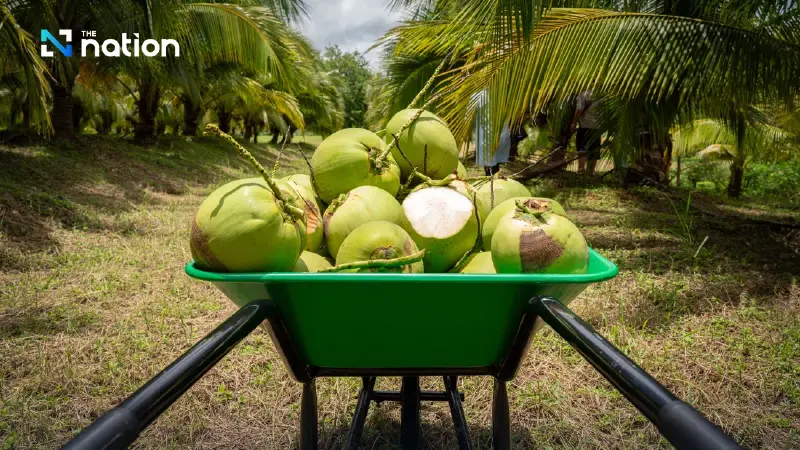


Commerce Minister orders urgent action on falling Nam Hom coconut prices, cracks down on nominee firms and expands new export markets
Commerce Minister Suphajee Suthumpun has ordered officials to closely monitor and address the sharp fall in Nam Hom (aromatic) coconut prices, urgently assisting farmers and entrepreneurs with measures covering the full supply chain, from upstream to downstream.
Suphajee said the Ministry of Commerce has been closely tracking the price slump and has instructed relevant agencies to step in quickly to help farmers and businesses. She said the ministry has already rolled out comprehensive support measures, from upstream to downstream, to shore up Nam Hom coconut prices since July 2025.

Nantapong Chiralerspong, Director of the Trade Policy and Strategy Office (TPSO) and spokesman for the Ministry of Commerce, added that, following the minister’s instruction, ministry agencies have integrated their work and coordinated with relevant bodies to tackle the low-price problem. Key actions are as follows:
Domestic market
The Department of Internal Trade has continued its work, divided into three phases:
1. First round of low prices: Continuous absorption of output totalling 830,000 coconuts (July–September 2025), including opening purchase points offering prices above the market in Bang Phae district, Ratchaburi province, setting up sales points, and organising pre-order and CSR activities with major private-sector companies and government agencies.
2. Second round of low prices: Absorption of output totalling 460,000 coconuts (November–December 2025) through linking provincial commerce mechanisms between source and destination provinces, ordering via the MOC GO app, linking coconuts directly from farmers to petrol stations (PT, Susco, PTT and Bangchak) in Bangkok and surrounding areas to distribute coconuts in place of drinking water, and public relations to build awareness and campaign for increased consumption through MasterChef Thailand Season 7.
3. Third round of low prices: A target to manage 1 million coconuts (late January 2026 to present) by opening purchase points offering above-market prices in four key producing provinces—Ratchaburi, Samut Sakhon, Samut Songkhram and Songkhla—and opening Nam Hom coconut sales points in Bangkok and surrounding areas.
This also includes, at Thong Fah (Blue Flag) fairs, accelerating efforts to bring in modern trade operators, wholesale markets and fresh markets to buy coconuts for sale through shops and markets nationwide, and coordinating with private companies to purchase Nam Hom coconuts from farmers through CSR activities.

Export market
The Department of International Trade Promotion will push exports of Thai Nam Hom coconuts to markets beyond China (the main market), such as the Middle East, Europe and the United States, with year-round plans to promote Nam Hom coconuts through various activities.
In the near term, a business-matching event for fresh fruit, processed fruit and other agricultural products (7th year) will be held on March 5, 2026 at the Hyatt Regency Bangkok Sukhumvit. Commercial counsellors have invited importers from around the world to join trade negotiations both offline and online. Initially, 101 exporters are expected to participate, including 38 coconut exporters.
Import controls
Authorities are regulating and controlling coconut imports (both mature coconuts and young coconuts) to prevent impacts on domestic farmers. Import management measures follow resolutions of the Oil Crop and Vegetable Oil Committee, including import measures under WTO agreements and AFTA agreements, as well as measures designating import checkpoints.
Under all agreement frameworks, coconut imports are permitted at only two checkpoints: Bangkok Port Customs Office, and Laem Chabang Port Customs Office, to prevent illegal coconut smuggling.
Because most coconut imports are outside the WTO quota (with no restrictions on volume and import timing), the Department of Foreign Trade has added measures to control imports during periods when domestic output enters the market in large quantities, including:
- Requesting cooperation from coconut processing factories to delay importing coconuts and coconut products from abroad, and to purchase coconuts from domestic farmers at appropriate prices.
- Since January 1, 2023, requesting cooperation from operators to submit written explanations of the necessity for imports and to purchase coconuts from domestic farmers at appropriate prices before import approval is granted for WTO out-of-quota imports.
Checks on “middleman” businesses and possible nominee structures
On inspections of coconut “middleman” businesses (packing houses/collection centres) that may involve nominee structures and violations of relevant laws, the Department of Business Development, together with relevant agencies, has made two field visits in Ratchaburi, inspecting three coconut packing houses and four companies that may have characteristics consistent with nominee arrangements.
It has also inspected 217 risk-group companies in Ratchaburi in which foreigners hold shares below 50% (and which therefore still have Thai status), and checked land holdings of five rai or more in Ratchaburi and Samut Sakhon.
The inspections found three companies with foreign shareholders holding land across three plots. Further in-depth checks are under way and relevant action will follow. Authorities are also scheduled to visit Ratchaburi to inspect foreign capital engaged in Nam Hom coconut farming, which is an offence under the law governing foreign business operations. Enforcement will be carried out intensively and decisively to ensure fairness for farmers and to protect the local economic system.
Value-added and GI development
The ministry is also prioritising value creation to upgrade Nam Hom coconuts—an emblematic community product—into a high-potential economic product through Geographical Indication (GI) registration. The Department of Intellectual Property has continued this work while also pushing and supporting farmers and GI entrepreneurs to expand marketing channels so they can reach consumers across diverse markets in tangible ways.
At present, there are four Nam Hom coconut products registered as GI products:
- Ratchaburi Nam Hom coconut
- Ban Phaeo Nam Hom coconut
- Bang Khla Nam Hom coconut
- Sam Phran Nam Hom coconut
Most recently, on February 18, 2026, “Ratchaburi Nam Hom coconut” was registered as a GI product in the European Union. This is expected to help expand export markets and raise the quality of Thai Nam Hom coconuts to gain international recognition, creating new long-term trade opportunities.
The ministry spokesman said the Ministry of Commerce is preparing several additional measures to care for Nam Hom coconuts, with year-round promotional plans to ensure surplus output has clear market outlets. The ministry will continue to closely monitor and watch prices for Nam Hom coconuts, as well as other agricultural products.
