
Arrest warrant for Ben Smith rattles Thai elite amid Bt1bn fraud probe
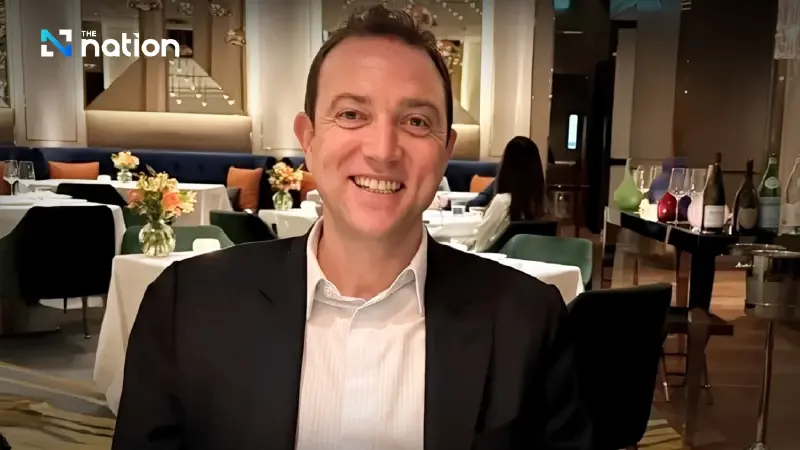


Thai police seek Ben Smith and wife over alleged Bt1bn transnational investment fraud and money laundering, as photos with elites spark scrutiny
An arrest warrant for “Ben Smith” has become a major political story, sending a chill through political circles after the Central Investigation Bureau (CIB) investigated the case and secured warrants for two suspects: 1) “Ben Smith” (Mr Ben Smith), also identified as Benjamin Mauerberger, and 2) his wife, Katreeya Beaver.
The pair are accused of jointly committing fraud, conspiring—by agreement between two or more people—to commit money laundering, committing money laundering as a result of that conspiracy, and jointly laundering money, with alleged damages amounting to more than a billion baht.
The CIB’s case file summarises that media reports have described the backgrounds of Ben Smith and Katreeya Beaver, stating that Smith is a foreign businessman whom Thai reports say US authorities have categorised as a high-risk individual allegedly linked to international scammer networks and money laundering.
Katreeya Beaver, Smith’s wife, has been reported as a major shareholder in several Thai listed companies, including Bangchak Corporation Plc (BCP).
Thai reports say that in December 2025, relevant agencies seized and froze assets under anti-money laundering law, and authorities believe the wider network may involve other offences.
The CIB therefore ordered the establishment of an investigative team to examine the conduct of Ben Smith and associates.
The investigation found foreign investors who said they had suffered losses from cross-border investment fraud and filed complaints with the CIB.
Police say Smith and his wife allegedly deceived victims into investing across multiple projects—stocks, real estate, a private jet, and energy businesses—using various methods to build credibility, causing losses of more than Bt1 billion.
According to police, the circumstances leading to the investigation began in early 2016, when a foreign investor sought to expand investment into Thailand and met Ben Smith, who presented himself as an expert and offered investment advice in the Thai stock market.
At the outset, Smith allegedly introduced businesspeople and politicians to co-invest in shares of QTC Energy Public Company Limited, and the investment did take place, leading the victim to trust him.
Police allege that Smith later persuaded the victim to invest Bt700 million in Pace shares, with Pace’s owner signing loan agreements and issuing cheques guaranteeing returns of 7% and 11%, totalling about Bt762 million, to build confidence.
Katreeya Beaver was described as managing this investment for more than one year.
Police also allege that Smith used this opportunity to propose buying a private jet priced at Bt255 million for both leasing and personal use, and obtained a Bt21 million deposit from the victim.
The following month, police say Smith used the victim’s interest in electricity investments to obtain another Bt126 million, claiming it would be used to partner with Thai investors to do business linked to the Electricity Generating Authority of Thailand (EGAT).
The victim later found that the Pace shares showed no movement as agreed. People in Smith’s network then allegedly proposed paying deposits for seven condominium units plus built-in fittings worth Bt144 million, claiming the units would be decorated and sold so the victim could recover funds along with higher returns than initially agreed.
However, by 2022 the victim still had not received delivery of the units. When the victim pursued the matter, there were delays and evasions, and the victim later learned all units had been transferred to other individuals, realising they had been deceived.
Investigators say evidence indicates Smith and his wife repeatedly obtained assets from the victim by claiming various businesses, continuously and on multiple occasions, but did not use the money as initially agreed—conduct police describe as fraud as a habitual business practice.
At this stage, police sought court approval for arrest warrants for Smith and his wife on charges of joint fraud and money laundering. Police also obtained six search warrants for locations in central Thailand to gather documentary and other evidence and identify individuals and legal entities linked to the case.
On February 27, 2026, investigators searched the targeted locations and seized 13 additional items of evidentiary value, mostly computers and electronic devices.
The case remains under review as authorities examine evidence and expand the investigation.
The CIB has also coordinated with AMLO to report the money-laundering predicate offence for inclusion, with the predicate conduct dating back to 2016 and alleged damages of more than Bt1 billion, to support asset seizure and freezing actions linked to the network.
A further point of interest in Thai reporting is that “Ben Smith” was recently linked by Tom Wright, a Pulitzer Prize-winning US investigative journalist, to claims that he is a South African–Cambodian businessman allegedly acting as a coordinator with scammer networks connected to neighbouring countries.
Smith has also appeared in photos with several prominent Thai figures, including Prime Minister Anutin Charnvirakul, former army commander Gen Apirat Kongsompong (known as “Big Daeng”), and Finance Minister Ekniti Nitithanprapas.
Thai reporting has also raised questions about business dealings connected to former prime minister Thaksin Shinawatra, with images showing Capt Thammanat Prompao—Agriculture and Cooperatives Minister and chief adviser to the Kla Tham Party leader—also appearing in the same frame.
There have also been images of Thammanat with Prasert Jantararuangtong (when he served as Digital Economy and Society Minister) and Smith, linked to an MoU with a Singapore private firm on an iris-scanning project currently being examined by the Department of Special Investigation (DSI).
However, individuals appearing in photos with Smith have denied any personal relationship, saying they did not know him or were not close to him.
Smith’s name also appeared in media coverage ahead of the 2026 election, after claims circulated that Suriya Juangroongruangkit, a leading figure in Pheu Thai, had purchased a private jet from Smith’s network for several hundred million baht.
The claim was later clarified, with reports saying Suriya co-invested with relatives, contributing about Bt30 million, while the remainder came from his brother Komol Juangroongruangkit and other family members.
Thai political commentary has suggested that state action—ranging from AMLO’s move to the Civil Court, resulting in an order for temporary asset freezing worth around Bt13 billion across the wider network, to the CIB’s arrest warrants over alleged Bt1 billion investment fraud—could be interpreted as pressure aimed at unidentified political actors.
This portion of commentary is speculative and not presented as an established fact.
Asked about the case on March 2, 2026, Prime Minister Anutin said it was part of continued government policy targeting scammers, “grey capital”, call centres and money laundering.
He said he focused on conduct, not names, and that anyone breaking the law and harming the public or the economy must face consequences.
He added that recent court asset-freezing orders against economic criminals—both foreign and Thai—have strengthened the confidence of operational agencies such as AMLO to crack down on illegal financial transactions.
He said this demonstrates that no influence is above the law and shows the public the government does not side with lawbreakers but supports enforcement agencies.
Asked whether there were reports of politicians or important figures being involved, Anutin said he had not interfered and would only be briefed once operations were completed.
He said he did not want to know who might be within scope because it could spark rumours that he was intervening.
He said his approach was to empower operational agencies to act fully, with a clear instruction: anyone who breaks the law will not be spared, no matter who they are.
On whether the case could cause political turbulence, given claims of links to some party figures, Anutin said he was not concerned about “ripples”, adding that public hardship and national damage matter more than government formation dynamics or deference to any influential figures.
While many of those pictured with Smith deny personal ties, Thai reporting argues that Smith’s presence alongside senior figures and his business dealings with networks of politicians and businesspeople reflect a complex web of influence that may have been used to build credibility and persuade victims to invest across multiple ventures—leading to losses of more than a billion baht.
