
Sihasak denies report US sought U-Tapao as military base against Iran
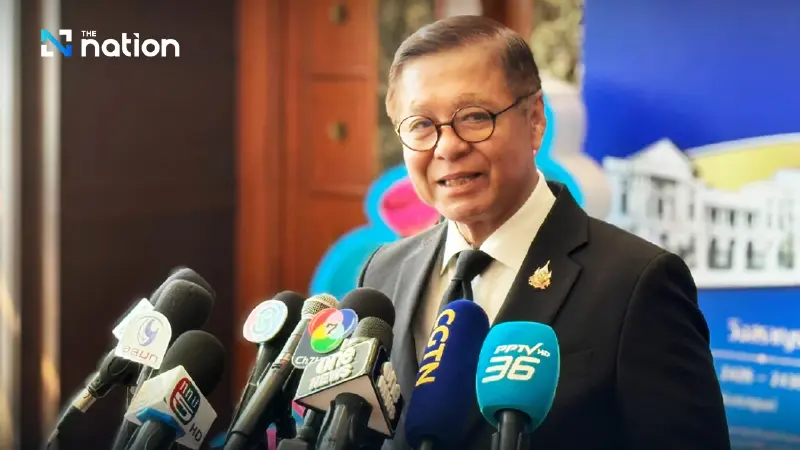


The foreign minister said March 4 talks with the US ambassador covered relations, trade tariffs and defence cooperation, not use of U-Tapao for attacks on Iran.
- Thailand's Foreign Minister, Sihasak Phuangketkeow, officially denied reports that the US sought to use U-Tapao Airport as a military base for operations against Iran.
- He clarified that the March 4 meeting with the US ambassador did not involve this topic, but instead focused on general relations, tariffs, and defence cooperation.
- Sihasak stated that while Thailand allows routine airport use for refuelling and overflights, using it as an offensive base to attack another country is against national policy.
Sihasak Phuangketkeow, Minister of Foreign Affairs, addressed reports that on March 4, Sean K. O’Neill, the United States ambassador to Thailand, met the prime minister to seek the use of U-Tapao Airport as a military operations base in fighting Iran.
“I can confirm that on March 4, there was no discussion of this matter. The discussion was about relations, updates on the situation, negotiations on import tariffs and defence cooperation,” the minister said.
Sihasak noted that cooperation involving the use of Thailand’s airport was already part of normal security arrangements, such as overflights and refuelling, which Thailand carries out with many countries.
However, using it as a base of operations to attack another country with which Thailand has good relations was not within policy, he added.

In discussions with the Ambassador Extraordinary and Plenipotentiary of the Islamic Republic of Iran to the Kingdom of Thailand on evacuating Thai nationals back to the country, Sihasak said talks had taken place.
According to Sihasak, the primary concern was evacuating all of the more than 200 Thai nationals in Iran.
This would depend on who was ready to leave on which day, with evacuees to be taken out of Tehran by land to the Turkish border.
As for when the evacuation would take place, he said a plan was already in place, but details could not be disclosed.
The minister added that Thailand had coordinated with the Iranian embassy in Thailand and the Thai embassy in Iran on safety, and had also been in contact with the United States and Israel on the route, the day and the details of the evacuation from Tehran to the Turkish border.
Thailand regarded the matter as humanitarian, and the route should be free from the danger of fighting, he stressed.
Sihasak said Thailand’s position was, first, the safety of Thai nationals; second, Thailand was not a party to this conflict; third, Thailand wanted to see a peaceful resolution through diplomatic negotiations rather than by military means; and fourth, a resolution based on international law and the United Nations Charter, whose provisions were already well known.
He added that Thailand’s position was already clear, but voiced concern over criticism from experts and former officials who said Thailand lacked clarity. “We are clear. We want to see peace. If people with expertise in foreign affairs read what we have stated, it is reasonably clear,” he said.
Sihasak added that the position was balanced, appropriate to the situation and aimed at protecting Thailand’s interests, which at present meant taking care of the more than 100,000 Thai nationals in that area.
