
Pork, chicken and egg prices jump despite price freeze pledge
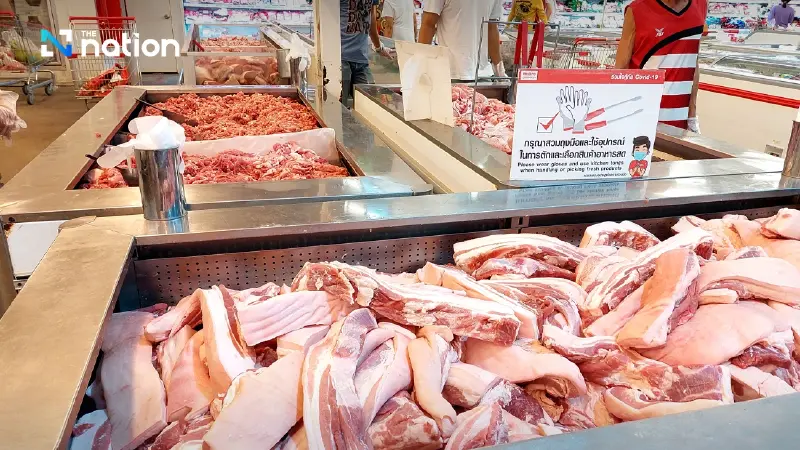


Thai consumers are being hit by rising pork, chicken and egg prices, despite the Commerce Ministry insisting no controlled goods have been allowed to increase
Thai consumers are being squeezed by rising living costs, with fresh food prices climbing sharply, particularly for pork, chicken and eggs.
The increases come amid conflict in the Middle East, which has driven up energy costs and disrupted global supply chains, in contrast to the Commerce Ministry’s insistence that no controlled goods have been allowed to raise prices and that price controls remain in place.
Data from the Internal Trade Department show clear signs of rising chicken prices. Chicken drumsticks, which were selling for Bt80-Bt85 per kilogramme at the start of March, began rising from March 9 and have now reached Bt90-Bt95 per kilogramme. Chicken thighs have also increased from Bt85-Bt100 to Bt95-Bt100 per kilogramme.
Pork prices have risen even more sharply, with lean pork reaching as high as Bt165 per kilogramme. In fresh markets, lean pork has climbed from Bt145-Bt150 per kilogramme at the beginning of March to Bt150-Bt165 as of March 20, marking an increase of Bt5-Bt15 per kilogramme.

Those figures are in line with data from the Office of Agricultural Economics, which show that live pig prices at farm level in Nakhon Pathom have risen from Bt56 to Bt62 per kilogramme, an increase of Bt6. This suggests that higher costs at farm level are already being passed on to consumers.

Egg prices have also moved higher. Size 3 eggs, which are among the most commonly consumed, rose on March 16 from Bt3.5-Bt3.6 per egg to Bt3.7-Bt3.8, or an increase of 20 satang each, equivalent to Bt6 per tray. However, small retail shops have already been selling eggs for more than Bt4 each, adding to the burden on households that rely on eggs as a daily staple.
“Although the Commerce Ministry has insisted that no controlled goods have been approved for price increases, figures from the Internal Trade Department and the Office of Agricultural Economics paint a clearly different picture,” a source said.
Consumers at several fresh markets said the prices they are actually paying are higher than those announced by the authorities, and urged the relevant agencies to investigate and tackle the problem seriously before the cost-of-living burden becomes unbearable for low-income households.
