
Thai Navy urges Cambodia to remove more of ‘silt-trap dam’ in Trat, citing 3,000 sq m of Thai land loss
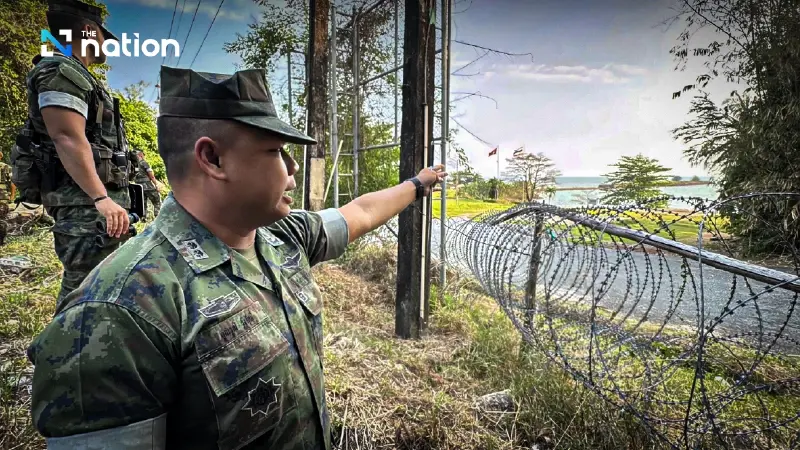


The Royal Thai Navy inspected the Thai-Cambodian border in Trat and said Cambodia’s partial removal of a silt-trap dam remains insufficient to restore the ecosystem, with Thailand citing over 3,000 sq m of land loss while Cambodia has gained more than 30,000 sq m.
On March 26, 2026, the Royal Thai Navy, led by Rear Admiral Phannarong Yutthawong, the Navy Secretary, took media representatives to the Thai-Cambodian border area in Khlong Yai district, Trat, to monitor the situation at Ban Hat Lek. The Navy said a “silt-trap dam” on the Cambodian side has continued to cause problems. Although 127 metres of the structure has been removed, it has not been dismantled down to the foundation level required under hydrographic principles. As a result, the ecosystem on the Thai side remains damaged, with Thailand losing more than 3,000 square metres of land, while Cambodia has gained more than 30,000 square metres.

In its latest border assessment, the Navy said that following clashes on December 20, 2025, a private operator on the Cambodian side in the Koh Kong area began removing the silt-trap dam that had encroached into the sea, but excavated only 127 metres using an excavator before stopping.
The Navy’s Hydrographic Department said that to properly restore the ecosystem, excavation would need to go around three metres deeper from the original crest line of the dam.


To date, Cambodia has not carried out any further deep excavation down to the foundation. As a result, conditions have not changed as they should, and the problem remains. The Navy said the issue will need to await renewed discussions under the Regional Border Committee (RBC).
Reports said construction of the silt-trap dam has increased land on the Cambodian side by more than 30,000 square metres, while Thailand’s Hat Lek area has lost more than 3,000 square metres. The partial removal of 127 metres has not restored Thailand’s ecosystem to its original condition.

Lt Cmdr Khunvut Rungratsamee, commander of Marine Task Force 182, stressed that during the two Thai-Cambodian border clashes, there were no confrontations in the Ban Hat Lek area, but forces have remained on constant watch. He said Thai territory in this section is coastal, while the Cambodian side is a ridge area at higher elevation, meaning troops must operate with caution.
He added that the unit is monitoring security threats including weapons trafficking, narcotics, and scammers. On scam networks, he said Cambodia has carried out crackdowns in the Koh Kong area. The situation has eased, he said, after South Korea and China also suppressed related networks, but vigilance remains necessary to prevent such groups from fleeing into Thai border areas—by both land and sea routes.

The Ban Hat Lek border crossing is described as a key economic area, with Thai-Cambodian trade valued at 30 billion baht, with Thailand running a trade surplus and imports valued at 2 billion baht.
On oil monitoring, he said radar is being used to track activity, and there have been no reports of illegal oil trading along the Trat border.
