
Chula Veterinary Faculty wins five international awards for interactive canine muscle model
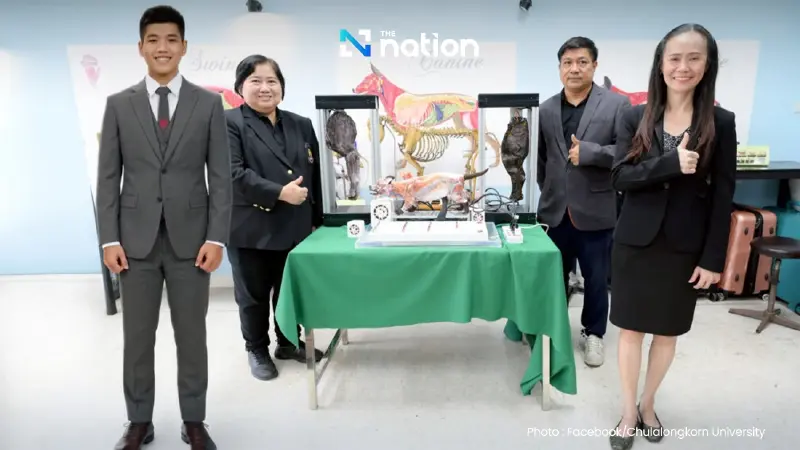


Chulalongkorn University’s Vet Faculty won five awards at INVENTCOR 2026 in Romania for an interactive dog muscular anatomy model for teaching.
Chulalongkorn University’s Faculty of Veterinary Science has won five international awards for an innovative interactive canine muscular anatomy model, developed by Asst Prof Pawana Chuesiri from the Department of Anatomy and her team.

The invention received five honours at the 7th International Exhibition, INVENTCOR 2026, held in Romania:
- INVENTCOR 2026 Gold Medal Award
- INVENTCOR 2026 Best Category Award (Veterinary Medicine – Category G) – certificate and trophy
- Special Award from the World Invention Intellectual Property Associations (WIIPA) – certificate and medal
- Special Award by the Haller Pro Inventio Foundation, Poland – certificate and medal
- Special Award by the National University of Science and Technology POLITEHNICA Bucharest, Romania – certificate

The team said winning both the Gold Medal and Best Category Award confirms international recognition of the work as a leading innovation in veterinary medicine.
Dual-model design for teaching
The innovation is designed to support anatomy teaching for Chula veterinary students and uses a dual-model system:
Model A (LED Topography): A life-sized Chihuahua model fitted with 43 LED points along the left side. Students press an English muscle name button and the corresponding LED lights up at the correct anatomical location, colour-coded by function:
- Red: flexor group (27 points)
- Black: extensor group (11 points)
- Green: adductor/abductor group (5 points)
It also includes MP3 audio narration, designed to feel like having an instructor guiding the lesson.

Model B (Biomechanical Simulation): A mechanical simulation of automatic movement in the forelimbs and hindlimbs of a Thai breed dog, reproducing joint flexion and extension angles in line with anatomical standards, such as the elbow (36-166 degrees) and knee (41-162 degrees). The aim is to show students how muscles work during real movement, something a cadaver cannot demonstrate.
Asst Prof Pawana said Model A uses a Chihuahua template because the body structure is clear and easy to transport, while Model B is based on a Thai dog to demonstrate standard joint motion in the hip, knee and ankle, as well as shoulder, elbow and wrist function.

Built from reused materials, with big learning gains
She said the project began in 2025, supported by faculty research funding and introduced to first-year veterinary students in Anatomy 1. The team reported that student knowledge scores rose from 37% to 93% after using the model.
The model also uses recycled materials such as plastic bottle caps and foam, bonded with resin, with rubber applied to enable joint movement, and wrapped in a special fabric to increase realism, helping reduce reliance on imported teaching tools.
Next steps: training and commercial expansion
The team said the model is drawing interest for training use at dog training centres, where common issues often involve muscles and joints, and where visual tools can help vets communicate more clearly with dog owners.
The model may also be used with K9 USAR Thailand (rescue dog units) to support conditioning and rehabilitation after intensive training and field operations.
Looking ahead, the Faculty of Veterinary Science plans to develop the project commercially with private-sector partners. The initiative is being incubated as a spin-off, CU Vet Best Model, under CU Vet Enterprise, with plans to expand into cat muscle models and cat resuscitation training models in the future.
