
Rare lunar night – Micro Blue Moon to glow over Thailand on Visakha Bucha
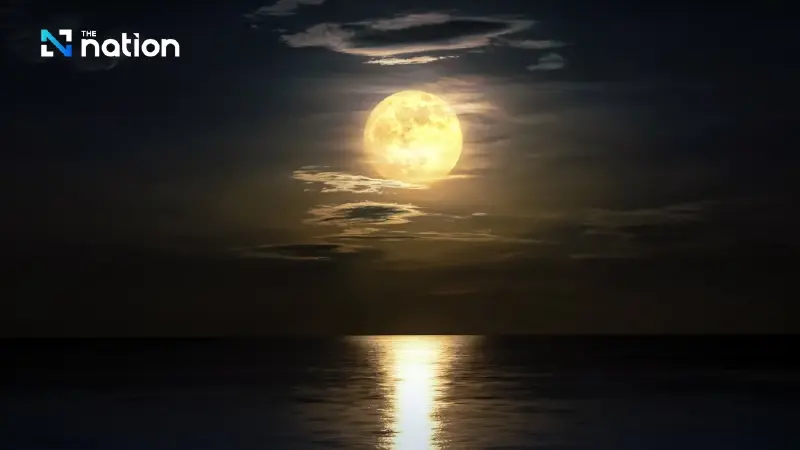


NARIT invites Thais to watch the year’s farthest full moon on May 31, when a Micro Full Moon and Blue Moon occur together
The National Astronomical Research Institute, or NARIT, is inviting the public to observe a rare Micro Blue Moon on the night of Visakha Bucha Day, May 31, 2026, when the full moon will be at its farthest point from Earth this year.
NARIT said the phenomenon will also mark the second full moon of the month, making it a Blue Moon. The institute stressed, however, that the moon will not turn blue. Instead, the full moon will appear slightly smaller than usual because of its distance from Earth.
According to NARIT, the Micro Full Moon will occur at around 3pm on May 31, when the moon will be about 406,127 kilometres from Earth. As the full moon will also be the second full moon in May, the two phenomena are collectively known in astronomy as a Micro Blue Moon.
The last Micro Blue Moon occurred about six years ago, on October 31, 2020. On the night of May 31 this year, the full moon will therefore appear marginally smaller than a typical full moon.

Why the moon appears smaller
The moon orbits Earth in an elliptical path, completing one orbit in about 27.3 days. This means that each month, there are times when the moon is closer to Earth and times when it is farther away.
The point at which the moon is closest to Earth is called perigee, at an average distance of about 357,000 kilometres. The farthest point is known as apogee, at an average distance of about 406,000 kilometres.
When a full moon coincides with the closest point to Earth, it is called a Super Full Moon. When a full moon coincides with the farthest point from Earth, it is called a Micro Full Moon.
Why it is called a Blue Moon
NARIT explained that a Blue Moon refers to the second full moon in the same calendar month. It is a rare occurrence, but the moon does not change colour.
On average, two full moons occur in the same month about every 2.7 years. This happens because the lunar phase cycle lasts around 29.5 days, meaning that in some 31-day months, two full moons can be seen.
The term “Blue Moon” is linked to the English expression “once in a blue moon”, which refers to something that happens only rarely.
Next rare lunar event
NARIT said the next full moon phenomenon combining a close or distant full moon with the second full moon of the month will be a Super Blue Moon on March 30, 2029.
People interested in following more astronomical events can check updates via NARIT’s Facebook page.
