
Legal Pioneer 'Happy' the Thai Elephant Dies at Bronx Zoo Aged 55
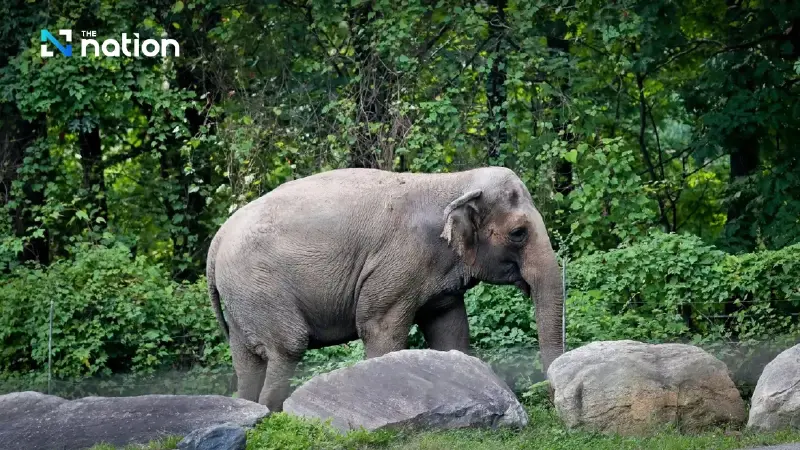


Happy’s death at the Bronx Zoo ends a half-century in captivity and closes a historic chapter in the global fight over animal autonomy
- Happy, a 55-year-old Asian elephant, was euthanized at the Bronx Zoo due to a rapid decline in health, including advanced arthritis and an inoperable tumor.
- She was the focus of a landmark legal case that sought to have her recognized as a legal "person" with a right to liberty, although the case was ultimately dismissed by New York's highest court.
- The legal battle was based on her proven cognitive complexity; in 2005, she became the first elephant to pass the mirror self-recognition test, a key indicator of self-awareness.
- Her death leaves only one elephant at the Bronx Zoo, marking the impending end of its elephant exhibit and highlighting a broader debate on the ethics of keeping large mammals in urban zoos.
Happy’s death at the Bronx Zoo ends a half-century in captivity and closes a historic chapter in the global fight over animal autonomy.
Happy, the captive Thai elephant who altered the scientific understanding of animal self-awareness and became the global focal point of a landmark legal battle over non-human "personhood", has been euthanised at the age of 55.
The legal advocacy group Nonhuman Rights Project confirmed that the Asian elephant was put to sleep at the Bronx Zoo on Tuesday following a rapid decline in her health.
Post-mortem findings revealed she suffered from advanced arthritis and a large, inoperable uterine tumour, alongside liver and kidney failure.
Her death leaves the zoo with just one remaining elephant, marking the twilight of large mammal exhibition at the historic New York institution.
From the Thai wild to scientific history
Captured in the wild in Thailand in the 1970s, Happy was separated from her herd at just one year old and imported to the United States. She arrived at the Bronx Zoo in 1977, where she spent nearly five decades in captivity.
While her early years reflected the traditional entertainment-focused role of zoo animals, Happy secured a permanent place in scientific history in 2005.
During a cognitive experiment, she became the first elephant documented to pass the mirror self-recognition test—a benchmark of self-awareness previously observed only in humans, great apes, and dolphins.

Faced with a mirror, Happy repeatedly used her trunk to touch an "X" painted above her eye, a mark visible to her only through her reflection.
"Happy was a magnificent animal who served as a wonderful ambassador for her species," said Craig Piper, interim director of the Bronx Zoo, noting that her loss has deeply affected keepers, some of whom had cared for her for over three decades.
The legal battle for personhood
Happy’s cognitive complexity became the foundational evidence for an unprecedented legal campaign. In 2018, the Nonhuman Rights Project filed a historic lawsuit against the Bronx Zoo, demanding that the court recognise Happy as a "cognitively complex and profoundly autonomous nonhuman being."
The lawsuit sought a writ of habeas corpus—a legal recourse traditionally reserved for humans to challenge unlawful detention—arguing that Happy was being illegally deprived of her liberty and subjected to psychological suffering by being kept in isolation.
The case advanced to New York State’s highest court before being dismissed in a tight 5-2 ruling in 2022. The majority opinion concluded that while elephants are intelligent and deserve care, granting them legal personhood would trigger a chaotic disruption to property laws and agriculture.

Happy’s death arrives amidst an escalating international debate over the ethics of keeping megafauna in urban environments.
The historical model of city zoos is facing intense scrutiny from zoologists and conservationists alike, who argue that small, artificial enclosures are fundamentally incompatible with species engineered to roam up to 50 miles a day in tight-knit social matrices.
The average life expectancy for Asian elephants in US zoos sits at roughly 45 years—significantly lower than their potential lifespan in protected wild habitats.
This stark demographic reality has prompted an industry schism:
The Sanctuary Migration: A growing number of Western facilities are phasing out their elephant programmes entirely, voluntarily transferring their ageing populations to expansive, multi-acre sanctuaries.
The Conservation Defence: Conversely, traditional institutions maintain that urban exhibits are indispensable tools for public engagement, generating the critical revenue and emotional connection required to fund global anti-poaching initiatives.
The Wildlife Conservation Society, which manages the Bronx Zoo, quietly ceased acquiring new elephants two decades ago. With Happy’s passing, the impending closure of its elephant exhibit highlights a broader shift in public and institutional sentiment—one where the curtain is slowly falling on the era of urban giants.
