
Suphajee meets nine Thai trade offices in China to decode Beijing’s five-year plan
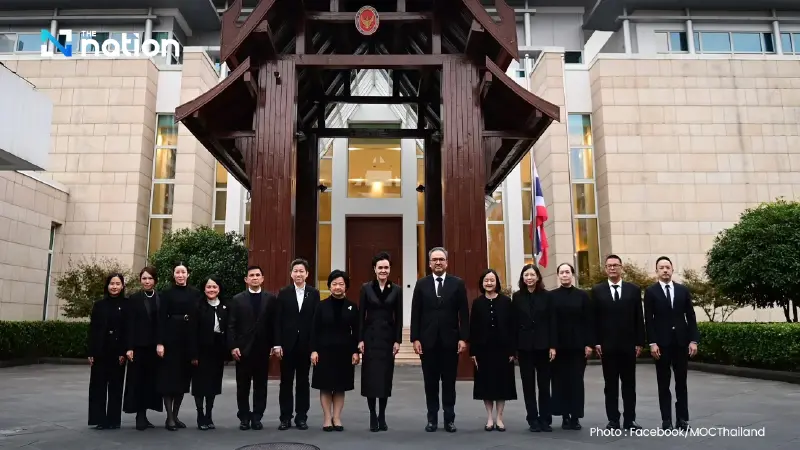


Commerce Minister urges nine Thai trade offices in China to decode Beijing’s five-year plan and form joint ventures to capture China’s 800-million consumer market

Commerce Minister Suphajee Suthumpun has directed all nine Thai trade offices in China to take a proactive approach in boosting exports and expanding Thai products in the vast Chinese market. The instruction was given during a policy meeting with the directors of the Ministry of Commerce’s offices in China — including the commercial office in Beijing and eight Thai trade centres in Hong Kong, Shanghai, Guangzhou, Qingdao, Xiamen, Chengdu, Kunming, and Nanning — held at the Royal Thai Consulate-General in Shanghai.
“Global trade is changing fast. Chinese consumers now value innovation, quality, and sustainability over cheap prices,” Suphajee said. “Our trade officers must analyse each province’s opportunities and challenges to develop targeted strategies for market expansion.”
She instructed the offices to seek Chinese partners and focus on products that meet market requirements to accelerate and scale up Thai exports.

“From now on, our work must go beyond trade matching or finding distributors. We must aim for joint ventures between Thai and Chinese businesses to co-develop and produce goods that match local consumer needs,” she added.
Suphajee also discussed aligning Thailand’s trade strategy with China’s new economic direction under the 15th Five-Year Plan for Economic and Social Development of the People’s Republic of China, announced by Premier Li Qiang at the opening of the China International Import Expo 2025 (CIIE 2025). The plan prioritises green growth, innovation, technology, and boosting middle-class income.
“We will decode China’s five-year plan to identify where Thai products can best fit — from agricultural goods, consumer products, animal feed, and health foods to games and digital products. China aims to double its middle-class population from 400 million to 800 million — a huge market Thailand must reach,” Suphajee said.
The directors of Thailand’s commercial offices in China presented regional opportunities and five key product groups for expansion:
- Agricultural and food products – rice, Thai fruits such as durian, mango, and mangosteen, processed foods, ready-to-eat meals, and condiments.
- Pet-related products – pet food and care products, reflecting the rising pet ownership trend in Chinese cities.
- Health and beauty products – bird’s nest, plant-based protein, coconut water, spa items, and health services.
- Eco-friendly and sustainable products – biodegradable packaging, organic cosmetics, recycled clothing, natural home décor, and eco-tourism.
- Innovation and digital content – intellectual property goods, films, games, and animation.

In addition to policy discussions, Suphajee met with Thai business leaders operating in China, including Phaichit Viboontanasarn, Vice Chairman and Secretary General of the Thai Chamber of Commerce in China; Wichai Thawisin, Vice Chairman of the Thai Chamber of Commerce in China and Director & General Manager of Saha-Union Investment (China) Co., Ltd.; Sitthichai Jiwattanakul, CEO of Bangkok Bank (China); Siriporn Reangjit, President of Kasikornbank (China); and Paiboon Praphatsornchaikul, General Manager of GC Marketing Solutions Co., Ltd. (PTT Group).
They shared challenges and suggestions to improve business operations in China, urging the Thai government to strengthen support in e-commerce, brand image building, and public–private cooperation with local Chinese authorities to unlock new trade opportunities.
The Commerce Ministry will integrate its efforts with related agencies to identify high-potential Thai enterprises and match them with capable Chinese partners for joint investment and market expansion, aiming to ensure that “Thai products win the hearts of Chinese consumers” sustainably in the long term.
