
'Ekniti' urges Thailand to seize opportunities in new global order, highlights foreign interest in key sectors
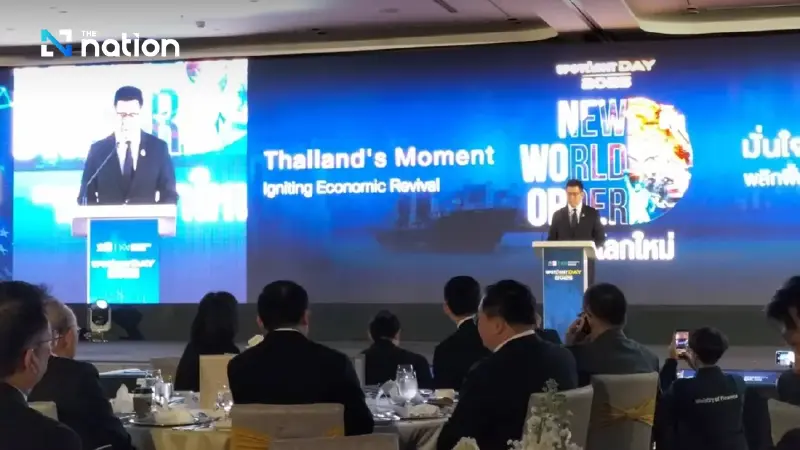


Thailand to seize opportunities in the new global order, attracting foreign investment in key sectors. The government pushes "Thailand Fast Pass" to unlock investment barriers.
Foreign investors are showing strong interest in investing in Thailand across several high-potential industries, such as modern agriculture, food processing, electronics, electric vehicles (EV), and healthcare, with investment applications to the Board of Investment (BOI) growing by 90%.
The government is pushing the "Thailand Fast Pass" initiative to remove infrastructure, permitting, and land-related obstacles, allowing approved large-scale investment projects to move forward smoothly. Additionally, the government is working to establish clean energy infrastructure to support new-age investments and promote reskilling and upskilling of the workforce to prepare for the new global order, including advancements in AI technology and climate change measures.
Ekniti Nitithanprapas, Deputy Prime Minister and Minister of Finance, spoke on the topic Thailand's Moment: Igniting Economic Revival at the Spotlight Day 2025 event, discussing New World Order: Thailand’s Economy in the New Global Order on November 28. He mentioned that the government’s economic policies are being developed within a tight four-month timeframe, aiming to revive the economy while preparing for the future. Despite various constraints, such as limited budgets, the government sees Thailand still having opportunities amidst the challenges posed by the new global order.
Acknowledging the realities the government faces, including budget limitations and warnings from rating agencies, Ekniti emphasized that Thailand’s outlook had been downgraded by two agencies prior to his appointment, leaving only S&P to maintain Thailand’s credit rating. Additionally, significant challenges include the intensifying global trade competition, Donald Trump's tax policies, AI technology, and severe climate changes.
"The commitment to using the available budget efficiently has been key in maintaining confidence, as reflected in S&P’s decision to keep Thailand’s Outlook stable two weeks ago. Actions to restore confidence, like the refund to the Bank for Agriculture and Agricultural Cooperatives (BAAC), have been central to this effort. While short-term economic recovery is expected in Q4, the focus is on building a solid foundation for future investment and inclusive growth," Ekniti said.
While global trade competition remains fierce, Thailand still has opportunities, as seen from the 90% growth in investment applications to the BOI. Key sectors attracting investment include modern agriculture (smart farming), food processing, smart electronics, particularly printed circuit boards (PCBs), upgrading the automotive sector to hybrid and electric vehicles (EVs), and developing Thailand as a medical hub.
However, a major issue is that over 80 approved projects, worth approximately THB 480 billion, are currently unable to proceed due to obstacles related to water, electricity, visas, permits, and land.
To address these challenges, the government has launched the "Thailand Fast Pass" project, which has already been approved by the Economic Cabinet and the Cabinet to remove these obstacles and allow investment to proceed. "This unlocking process does not require any new budget allocation. For the long-term solution, real issues faced by over 80 large-scale projects, each valued at over THB 1 billion, will be addressed through the government's 'Guillotine' reform to improve regulations and establish a digital permitting system," Ekniti added.
Moreover, the government is accelerating the development of energy infrastructure to support new investments, particularly in clean energy for digital and AI technologies, including the construction of data centers. The government is also pushing for direct power purchase agreements (PPA) between private companies to allow them to invest in and sell clean energy. This requires regulatory reform by the Energy Regulatory Commission (ERC).
Thailand’s abundance of land and reservoirs also presents a significant advantage. The government plans to use over 10 million rai of state-owned land to develop solar farms or floating solar power plants, offering low lease rates to create a clean energy production base.
To address the global climate regulation, Europe will soon implement the Carbon Border Adjustment Mechanism (CBAM), imposing carbon taxes on five types of products. In response, the Thai government supports the Low Carbon City project in collaboration with the World Bank to create a model for carbon reduction. This initiative builds on the Saraburi Model, which results from cooperation between the private sector, government, and local communities.
The government is also promoting the use of biofuels and ethanol from agriculture to meet the growing demand in Europe and Japan, thus creating value for farmers.
Additionally, the government is focusing on human resource development, particularly reskilling and upskilling to prepare for the AI-driven world. While many Thais are skilled in social media, there is a lack of digital and AI expertise for professional use. To address this, over 78,000 businesses have signed up for training, with the government launching the "Let’s Go Halves Plus" program. This program focuses on long-term outcomes, offering AI training, basic household accounting, and online sales skills. The program partners with food delivery platforms and participating banks, offering low-interest loans up to THB 50,000 to reduce informal lending.
Additionally, the BOI has allocated over THB 10 billion from its Competitiveness Enhancement Fund to focus on reskilling and upskilling in high-demand areas such as data centers, cloud computing, and applications.
