
Thai Government Ramps Up B20 Biodiesel Supply to Tackle Rising Transport Costs
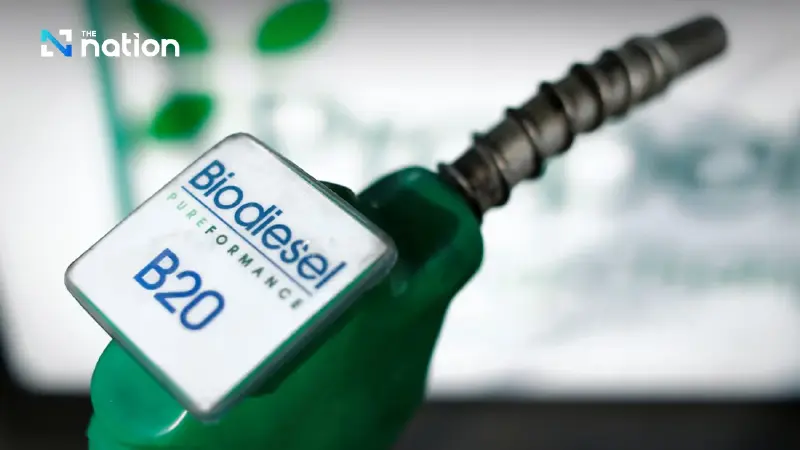


New subsidies to keep B20 prices $0.15 (5 baht) lower than standard diesel, aiming to shield supply chains from inflation and support local farmers
- The Thai government is subsidizing B20 biodiesel to make it 5 baht ($0.15) per litre cheaper than standard diesel, aiming to lower costs for the transport and industrial sectors.
- Major fuel retailers, including PTT, Bangchak, and Shell, are expanding their distribution networks to increase the nationwide availability of B20 fuel.
- The policy uses domestically produced palm oil to create stable demand for local farmers' crops, support the agricultural sector, and reduce reliance on fuel imports.
New subsidies to keep B20 prices $0.15 (5 baht) lower than standard diesel, aiming to shield supply chains from inflation and support local farmers.
The Thai government has accelerated the expansion of B20 biodiesel distribution points across the country, a strategic move aimed at slashing overheads for the transport and industrial sectors.
By promoting a higher blend of domestic palm oil, ministers hope to stabilise consumer goods prices while providing a critical financial lifeline to the nation’s agricultural heartlands.
Ratchada Thanadirek, assistant minister to the Prime Minister’s Office, confirmed that B20—a diesel blend containing 20% domestically produced palm-based methyl ester—is now being positioned as a primary alternative to standard fuel.
The initiative focuses on compatible heavy-duty vehicles and industrial machinery, offering a seamless transition for operators looking to mitigate high energy expenses.
Price Incentives and Logistics Support
To ensure rapid adoption, the Fuel Fund Administrative Committee (FFAC) has implemented a price gap, maintaining B20 at approximately 5 baht (roughly $0.15) per litre cheaper than standard B7 diesel.
This subsidy is designed to provide "tangible relief" to the logistics and manufacturing sectors, which have been struggling with volatile global oil markets.
"The government is prioritising the management of energy costs for both the public and commercial operators," Ratchada stated. "Promoting B20 is a multifaceted measure that bolsters the economy, supports our farmers, and strengthens national energy security in the long term."
Expanding the Retail Network
Major fuel retailers are already increasing their B20 footprint to meet anticipated demand:
Bangchak has commenced distribution at its Phra Khanong depot.
PTT Oil and Retail (OR) is now supplying the fuel via its Songkhla and Saraburi hubs.
Shell is expected to begin B20 sales at designated points from early April.
Agricultural Stability
Beyond the transport sector, the policy serves as a domestic "price floor" for Thai palm oil.
By increasing the mandatory blending requirement for these specific distribution points, the government is effectively soaking up excess agricultural supply.
This strategy is intended to prevent price collapses for raw palm fruit, ensuring a stable income for millions of small-scale farmers and reducing the country’s reliance on expensive fuel imports.
Analysts suggest that if the rollout is successful, it could significantly dampen the "second-round effects" of inflation, preventing transport companies from passing higher fuel surcharges on to consumers.
