
Anutin tells Parliament: ‘I will do everything possible’ for Thais
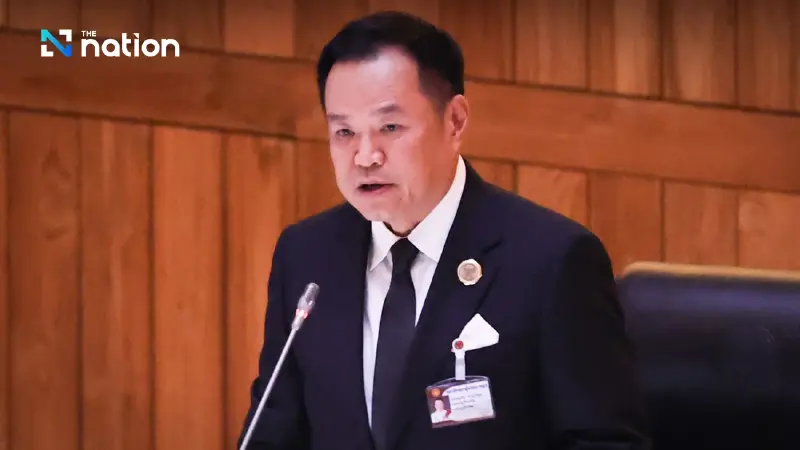


PM Anutin outlines policy agenda to stabilise Thailand’s economy, tackle drugs, reform laws and support citizens amid global and energy pressures
Prime Minister Anutin Charnvirakul has pledged to do “everything possible” to help Thai citizens regain economic stability, as he delivered his government’s policy statement to Parliament, outlining a sweeping reform agenda aimed at steering the country through mounting global and domestic challenges.
Speaking before a joint sitting of Parliament chaired by Sophon Saram, Anutin formally presented the Cabinet’s policy platform in accordance with Section 162 of the Constitution. The session opened with a lively atmosphere as ministers attended to hear the statement and respond to parliamentary debate.
The prime minister began his address at 9.05am, speaking for 1 hour and 8 minutes, and emphasised that once the government assumes full administrative authority, it will accelerate key policies while maintaining fiscal discipline.

He said priority would be given to maximising the use of state resources, improving budget disbursement efficiency and fast-tracking legislation to transfer the 2026 fiscal budget. The move is intended to cushion the impact of the Middle East conflict, particularly on vulnerable groups, businesses and the agricultural sector.
At the same time, the government will expedite preparation of the 2027 budget to ensure it takes effect within the fiscal year.
On economic policy, Anutin highlighted job creation, equal access to employment opportunities and comprehensive debt resolution as urgent priorities. The government will roll out a “Half-Half Plus” scheme alongside efforts to upgrade workforce skills, particularly in financial literacy and future-ready competencies.
He also pledged to reduce operating costs for SMEs, strengthen the role of local administrations and push forward the “home city tax” legislation to support regional development. Science, technology and innovation will be promoted to lay the foundation for a new economic structure and attract strategic investment.
In trade policy, the government aims to integrate Thailand more deeply into the global economy by building new partnerships and improving the competitiveness of Thai businesses. It will also tighten controls over product origin to prevent low-value imports, while promoting Thai goods and services internationally through a unified “Team Thailand” approach.

Agriculture will be upgraded into a modern agro-industrial and food sector, positioning Thailand as a global food security hub, while tourism will be strengthened to reinforce the country’s status as a key regional destination.
On foreign policy and security, the government plans to rebuild confidence in Thailand on the global stage, deepen ties with middle powers and new regional partners, and pursue a balanced diplomatic strategy amid shifting geopolitical alignments.
Efforts will also focus on strengthening border security, tackling transnational crime and reviewing visa-free policies to curb financial crime networks, including scams, money laundering and illicit “grey capital”.
Regarding Thailand-Cambodia relations, the government said it would pursue peaceful solutions through existing bilateral mechanisms while accelerating studies on the possible termination of the 2001 memorandum of understanding.
The administration also signalled a tougher stance on drugs and law enforcement. Officials who fail to act against drug-related activities in their jurisdictions will face severe disciplinary and criminal penalties, including immediate suspension from duty.
In defence policy, the government will develop a voluntary military service system, offering contracts of four years with compensation, alongside broader reforms of conscription and military modernisation.
Social policy priorities include ensuring genuinely free education that leads to employment, expanding access to learning through digital platforms and improving healthcare and social security systems.
The government also pledged to strengthen disaster preparedness, including investment in water infrastructure, unified emergency management systems and the development of a national disaster insurance scheme to reduce losses and improve recovery.
On governance reform, Anutin said outdated laws would be overhauled to address economic constraints, including procurement rules to ensure value for money rather than simply the lowest price.
Measures will also be introduced to hold state contractors accountable for damages and to tackle systemic corruption through stricter ethical standards and enforcement mechanisms.
The government plans to organise its agenda into five strategic pillars, macroeconomic management, production and trade, infrastructure, social welfare, and foreign affairs and security, each with clearly assigned leadership and accountability to ensure effective implementation.
Closing his address, Anutin reaffirmed that the government would prioritise national and public interest while maintaining fiscal discipline and economic stability.
“Thailand is facing significant uncertainty and volatility, but this government is ready to mobilise all available resources to address people’s livelihoods,” he said. “I will do everything possible to ensure Thailand is strong from within, that Thai people can stand on their own feet, that our economy remains competitive, and that the world retains confidence in Thailand.”

