
e-WorkPermit gridlock exposes strain in state digital reform
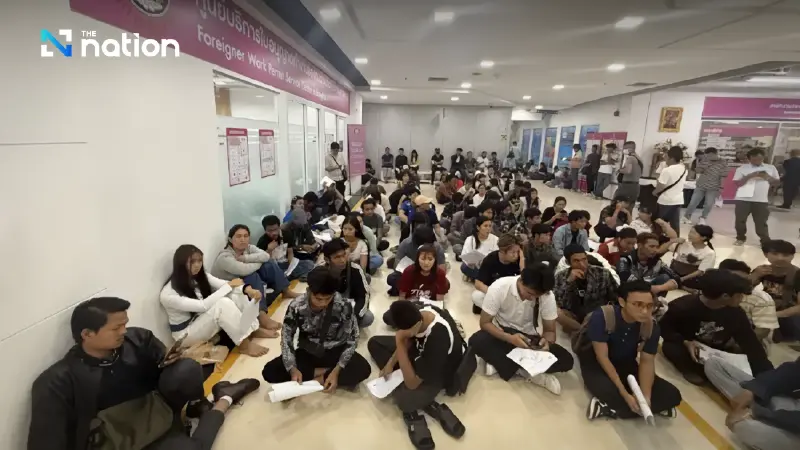


Thailand’s e-WorkPermit project faces claims of unpaid work, unanswered letters and a foreign labour permit backlog
Thailand’s e-WorkPermit project, a digital system designed to modernise work permits for foreign workers, has become mired in bureaucratic gridlock, with more than 90,000 applications reportedly entering the system each day, while the Department of Employment has allegedly failed to respond to official letters, inspect completed work or settle payments worth 364 million baht.
The dream of transforming Thailand’s foreign labour permit system, moving it away from piles of paperwork and long queues towards a modern digital platform, is now facing a serious setback.
The problem, according to the private contractor behind the project, is not technological failure, but a bureaucratic wall that continues to block change at every step.
Chairat Sangchan, CEO of the Future Sky joint venture, the private contractor providing outsourcing services for the Department of Employment under the Labour Ministry, said the problems reflected an expensive lesson now being borne by the company.
He raised a central question: as long as Thailand’s bureaucracy refuses to change its mindset and working methods from within, can any state-led digital reform truly move forward or will it repeatedly become trapped in the same old system?

From planning to a very different reality
The Department of Employment began studying the project in 2022. The system was designed to handle 6,000 applications per day, with 72 verification officers and an average processing time of five minutes per application.
On paper, the plan appeared structured and reasonable. But when the e-WorkPermit system officially launched on October 13, 2025, the reality proved entirely different.
At certain periods, more than 90,000 applications entered the system each day, 15 times higher than the original estimate.
This was not a temporary surge that later eased. It became the daily reality faced by the joint venture, while the Department of Employment, as the employer under the contract, continued to insist that operations proceed under the original framework, which had effectively become outdated from the first day the system went live.
The unavoidable question is where the original projection came from, and who should be held responsible when that figure proved so far removed from reality.
Broken data, stalled systems and bureaucratic silence
If the workload problem could still be addressed by adding staff, the larger and harder problem was the quality of data provided by the Department of Employment.
Basic data on foreign workers whose permits needed renewal, transferred from the department to the company, was incomplete and full of errors.
Even information officially certified by the department contained many discrepancies, causing the e-WorkPermit system to run into obstacles from the outset.

The problem was compounded by inconsistent standards among agencies involved in foreign labour administration, including the Department of Employment, the Immigration Bureau and the Ministry of Foreign Affairs.
Each agency recorded names differently. Some placed given names first, others placed surnames first, while some used different titles or prefixes.
These inconsistencies, which may appear minor in practice, became major obstacles that prevented the system from processing applications successfully.
The company said it had been left to shoulder the burden alone by adding staff and repeatedly improving the computer programme, without any state agency offering serious support.
Letters were sent, but answers never came
At the heart of the problem was what the company described as a complete breakdown in communication between the private contractor and the bureaucracy.
Since the project began, the joint venture said it had regularly submitted letters to the Department of Employment to report problems, propose solutions, request guidance and seek permission to proceed with various actions.
However, every letter allegedly disappeared into silence, with no formal reply.
Instead of communicating through traceable and referable documents, the department allegedly chose to communicate through individuals.
When coordinators changed, directions and requirements also changed, while deadlines remained the same. This left the company chasing constantly shifting demands without any written evidence to rely on.
When the joint venture proposed opening additional temporary special service centres at its own expense, covering staff, premises and equipment, to cope with excessive demand, the proposal was also allegedly ignored without any clear explanation.
Bureaucracy tries to return to the old system
As problems accumulated, the Department of Employment allegedly chose an even more alarming path: attempting to open channels for foreign worker registration and permit renewal outside the e-WorkPermit system, citing system problems and delays by the private contractor.
Such a decision, according to the company’s account, would not only undermine an ongoing project but also send the wrong signal.
Instead of confronting problems and solving them directly, Thailand’s bureaucracy appeared to be retreating to familiar methods even though those methods were precisely what the project had been designed to replace.
This contradiction raises questions about whether the intention to reform was genuine, or merely rhetoric.
Where is the work inspection committee?
The clearest and most verifiable issue, according to the company, is that since the e-WorkPermit system began operating on October 13, 2025, the Department of Employment’s work inspection committee has not convened a single meeting to inspect and accept completed work.
During the same period, the joint venture said it had issued almost 700,000 work permits for foreign workers, representing about 364 million baht under the contractual rate.
However, because the committee has never inspected and accepted the work, none of the payments has been made.
Meanwhile, the company has had to carry all operating costs using its own funds.
The situation, the company said, was no different from being hired to do a job, only for the employer to disappear when payment was due.
At the same time, the company said it had also been instructed to provide services in remote areas such as Mueang Mae Hong Son district, using electric buses and generator trucks for charging, with each trip costing the company several hundred thousand baht.
Voices from independent observers
Even at a meeting on April 1, 2026, attended by independent observers from the Anti-Corruption Organisation of Thailand, or ACT, experts selected to oversee the public procurement process expressed views in line with what the private contractor had long been requesting.
They said the agreement should be revised to reflect actual conditions.
But even weighty voices from outside the process failed to push the Department of Employment into issuing concrete policies or orders.
The agreements reached in the meeting room appeared to vanish into thin air. There were no announcements, no orders and no subsequent changes.
A warning that should reach policymakers
Chairat’s remarks point to a wider conclusion: the problems are not the failure of technology or shortcomings by the private sector, but a reflection of a bureaucracy unprepared to take responsibility for a project it initiated.
In an outsourced government project, the contractor is left to shoulder financial and management risks alone, while the state agency responsible for supervision and response remains silent, despite problems that are clear and visible.
Chairat’s message is therefore not only the frustration of a business executive left stranded halfway through a project.
It is also a warning that should reach policymakers: genuine digital reform cannot happen if leaders on the bureaucratic side remain tied to old working cultures that avoid responsibility, fail to communicate systematically and lack the courage to admit that what was designed on paper no longer matches reality.
A lesson Thailand must learn
The e-WorkPermit case is not merely a contractual dispute between the state and the private sector.
It reflects a structural problem that has long held back Thailand’s digital government reform.
Whenever state agencies are not ready to change their internal working culture, no matter how much new technology is introduced, the outcome will remain the same because the new system is forced to run on old tracks that have never been repaired.
The absence of clear central standards or a service level agreement to govern the project has allowed employment offices across the country to operate under different and sometimes conflicting criteria.
This has created confusion that falls on the private contractor, which must deal with uncertainty every day.
Future Sky joint venture said it would continue providing services through 40 service centres nationwide, five employment entry and termination centres, and eight mobile service units.
However, the company said private-sector commitment alone could not sustain a project that lacked firm support from the state indefinitely.
As long as the Department of Employment fails to answer letters, convene work inspection meetings, issue written orders or revise rules to match reality, the dream of giving nearly one million foreign workers in Thailand access to modern, fast and transparent services will remain only a dream, one extinguished by the very system that should have made it real.
Time for Julapun Amornvivat to act
At a time when the e-WorkPermit project is standing on the edge, the question is no longer whether the problems exist. The evidence, according to the company, speaks for itself.
The real question is whether Labour Minister Julapun Amornvivat will stand by and watch a digital reform project that should be part of this government’s legacy collapse before his eyes, or use his authority to cut through the deadlock.
What is needed is not another study or another committee, but clear orders on three urgent issues.
- First, the work inspection committee should be instructed to meet immediately to unlock long-delayed payments, described in the source as nearly 700 million baht.
- Second, the Department of Employment should be ordered to review the contractual framework so it reflects the real workload, which is 15 times higher than projected.
- Third, all related agencies including the Immigration Bureau and the Ministry of Foreign Affairs should finally integrate their data standards into a single system.
Nearly one million foreign workers waiting in the system, hundreds of thousands of employers seeking legal certainty, and the private contractor carrying costs without knowing when it will be paid are all waiting for an answer from the minister as the top authority in the ministry.
Whether reform succeeds or fails does not depend on technology alone. It depends on political will to solve problems seriously.
The ball is now in the minister’s court.

